Every June, the same thing happens. The weather apps update their icons to little angry spirals, someone at the National Hurricane Center gives a press conference with a lot of charts, and suddenly every big box store looks like it got turned upside down and shaken.
And every June, people buy the same stuff. Cases of water. Flashlights. More flashlights. A lantern they will absolutely not be able to find the batteries for when it actually matters. Candles that smell like a Bath & Body Works exploded in the middle of a crisis.
I’ve been through enough storm seasons to know that the prep aisle at your local hardware store is not going to save you. What’s going to save you is one specific thing — and it’s not the thing anyone’s talking about.
What’s actually wrong with the standard hurricane kit?
The standard FEMA-recommended emergency kit is fine. It’s not wrong, exactly. FEMA’s official prep guidance will tell you water, food, first aid, flashlight, radio, documents. Sensible stuff.
But here’s the thing — most people buy the water and the flashlight and stop there. They feel prepared. They are not prepared.
The part everyone skips is information. Real-time, reliable, doesn’t-need-Wi-Fi information about what the storm is doing right now, where it’s going, and whether you need to leave or shelter in place. That gap is where things go sideways.
Why does your phone fail you exactly when you need it most?
Your phone is genuinely the worst hurricane prep tool you own — and also the one you’re most likely to trust with your life.
Here’s the problem. Cell towers go down. They get overloaded. They lose power. And even if yours is miraculously still up, you’re burning battery trying to load a radar app that’s not refreshing anyway because the data signal is garbage. You’ve got 14% battery, it’s 2am, the wind sounds like a freight train, and you have no idea if this is the worst of it or if worse is still coming.
That is a bad situation. Don’t be in that situation.
The one prep product worth actually buying
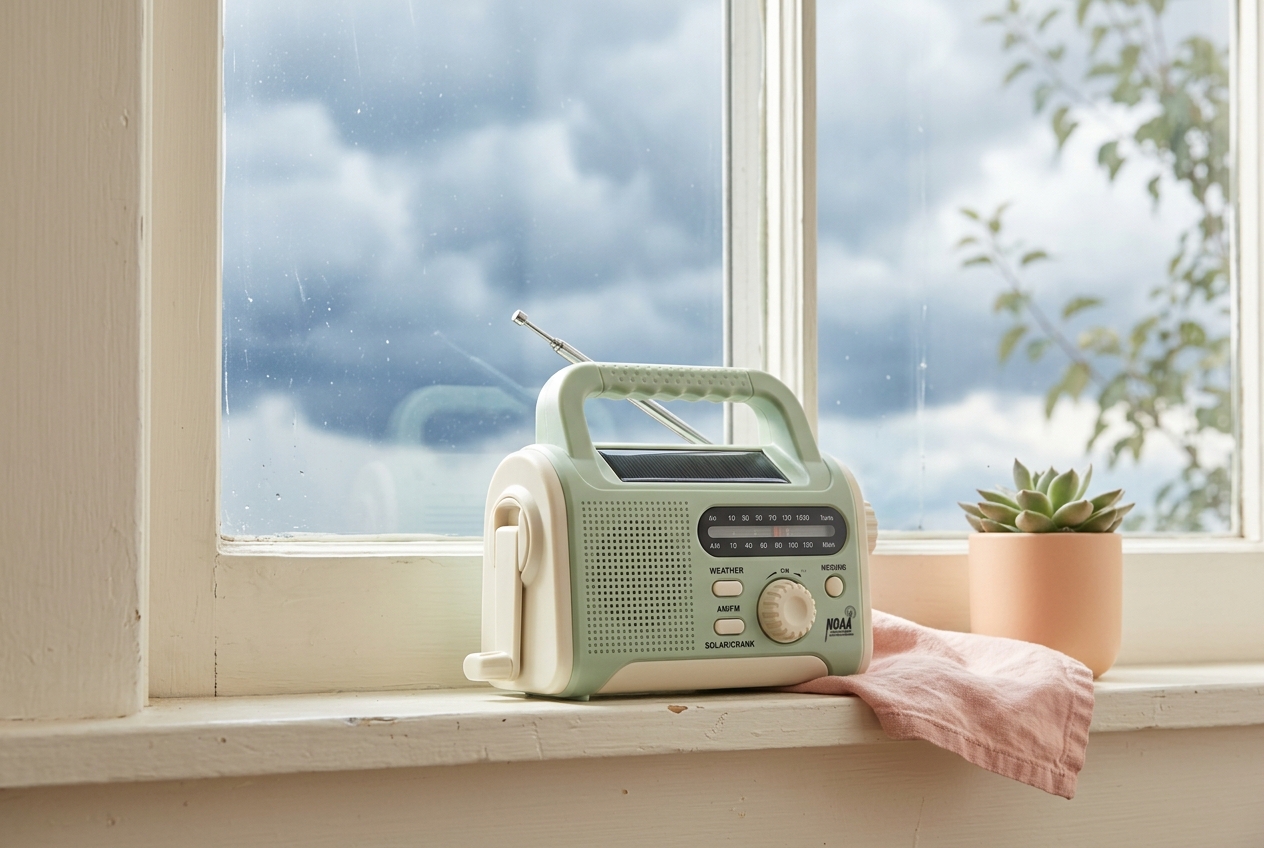
A hand-crank NOAA weather radio is the thing I actually trust. Not the cheapest one on the shelf — a solid one with a solar panel backup, USB charging port, and SAME (Specific Area Message Encoding) so it only alerts you for YOUR county, not every county in a three-state radius.
NOAA Weather Radio All Hazards broadcasts 24/7 from a network of over 1,000 transmitters covering 95% of the U.S. It runs on hand-crank power. It runs on a little solar panel. It does not care that your neighborhood has been without electricity for two days.
That thing will tell you when the eye is passing, when the back wall is coming, and when it’s safe to open a window. That information is worth more than 40 bottles of water and a flashlight that takes D batteries nobody has.
Okay but what about the water and the flashlights?
Yeah, get those too. I’m not saying don’t. One gallon per person per day for at least three days is the baseline — the CDC backs this up and it’s genuinely correct.
But a flashlight that runs on hand-crank or solar is a smarter buy than one that eats AA batteries in four hours. Same logic applies. Same principle.
The through-line with all of it: stop depending on the grid. The grid is the first thing that goes.
What else do people forget that actually matters?
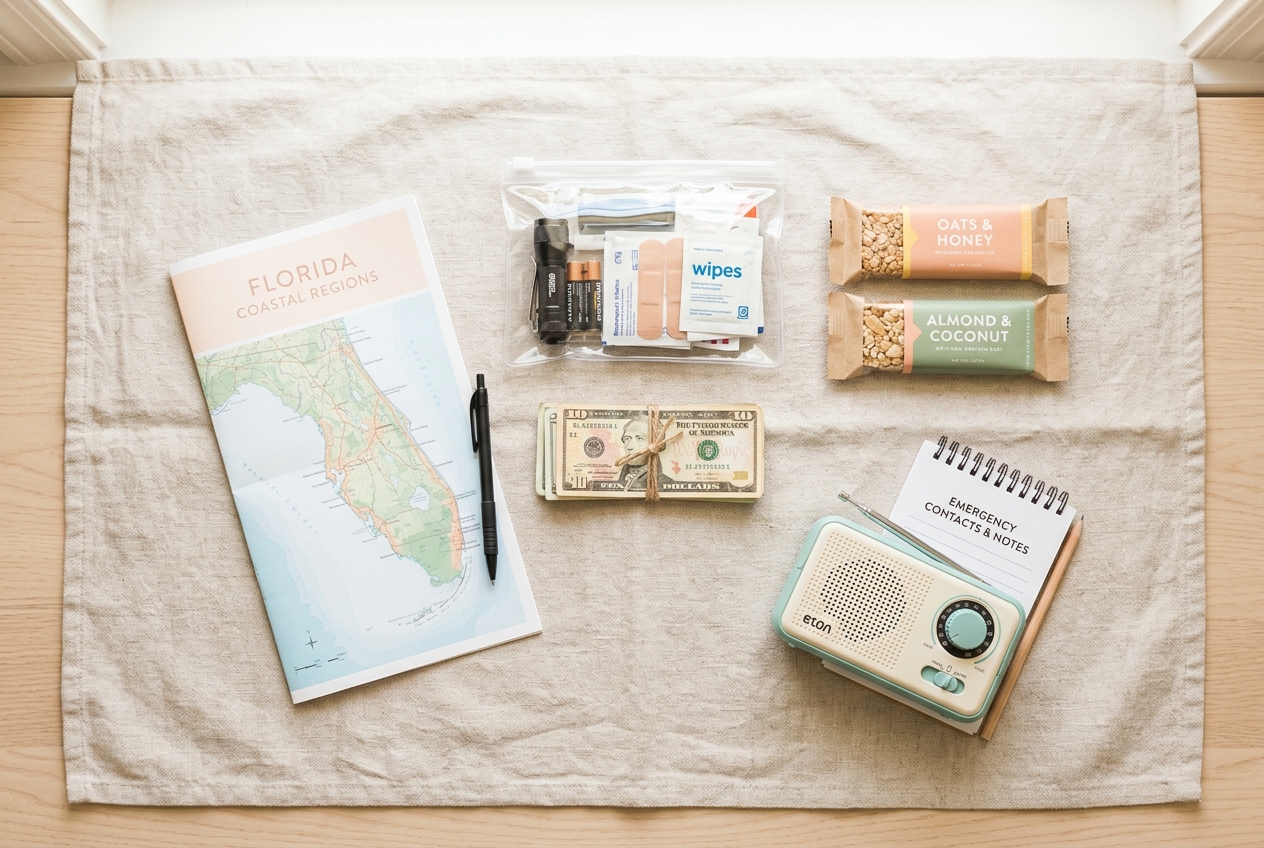
Documents. Physical copies, in a waterproof bag. Insurance card, ID, any medical records that matter. If you have to leave fast, you grab that bag. You don’t have time to log into a portal.
Cash. Small bills. ATMs don’t work without power. Card readers don’t work without power. The gas station that’s somehow still open on the one road out of town is going to be cash only, and you will be so grateful you have two twenties in your kit.
A paper map of your county. I know. I know. But GPS is also a grid-dependent luxury, and if you’re evacuating a route you’ve never driven before in zero visibility rain, a paper map is not a joke.
Is it worth buying a pre-made kit or building your own?
Building your own is almost always better — and I say this as someone who has definitely bought a pre-made kit and then discovered it contained one granola bar and a whistle.
Pre-made kits are convenient, but they pad out the list with stuff that feels reassuring rather than stuff that’s useful. You end up paying for a lot of packaging and a false sense of readiness.
Buy the radio first. Then work backward from what your specific household actually needs. Someone who takes daily medication needs a different kit than someone who doesn’t. Someone with a pet needs a different kit. Someone in a mobile home needs a completely different evacuation plan, full stop.
Start with your actual life, not a generic list.
When should you actually start prepping for hurricane season?
Atlantic hurricane season runs June 1 through November 30. You want to have your kit together by May 15 at the latest — before the first named storm forms and panic-buying strips the shelves.
Don’t wait for a named storm to start thinking about this. By the time a storm has a name and a projected path, you’ve got maybe 72 hours, and so does everyone else in your region. That’s not enough time to order anything online. That’s barely enough time to find the flashlight you bought last year.
Get ahead of it now. Even if this season turns out to be nothing. Especially if this season turns out to be nothing, because then your kit will just sit there, ready, and that is a genuinely great outcome.
The internet is full of hurricane prep content that’s really just an excuse to sell you a $200 duffel bag full of things you could’ve grabbed at CVS for forty bucks. I don’t want that for you.
Get the radio. Get the water. Get the cash and the documents and the paper map. Then stop doom-scrolling the weather apps and go do something useful with the rest of your summer.
But what do I know — I’m just a blogger who’s been through a few too many June press conferences.
Frequently asked questions
What is the most important item in a hurricane prep kit?
A hand-crank NOAA weather radio is the single most important item — it gives you real-time storm information when your phone battery dies and cell towers go down. Everything else is secondary.
When should I start preparing for Atlantic hurricane season 2026?
Have your kit together by May 15 at the latest, before the first named storm forms and panic-buying clears store shelves. Waiting until a storm has a name gives you 72 hours at best.
How much water do I need for a hurricane emergency kit?
One gallon per person per day for at least three days is the CDC-recommended baseline. Factor in pets and any medical needs on top of that.
Is a pre-made hurricane kit worth buying?
Usually not. Pre-made kits pad the list with feel-good items over functional ones. Building your own around your household’s specific needs — medication, pets, mobility — is almost always more useful.
Why does my phone fail during a hurricane?
Cell towers lose power, get overloaded, or go down entirely. Even if signal exists, streaming radar apps drain your battery fast. A hand-crank radio doesn’t depend on any of that infrastructure.
What documents should be in a hurricane emergency kit?
Physical copies of your insurance card, ID, and any critical medical records stored in a waterproof bag. If you evacuate fast, you grab that one bag and go.
Why should I keep cash in a hurricane kit?
ATMs and card readers require power to operate. During and after a major storm, cash — specifically small bills — is often the only accepted payment at gas stations or open stores.