If you’re a self-identifying aesthete and haven’t been to Hong Kong, the city is no doubt on your travel wish list. A global financial hub with a rich East-meets-West heritage, Hong Kong boasts a culinary scene with nearly 80 Michelin-starred restaurants and a world class cultural scene, including a thriving art market fueled by a savvy collector base. Whether you visit during one of the big annual events, like Art Basel and Maison & Objet, or exploring on your own, here’s how we suggest design aficionados get the most out of their time in Asia’s World City.
What to See and Do
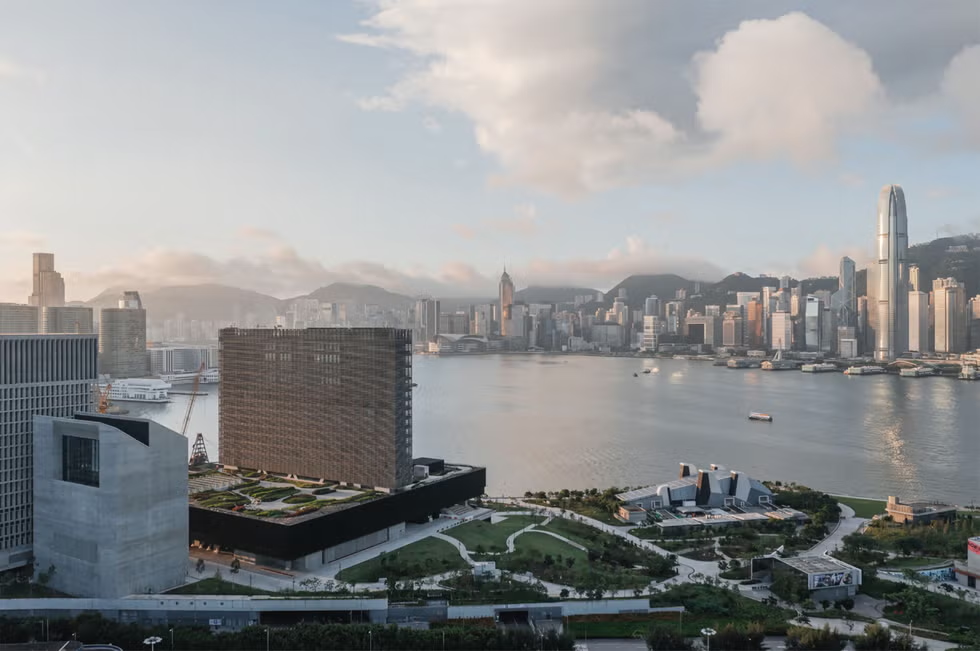
Topping the list of any art-and-design-focused visitor to Hong Kong is the M+ museum, a game-changing institution that is celebrating its fifth anniversary in 2026. Designed by Herzog & de Meuron, the 700,000-square-foot complex anchors the West Kowloon Cultural District’s 100 waterfront acres of gardens, museums, performing arts venues, and luxury retail, all overlooking Victoria Harbor.

The M+ museum overlooking Victoria Harbor.
M+ is one of the world’s largest contemporary art museums, with a distinctive design often described as an upside-down T, its exterior clad in a system of tiled louvers that defend against the city’s high humidity and wind. Beneath an 18-story tower with offices, a research center, and restaurants sits a broad, garden-topped podium that contains galleries, theaters, and public areas, while on the subterranean level “found” spaces carved out next to airport railway tunnels are used for large-scale art installations.
The plus sign in the name signifies a “museum and more” concept, which covers everything from paintings, drawings, photographs, and sculptures to design, architecture, film, and animation, all under one huge roof. Not to be missed are the galleries devoted to the M+ Sigg Collection, a trove of more than 1,500 works of Chinese contemporary art, the largest anywhere. (A personal favorite from the Sigg holdings is Yue Minjun’s 2000 A.D., a group of 25 standing figures in forward-facing formation, conveying the irony and boredom of Chinese society during economic reform in the early ’90s.)

The main lobby of the M+ museum.
“What strikes me most about M+’s collection is how it reconnects us with our own history,” says Nancy Wong, head of Asian communications for Sotheby’s. “The photographs on the ground floor, particularly of the Vietnamese refugee camps in Hong Kong taken in the late ’90s, are deeply moving and reflect the history of Hong Kong, which I had forgotten.”
Another highlight is the museum’s long-term installation “Things, Spaces, Interactions,” which features a restored apartment from Japanese architect Kisho Kurokawa’s groundbreaking 1972 Tokyo Nakagin Capsule Tower. Also on view is the building’s Kiyotomo sushi bar, created by the late Japanese designer Kuramata Shiro in 1988; every element, from its polished granite frame to the blue curtains, has been painstakingly reconstructed.

The M+ museum from the other side of the harbor.
Beyond M+, design enthusiasts will want to check out the very 21st-century development Tsim Sha Tsui at Victoria Dockside, where K11 Musea elevates luxury retail shopping to an art form. The stunning 10-story, 1.2 million-square-foot “cultural-retail” destination—with more than 50,000 square feet of living wall—houses outposts of major labels from Chanel to Yohji Yamamoto alongside eye-catching art installations such as a bear sculpture by Paola Pivi clad in fluorescent pink feathers.
Across Victoria Harbor, the city’s bustling, skyscraper-lined Central neighborhood is a cosmopolitan intersection for dining, nightlife, shopping, and culture. The area is home to the Hong Kong outposts of major international art galleries such as Hauser & Wirth, Zwirner, White Cube, and Gagosian, which resides in the historic 1920s Pedder Building. It’s also where you’ll find Tai Kwun, a cultural hub that occupies the restored former Central Police Station; it features an array of shops, restaurants, and bars. “It’s been beautifully revitalized, and the central courtyard, framed by colonial architecture, is particularly special,” says Laura Cheung, founder of wallcoverings atelier Lala Curio. Pop into Touch Ceramics for handmade pottery or LockCha Tea House for all things tea, and then slip into 001 for an Early Grey Martini.

Tai Kwun.
Be sure to stroll the historic Cat Street market, which is lined with makeshift hawker stalls and hole-in-the-wall shops. Here you’ll find vintage jewelry, jade tchotchkes, silk embroidery, porcelain vases, classic mah-jongg sets, and much more.
Designer Jessica Davis, who grew up in Hong Kong during the 1980s and visits regularly, recommends making the trip—whether by car or the number 6 bus—from the Central district over the Wong Nai Chung Gap to Stanley Market and nearby Repulse Bay. “It’s an amazing way to experience the city’s architecture and its scale,” Davis says. The open-air Stanley Market, on the south side of the island, is a great place to pick up souvenirs and traditional Chinese crafts, while Repulse Bay offers a secluded, resortlike atmosphere with shops and restaurants along a crescent-shaped stretch of public beach.

The Chi Lin Nunnery.
Another worthwhile excursion is a visit to the Chi Lin Nunnery, a serene oasis in Kowloon’s Diamond Hill district. Designed in the architectural style of the Tang Dynasty, the Buddhist temple is the world’s largest handmade wooden building, reconstructed in the 1990s in cypress without using a single nail.
Where to Eat and Drink
Nestled along the incline of historic Elgin Street, Ho Lee Fook not only features a Michelin-recognized Cantonese menu by executive chef ArChan Chan, it’s a full sensory experience. After you pass through an entry arrayed with waving gold maneki-neko (beckoning cat) figurines, a crimson-carpeted staircase leads you down to the cinematic dining room, where bold cheongsam-inspired wallpaper, blood-red upholstery, and a mirrored ceiling recall Hong Kong’s new wave film movement of the 1980s.

As a tribute to classic streetside food stalls, Chan—in partnership with hospitality veteran Jonathan Leung—opened Peng Leng Jeng in Central’s SoHo neighborhood. The lively gathering spot offers neon-lit revery where ’90s Cantopop plays and dai pai dong-style dishes like salt-and-pepper squid and crispy pork ribs with mayonnaise are served family-style.
Over in the buzzy Sheung Wan neighborhood, Yardbird is a delightfully modern Japanese izakaya from Matt Abergel and Lindsay Jang. The relaxed spot, designed by Dix Design + Architecture, is an homage to Bauhaus-era German factory worker canteens. “The vibe is always lively, humming with energy,” says Cheung. “I always go back for the corn fritters and the chicken skin rice.”

Bar Leone.
When it comes to standout drinking destinations, Justin Shun Wah and Lorenzo Antinori’s Bar Leone nabbed the top spot among last year’s World’s 50 Best Bars, thanks to impeccable yet uncomplicated cocktails and an atmosphere teeming with la dolce vita. Just as inviting is Antinori’s second spot, with partner Simone Caporale, the Cuban-inspired watering hole Montana, featuring cozy leather banquettes, an electric disco soundtrack, and carisma to spare. For seductively futuristic ambience, head to Peridot, situated on the 38th floor of a Zaha Hadid tower, where Studio Paolo Ferrari created an enveloping “deconstructed disco ball” interior—in a symphony of soft greens—that creates the impression that you’re on the set of a Ridley Scott epic.
Where to Stay
When it comes to Hong Kong hotels, everyone has their favorites. “I think the Eaton Hotel in Kowloon, redesigned by AvroKO several years ago, is supercool,” says Davis. “And then, of course, there’s always Upper House, which was designed by architect André Fu, who’s just a total icon.”

A room at the Kimpton Tsim Sha Tsui.
One of the city’s newest hotels is the 50-story Kimpton Tsim Sha Tsui, the brand’s largest property, built adjacent to the historic Mariner’s Club in Kowloon. Its 495 guestrooms and suites all offer stunning harbor views, while the amenities include a rooftop Swim Club with an infinity pool, cabanas, and a cozy speakeasy. Nearby, the Langham offers five-star amenities—as well as the Michelin-starred T’ang Court restaurant—enlivened by a backdrop of contemporary art. The Rosewood Hong Kong, situated on the harbor in the Victoria Dockside arts district, is another luxury option with interiors by New York–based designer Tony Chi and 11 culinary venues, including the sleek, award-winning jazz and cocktail lounge Darkside.
Getting There
Cathay Pacific offers nonstop flights from multiple U.S. cities, with departures out of New York, San Francisco, and Los Angeles offering the airline’s new Aria Suite premium business class. “It’s the only way to get there,” says Melody Yung, principal of San Francisco–based design and branding firm Yung Studio (a seven-time Webby winner for its work on Lady Gaga’s website). “And on your way home, leave time to explore their incredible lounges at the Hong Kong airport.”