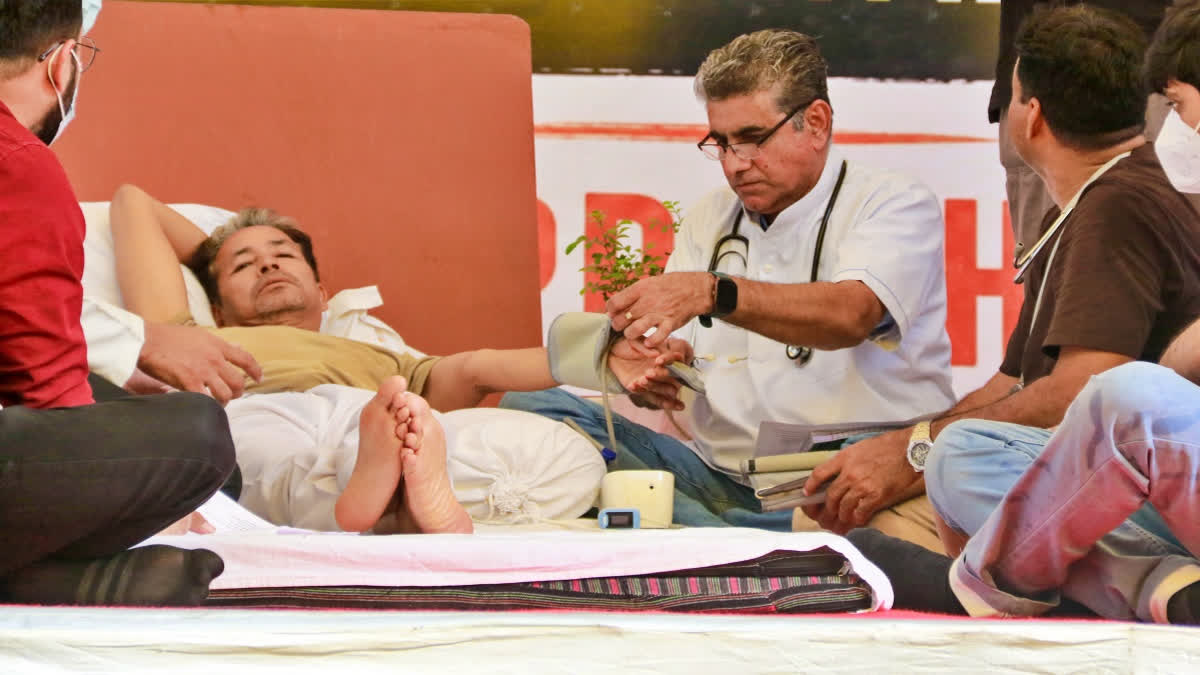
Activist Sonam Wangchuk receives medical attention during the 19th day of his indefinite hunger strike at the Cockroach Janta Party (CJP) protest site at Jantar Mantar in New Delhi on Thursday, July 16, 2026 (IANS Photo)
Social activist Sonam Wangchuk, 59, is reported to be on an indefinite hunger strike at Jantar Mantar in Delhi, surviving entirely on water and salt. He has already lost about 9 kg during the fast which has raised serious concerns about his health, reports state.
The hunger strike is part of a continuing protest against alleged irregularities affecting students, including the NEET paper leak, UGC exam issues, and problems with CBSE answer sheet evaluation. Doctors warn that starvation for extended periods can send the body into survival mode where it begins to eat its own reserves to stay alive.
What Happens To The Body?
The calories the body needs to keep its organs working come from the carbohydrates, fats and proteins in food. Water and salt help to keep dehydration at bay and maintain some of the balance of electrolytes, but they do not provide the calories the body needs. When the food supply stops coming, the body goes into emergency survival mode.
- First days: First the body uses up its stores of carbs, known as glycogen. These reserves are limited and typically depleted in a day or two.
- Second stage: When glycogen is gone, the body begins to break down stored fat, producing molecules called ketones, which become the body’s alternative fuel source. This is the rapid breakdown of body fat . This is a large part of the reason why there is such a dramatic weight loss during extended fasts.
- Week 3: As the fast nears three weeks, fat stores are even more depleted. The body then starts to break down muscle tissue for energy. This is not just affecting muscles in the arms and legs. The heart is a muscle too. Long periods of starvation will slowly weaken it and other vital organs.
Which Organs Are Vulnerable?
Studies by the US National Institutes of Health (NIH) reveal that prolonged starvation influences almost all the organs in the body.
Kidneys: The kidneys have to filter more and more waste products since fat and muscle are further broken down. Add to that the reduced blood volume from dehydration and the kidneys are under huge strain, and this can eventually cause kidney injury.
Heart & blood pressure: Not enough calories means the heart has less energy to pump blood efficiently. Blood pressure may drop to dangerous levels, increasing the risk of dizziness, fainting and even loss of consciousness.
Shortage of electrolytes: Salt gives sodium, but the body requires minerals like potassium, magnesium and phosphate to keep the muscles and heart working properly. If you fast for a long period of time, you can get dangerously low on essential electrolytes and get life threatening abnormal heart rhythms.
Low immunity: The body cannot make new immune cells without enough protein and nutrients. When the immune system is weak, even small infections can become serious.
Force Feeding
There have been calls for Sonam Wangchuk to be fed through a feeding tube. In general though, law and medical ethics allow a mentally competent adult to refuse food. Doctors normally intervene only if the person has lost consciousness or can no longer give informed consent to his/ her medical care. Even tube feeding is not without risk. Food may accidentally enter the lungs instead of the stomach, leading to aspiration pneumonia, a potentially life-threatening complication. Injury, vomiting or bleeding can also occur due to tube insertion.
Also read: Wangchuk’s Health Condition May Invite Emergency: Medical Expert
Syndrome of Refeeding
Ironically, one of the biggest risks comes after the hunger strike is over. A doctor can’t just give a person who hasn’t eaten for weeks a big meal. This may result in refeeding syndrome, which is a medical emergency. Insulin levels skyrocket when food is suddenly introduced to the body after a long period of starvation. This causes the remaining potassium, phosphate and magnesium in the blood to move into the body’s cells.
The result can be dangerously low levels of these minerals in the blood, resulting in:
- Sudden cardiac death
- Severe difficulty breathing
- Weakness of muscles
- Convulsions Tics
- Irregular heartbeat
- Death in severe cases
This is why doctors reintroduce food very slowly, beginning with small quantities of easily digestible liquids, while carefully monitoring electrolyte levels. A prolonged hunger strike is more than just “not eating”. Within days, the body will begin burning stored energy. Within weeks, it starts to eat its own muscles, including its heart, while vital organs are put under increasing strain.
References:
Also read: