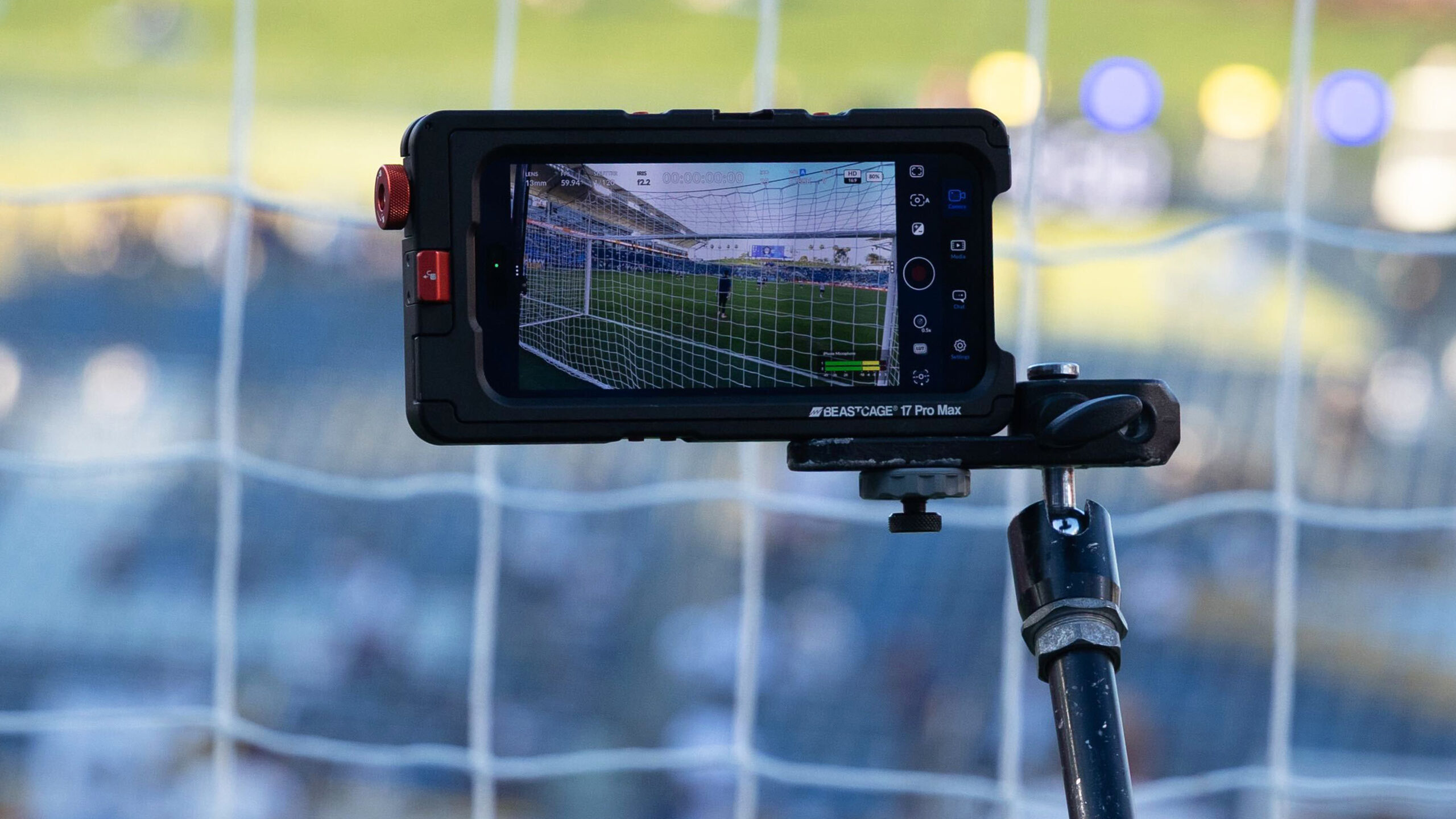
While Apple TV first showed that the iPhone 17 Pro and iPhone 17 Pro Max could handle the demands of a live professional sports broadcast during Friday Night Baseball, the company has since expanded their role into Major League Soccer, using the smartphones to capture angles traditional broadcast cameras simply can’t.
Nearly a year after Apple first put iPhone 17 Pro Max units into a live sports broadcast workflow, the cameras are back for 2026 MLS All-Star Week in Charlotte, North Carolina. During the July 28 Skills Challenge and the July 29 MLS All-Star Game, iPhone 17 Pro Max can be mounted behind goals, attached to Magic Arms — articulated mounts commonly used in film and broadcast production — and carried on Ronin gimbals by roaming camera operators. If a penalty kick happens, one could even end up just feet behind the player taking the shot, delivering an even more immersive perspective.
I’ve been on the ground in Charlotte this week and caught up once again with Royce Dickerson, Executive Producer, Live Sports on Apple TV, to see how the company’s approach has evolved over the past year. For Dickerson, the mission is no longer proving the iPhone belongs in a live broadcast — it’s figuring out what broadcasters can do with it that they couldn’t before.
Latest Videos FromTechRadar
“We’re always looking for ways to innovate and bring fans closer to the action,” Dickerson told me. “How do we continue to be creative with the spaces that we have? Where can we stick iPhones that we haven’t thought about before?… We’re always striving for… what is that perfect shot? I don’t think we’ve found it yet.”
That shift in mindset is perhaps the biggest takeaway one year later. Apple is no longer asking whether the iPhone can work as a broadcast camera — it’s asking how many more it can deploy and where they can go next.
‘Just like another camera’

A year in, nobody on Dickerson’s crew treats the iPhone as a novelty act anymore. He pointed back to that first Friday Night Baseball broadcast, when veteran director John Moore ended up cutting to the iPhone shot more often than he expected once he saw the picture quality for himself. Camera operators reached the same place, Dickerson told me that once they’re familiar with the iPhone, “it’s just like another camera to them.”
That comfort is why Apple is running the setup weekly across both MLS and Friday Night Baseball now, rather than treating it as a special event. “I don’t think we’d be doing it week-over-week in MLS right now and in Friday Night Baseball if everybody wasn’t 100% comfortable with the camera,” he said.
The hardware has diversified slightly, too — alongside the now-recognizable Cosmic Orange units, Apple has mixed in some silver iPhone 17 Pro Max cameras as well.
From four iPhones to 15 — and eventually 30?
Ask Dickerson what he took away from that first Fenway broadcast and applied directly to MLS, and his answer is immediate: they needed more iPhones.
That first game ran four units total — one on the Pesky Foul Pole, one tucked into the Green Monster, one on a Ronin gimbal, and one in the dugout. Seeing how unobtrusively that small footprint could be worked into a stadium convinced him the ceiling was much higher than four.
“We need more of them,” he told me. “The small-scale size of that just showed me we can put iPhones anywhere. We need to be able to say, like, let’s put 20 — what can we do that’s crazy in a stadium that just provides full 360 coverage inside of a venue?”
That thinking has already become reality. For a dedicated MLS match shot almost entirely on iPhone, Apple deployed 15 iPhone 17 Pro Max cameras throughout the stadium — and Dickerson doesn’t see that as a ceiling.
“I see a world where we have 20 iPhones. I see a world where we have like 30,” he said. “With the confidence that everybody has in them now, the envelope’s going to start getting pushed a little bit further out.”
The workflow has caught up with that ambition. What used to take a full day of rigging and connectivity checks is now, in Dickerson’s words, roughly a tenth of the time it took a year ago — purely a result of doing it week after week and building familiarity with the process.
Crews are still using Beastgrip rigs for mounting, but the iPad-based control setup I saw a year ago is gone: camera input and shading are now integrated directly into the truck’s standard broadcast system, no separate tablet required.
Geometry is a key difference between capturing MLB and MLS

The biggest difference between MLB and MLS comes down to something surprisingly simple: geometry.
A pitch is the same size in Charlotte as it is in LA, Miami, or New York, and in many soccer stadiums, the stands run right up to the touchline — meaning a Ronin-mounted iPhone can get shockingly close to the run of play.
Baseball doesn’t offer that flexibility. The foul lines are a hard boundary, and once you cross onto the field of play, that’s it — no matter which park you’re in, and no matter how the dimensions shift from stadium to stadium. Soccer’s more consistent footprint, paired with sideline access, is letting Apple push cameras nearer to the action than it could at a ballpark.
That proximity has led to placements you wouldn’t get near a diamond: a Ronin at the touchline for tight shots, an iPhone on the team benches (Dickerson mentioned catching LA Galaxy head coach Greg Vanney’s face as he made notes on an iPad during a match), cameras tucked into the goal net, in the tunnel, and mounted on field-level advertising boards. None of it blocks a fan’s sightline, and all of it is small enough that it goes unnoticed until a broadcast cuts to it.
Dickerson also pointed to a subtler benefit: players, coaches, and managers react differently to an iPhone than they do to a traditional broadcast camera.
“Usually there’s a big broadcast camera being shoved in their face, and they immediately kind of retreat within themselves,” he said. “But all of a sudden there’s just an iPhone 17 Pro Max on a gimbal… and it kind of eases them.”
That reaction is helping Apple capture more intimate, unguarded moments without disrupting play or fans’ sightlines.
What to watch for in Charlotte
Tuesday’s Skills Challenge leaned heavily on mobility with Ronins at the stadium, two of them on RF for full remote control, plus two more mounted on Magic Arms positioned for organic, up-close angles of balls in flight and players running by.
Wednesday’s All-Star Game mixes in two Ronins pushed toward the sidelines, alongside iPhones positioned around the halftime stage for Ciara’s performance (produced by a separate crew that Apple’s broadcast will ingest as a feed).
Dickerson’s dream shot for the All-Star Game: a Ronin-mounted iPhone getting a tight angle from behind a player on a penalty kick — a shot that’s essentially impossible with a traditional camera rig.
I’ll be keeping an eye out for that moment during the match, because if Apple can pull it off, it may be one of the clearest examples yet of why these tiny cameras are changing what’s possible in a live broadcast.
Still searching for the perfect shot

Twenty years into a broadcast career, Dickerson isn’t interested in declaring victory. He pointed to a home run from Phillies outfielder Bryson Stott, shot from a low third-base angle, as one of the closest things to a perfect shot his team has captured with the iPhone so far — but he’s clear it’s not the finish line.
The goal, as he put it, is finding angles nobody’s thought to try yet, in stadiums that all start to look the same until you walk them looking for a spot nobody’s used before.
With Apple already talking about a “year-and-a-half” of testing and implementation behind it heading into the next MLS season and Friday Night Baseball campaign, Dickerson is promising more of what got Apple here in the first place: more iPhones, more unconventional angles, and continued insistence that the phone in your pocket can shoot alongside — and sometimes replace — a six-figure broadcast camera.

Follow TechRadar on Google News and add us as a preferred source to get our expert news, reviews, and opinion in your feeds.