The variability of a football club’s circumstances from one season to the next — the impact of promotion and relegation, the jumbled mass of player contracts on their books — means no two teams ever approach a transfer window from the same vantage point.
That fact is often lost. Big spenders are routinely pilloried or applauded for improving their squad or splurging wastefully, regardless of whether they’ve been careful in years past. The more frugal sides are decried as misers or praised for their market savvy, no matter the surrounding factors.
One way to delve a little deeper is to look beyond the money spent and instead at what, exactly, it was spent on. Positions spring to mind as one way of doing this, but another, and one that can prove quite telling in terms of where a club are on their particular journey, is to look at the ages of players signed.
The Athletic, then, has done just that.
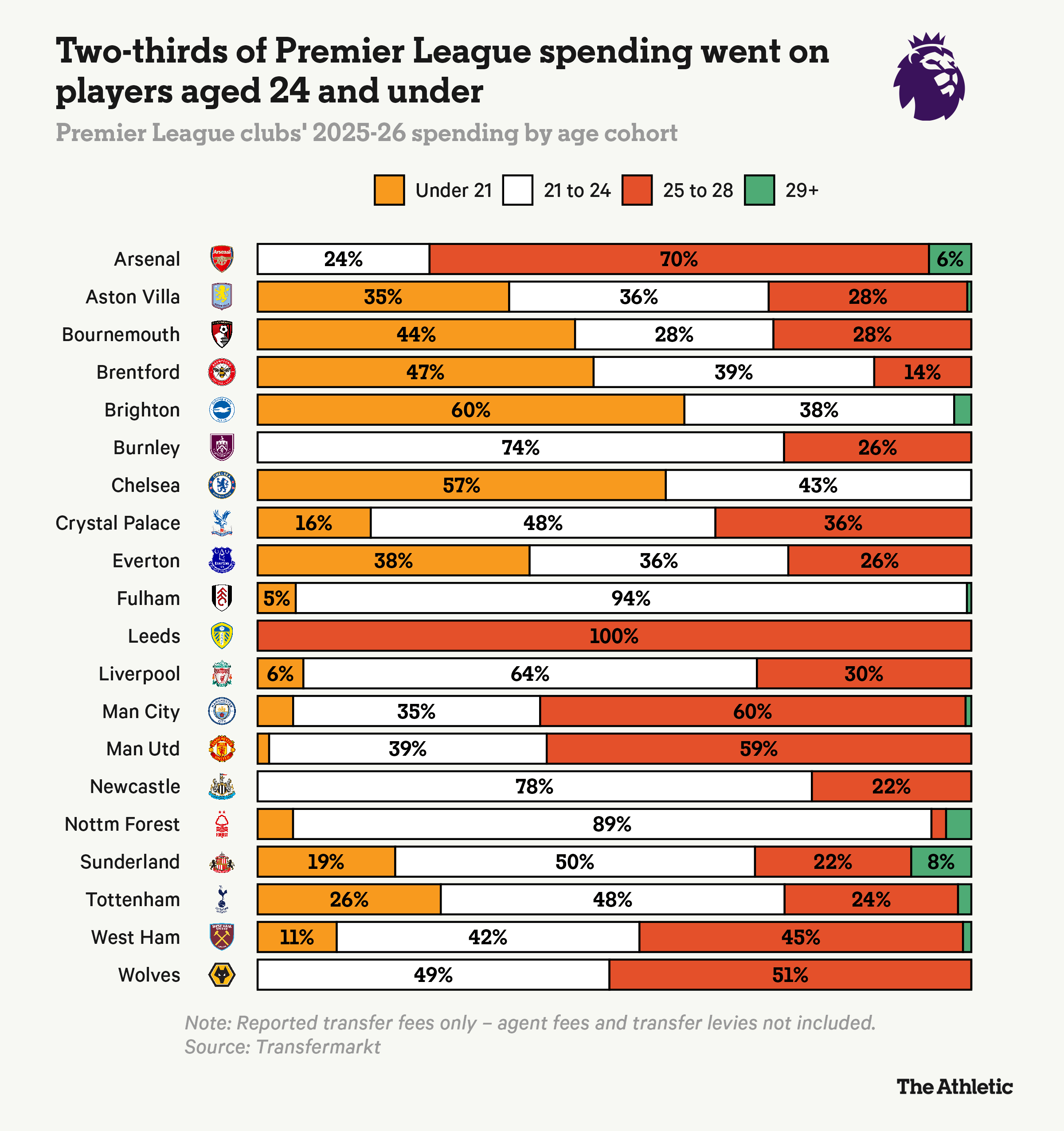
After totting up the £3.5billion-plus ($4.75bn) the 20 Premier League teams have spent on new faces this season, we’ve broken it down by club and split their spending into four distinct age ranges: under-21s, 21-to-24-year-olds, 25-to-28-year-olds, and those aged 29 and older.
On a collective basis, a division-wide trend continued. As detailed in our final Transfer DealSheet of the season last week, 49 per cent of spending went on players in the 21-to-24 bracket, the eighth season in a row that the largest share of fees has been directed toward that group.
Employing a club-by-club view provides greater insight.
Take current Premier League leaders Arsenal.
Mikel Arteta’s side has been built through several years of significant transfer investment, and 2025-26 was little different. At over £250million on new players and little in sales, they are English football’s highest net spenders this season.
Of note was a significant shift in the age profile of players brought to the Emirates Stadium last summer.
Since Arteta was appointed in December 2019, Arsenal have tended to spend more heavily on youngsters (though scarcely anything has been spent on under-21s, reflecting their productive academy). Two-thirds of spending in the five seasons before this one went on players aged 21 to 24. This year though, that has shifted markedly, with 70 per cent — almost £180million — going on Martin Zubimendi, Eberechi Eze and Viktor Gyokeres. All three are 27 or, more pointedly, of an age when players are generally deemed to be at their peak.
There was a sense, last summer, that Arsenal were making a big play for honours in the coming season; as The Athletic detailed then, without player sales, the club ran close to the limit of UEFA’s squad-cost rule, yet they were still happy to invest. In spending heavily on a trio of slightly older heads, Arsenal’s intent was clear: we’re trying to win now.
If analysing Arsenal’s signings by age showcases the club’s short-term aims, something different is true elsewhere in London.
Chelsea have spent close to £300million this season, a matter that drew less attention than their splurges of recent years because they recouped as much from player sales.
Even so, where that expenditure was directed reflects their overarching strategy. Their budget was focused on youngsters: Chelsea spent nearly £170million — a significant figure — on players under 21, including Jamie Gittens, Estevao and Jorrel Hato. That was nearly £100m more than the next highest spenders on the youngest cohort (Bournemouth: around £70m across Rayan, Ben Gannon-Doak, Veljko Milosavljevic and Alex Toth).
It reflects a sharp shift in the west London club’s transfer focus since being taken over by a consortium led by Clearlake Capital in May 2022. Player trading has long been a key strand of the Chelsea business model, but the policy has been taken to its extreme.
Using Transfermarkt (a resource we’ve relied upon throughout this piece), of Chelsea’s £1.4billion in gross transfer fees spent across the past four seasons, £1.2bn went on players aged 24 or younger. A total of £319m, or 22 per cent of the total spend, has gone toward buying teenagers. Since that takeover, they have spent more on players aged under 20 than the rest of the Premier League’s traditional ‘Big Six’ combined.
Chelsea make huge operating losses — more than £200millkion in each of the past three known seasons (their 2024-25 financials are yet to be published) — so keeping player-trading profits high is essential. Buying young helps the books.
Interestingly, the only club to direct a higher proportion of their 2025-26 spend at under-21 players were Brighton, who Chelsea have regularly signed players from in recent seasons.
Brighton spent only a third of the club-record £210million they paid out in 2024-25 this time, but over half of their sum went on two teenagers — Charalampos Kostoulas and Tommy Watson. They are another club for whom effective player trading is essential.
Intriguing, too, is the contrast in approach of this year’s three promoted sides.
Sunderland, incongruously with the youth-focused strategy that got them back to the Premier League after eight years in the second and third tiers, were the busiest shoppers in the division on players aged 29 and over, both as a proportion of individual club spending and in monetary terms. They were responsible for close to a third of the Premier League’s total outlay of £49million on players edging towards the ends of their careers, having not parted with a penny in transfer fees on anyone aged over 24 in the four seasons before last summer.
The bulk of their elderly spending, of course, went on Granit Xhaka, who has been integral in steering Sunderland clear of the relegation zone. Sunderland did not forget their youth-first mantra, spending well over £100million on players aged 24 and below, but adding experience has served them well.
Arguably, that’s the case at Leeds, too, where, remarkably, last season’s Championship title winners spent all of their summer outlay on players enjoying their peak years. Focusing transfer resources completely on the 25-to-28 group meant they bought targets ready to come straight into the first team. Daniel Farke’s side are six points clear of the relegation zone after 25 games — far from safe, but making a much better fist of staying up than many promoted teams in recent years.
Burnley? Not so much. They sit second-bottom, 11 points off 17th place, despite spending heavily in their second post-promotion summer in three years. All £100million of their transfer fees went on guys aged 26 and under, with three-quarters of it devoted to those in the first half of their twenties.
Whether that was a strategy undertaken with only survival in mind is unclear. Burnley’s leveraged takeover in December 2020 has left the club with high-interest debt, which becomes a much greater burden if relegation occurs — as it has twice already under these owners. One way they’ve reduced the strain has been from big sales, which are easier to achieve with younger players. The age profile of Burnley’s signings has changed markedly since the years when they were Premier League regulars.
The two Manchester clubs shared a similar profile, spending around 60 per cent of their transfer fees on players aged 25 to 28.
City’s captures of Antoine Semenyo and Marc Guehi last month reflected a theme over the past decade — no other Premier League club has spent more on buying players in their perceived prime. At United, Bryan Mbeumo and Matheus Cunha mirrored the work of their neighbours: gobbling up arguably the best players at other Premier League clubs, each one in his prime years.
This season saw the wealthiest Premier League clubs happier to buy players whose resale values will likely be lower than their purchase price. Of the 16 Premier League signings who cost £50million or more, six — Cunha, Semenyo, Zubimendi, Eze, Gyokeres and Yoane Wissa — are aged 26 or older, and all six signed for either Arsenal, the two Manchester clubs or Champions League-bound Newcastle United.
In the 10 previous seasons combined, only eight players aged 26 or older were signed for fees above £50million. That reflects both a continuing surge in transfer values in England and the growing ability and appetite (at least this season) of some clubs to spend big on snaffling stars from Premier League sides with lesser resources.
And what of Liverpool, by far this season’s biggest spenders? Even without the £55million now committed to signing 20-year-old Jeremy Jacquet this summer, the Premier League champions dropped more than £400m on new players before the season kicked off, the third-highest single-season spend in English football history.
Such extravagance was a departure from the norm at Anfield and, though Jacquet’s signing might suggest otherwise, big splurges are not expected to become routine. The profiles of coach Arne Slot’s newest players point towards Liverpool’s squad getting younger, with 70 per cent of fees spent on targets under 25.
British-record signing Alexander Isak, already 25 years old when he arrived and now 26, stands a little opposed to that, but after signing a six-year contract in September, his new club will hope to enjoy the striker’s best years. And they have surrounded him with others who they expect will become fixtures at Anfield.
Liverpool’s spending was undeniably big, but their outlay had the future firmly in mind.


This is really interesting, You’re a very skilled blogger. I’ve joined your feed and look forward to seeking more of your magnificent post. Also, I’ve shared your site in my social networks!