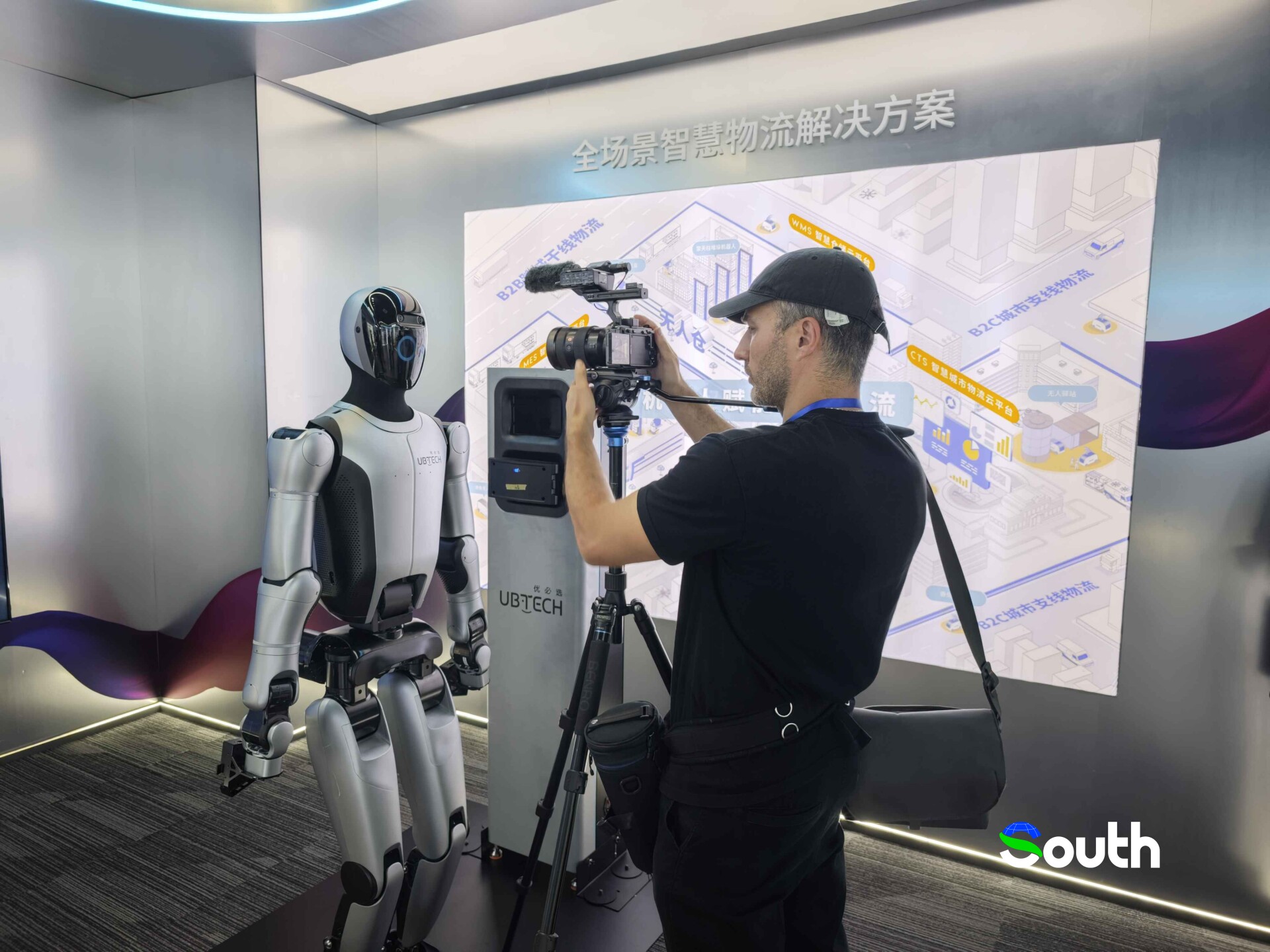
A delegation of 86 journalists representing 52 media outlets from the United States, the United Kingdom, Brazil, Russia, Japan, and beyond toured Guangzhou on April 16, diving deep into the innovation engine of the Guangdong-Hong Kong-Macao Greater Bay Area.
The visit turned the spotlight on how the region’s unique blend of specialized industry and academic research is fueling technological ambition.

At the Guangdong Power Grid Robotics Laboratory, reporters saw firsthand why state-owned utilities are building bespoke machines. BBC journalist Stephen McDonell asked the obvious question: with so many professional robotics firms already in China, why reinvent the wheel?
Li Duanjiao, director of the laboratory, had a clear answer: context matters. “Plenty of companies make great robots for factories, homes, and hotels,” Li said. “But the power grid is a vertical world itself. The harsh environments, the specific tasks, the complexity—off-the-shelf general-purpose bots simply can’t cut it.”
Li explained that the lab builds realistic power-line scenarios and develops specialized capabilities that commercial vendors do not offer. “We’re filling a very specific gap,” she noted. “This is joint development aimed at solving problems unique to the power grid.”

The narrative shifted from hardware to human capital at the Hong Kong University of Science and Technology (Guangzhou). Inside the Advanced Hybrid Manufacturing Lab, Reuters journalist David Kirton pressed for the real bottlenecks facing Chinese manufacturers trying to level up. “What does it actually take to reach the cutting edge where your startups operate?” he asked.
Professor Kai Tang, who spends his weeks embedded with local factories, offered an unfiltered take from the front lines. “I’m out there talking with industry constantly,” Tang said. “They’re all fixated on one thing: using AI to overhaul their production lines. And when I ask what kind of graduates they need, the answer is unanimous—people who are adept in both traditional manufacturing fundamentals and emerging AI. They want hybrid engineers, and right now those people are hard to find.” That skills gap, Tang implied, is the real choke point for China’s next industrial leap.

The university’s top brass reinforced the global outlook underpinning this push. Professor Lionel M. Ni, president of HKUST (Guangzhou), pointed to the institution’s expanding international footprint. “Our student exchanges went global in January 2024,” Ni said. “We now have 62 institutional partners and 33 active agreements. The whole idea is to build real international collaboration—sending our students out and bringing the world’s talent to campus right here.”
Brazilian journalist Nelson Pancini De Sa from UOL Group observed the broader economic interplay at work, highlighting the natural fit between Brazil’s commodity exports and China’s surge in high-tech investment.
Reporter: Guo Zedong
Photo, cover & video: Pan Jiajun