The US Dollar and the Canadian Dollar have settled into an uneasy pause. Neither seems ready to force the next move, and that hesitation is its own kind of signal. Traders on both sides appear to be circling the same question: who blinks first when both currencies have a case for holding steady?
It’s the kind of quiet that invites second-guessing. Recent numbers have chipped away at some of the confidence traders once had in the Dollar’s direction, yet nobody seems in a hurry to abandon it either. That tension, more than any single data point, is what makes this pair worth watching right now.
What makes the current setup more interesting is not the exchange rate itself, but the shifting mood behind it. The Dollar’s recent run of numbers has been softer than what markets grew used to earlier this year, and that has traders reassessing how much room the Federal Reserve really has. A cut in September is still seen as more likely than not, but the odds sit close enough to even, around 55%, that neither side of the market feels fully justified in its position.
At the same time, Canada’s economy delivered a jobs report that caught plenty of people off guard, coming in stronger than expected just as the US figures disappointed. That kind of divergence usually forces a repricing, yet the pair hasn’t reacted the way the textbook might suggest. That gap between the data and the price action is worth sitting with.
A Key Support Level Faces Its Next Test
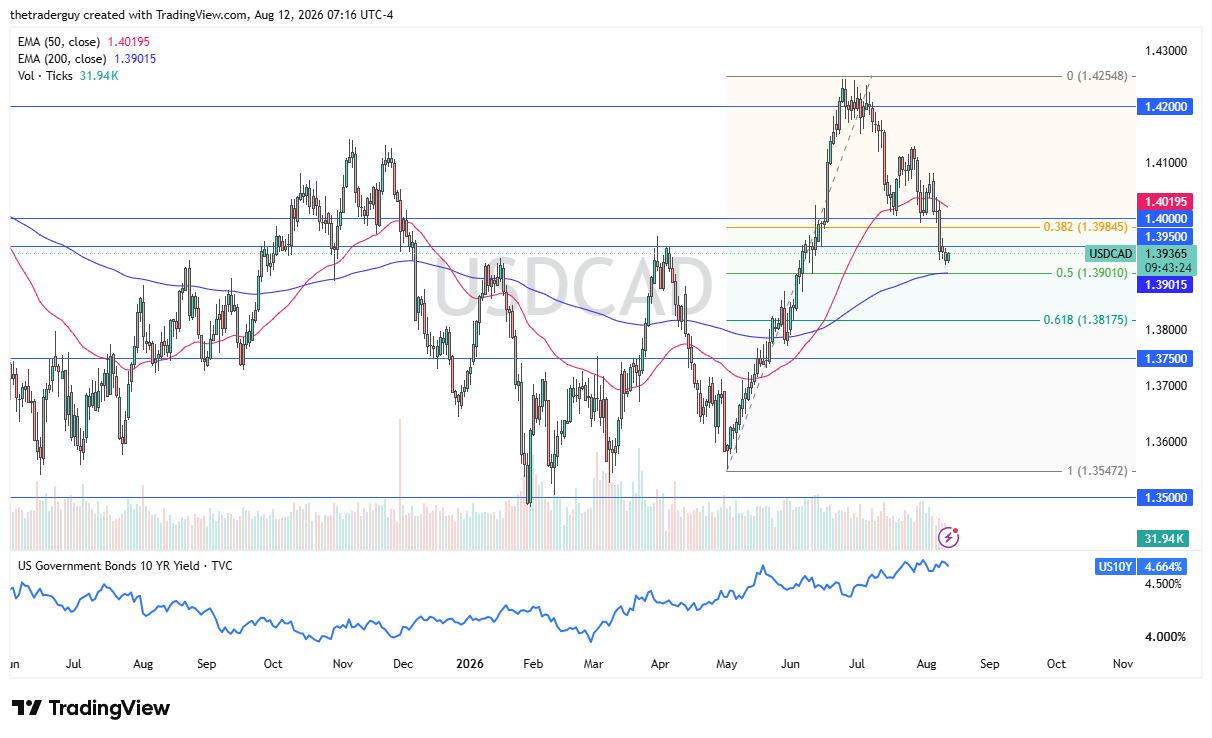
Ultimately, this market is sitting at a level that seems to be doing exactly what technical levels are supposed to do: slow things down. From a purely technical standpoint, the current zone looks like one buyers might reasonably lean on. It lines up with the 50% Fibonacci retracement of the recent move, and the 200-day EMA is sitting almost exactly on a level that has mattered to this pair before. That kind of confluence doesn’t guarantee anything, but it does explain why price has struggled to push through with any real conviction.
The CPI release during Wednesday’s session adds another layer to watch. It won’t resolve the standoff on its own, but it will influence how traders read the next move in interest rates, and interest rates remain the clearest signal here. If US rates start climbing again, that tends to favor the Dollar. If they slip instead, the Dollar typically finds itself on the back foot. For now, the market appears to be waiting for one of those two paths to become clearer before committing in either direction.
Divergence in Jobs Data Continues to Widen
The jobs divergence between the two economies highlights something traders may be underestimating. Canada’s better-than-expected report and the softer US figures should, in theory, have pulled this pair in one clear direction. Instead, it has barely moved, and that gap between expectation and reaction deserves more attention than it’s getting.
Oil plays a role here too, but only to a point; its influence has been more of a background hum than a driving force lately. The bigger blind spot may be complacency itself, with traders assuming the current calm reflects genuine balance rather than a market that simply hasn’t been tested yet. Supply-chain concerns tied to the Strait of Hormuz haven’t gone away either, and a market this quiet may not be pricing that risk fully.
There’s a case for a very different path here, one where the pair simply grinds lower over time rather than staying range-bound. That would fit the historical pattern for USD/CAD, a pair where so much of the flow is driven by trade and necessity rather than speculation, which tends to produce slow, grinding moves rather than sharp reversals. A clear break of the technical confluence described above, paired with a decisive shift in US rate expectations, would be the clearest sign that this alternative path is taking over.
Getting a proper read on where this pair goes next means watching more than just the chart. Inflation data out of the United States, and to a lesser extent Canada, will matter. So will oil, and so will the broader question of whether traders start pricing in real supply-chain risk around the Strait of Hormuz. Wednesday’s session may only be the first piece of that puzzle to fall into place.
Ready to trade our USD/CAD analysis? Here is our list of the top 10 brokers worth checking out.
