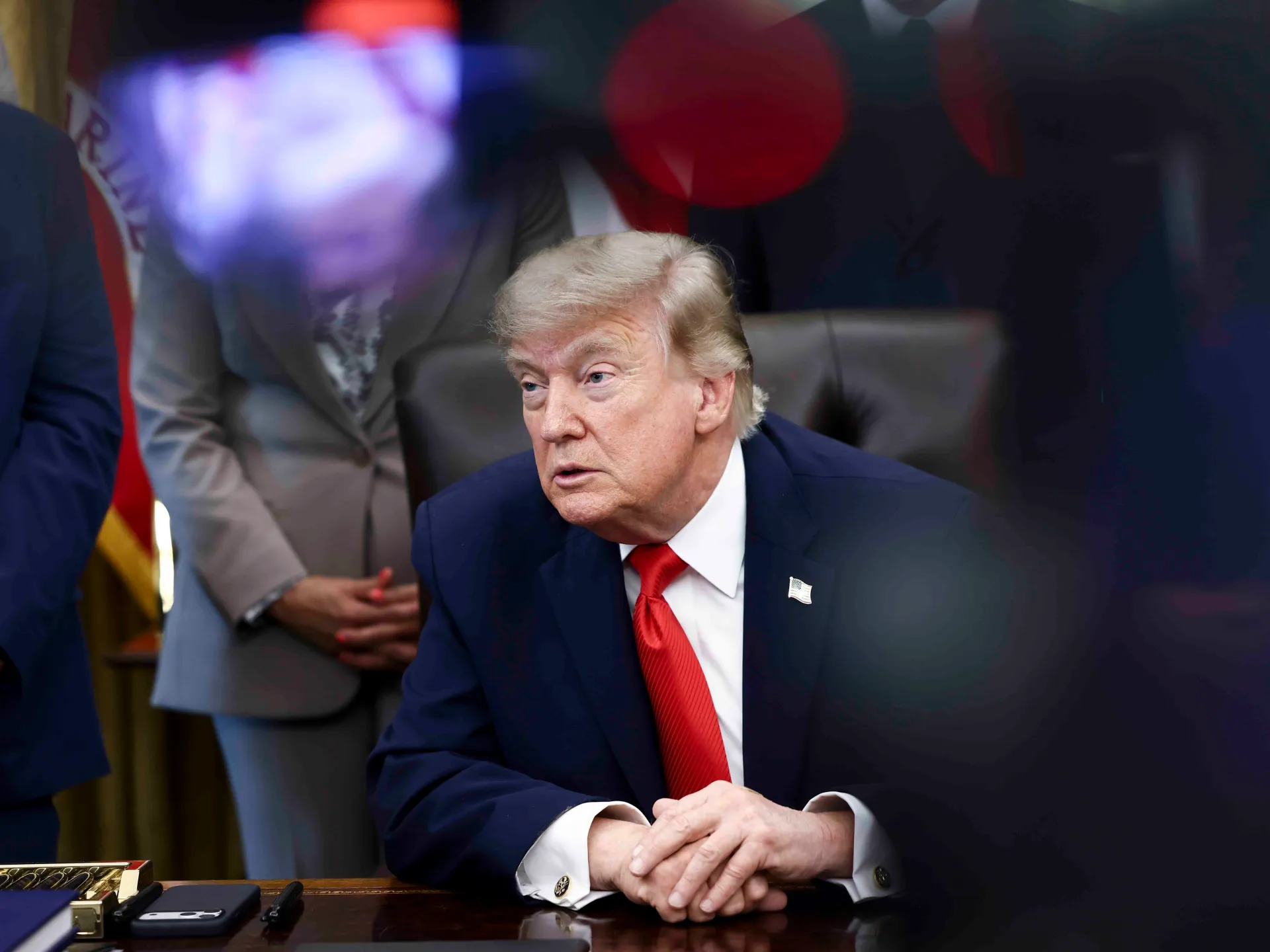
The decision by the United States to carry out strikes on Iran has not only drawn retaliatory attacks from Tehran but also brought criticism from a Democratic lawmaker who has accused Republican President Donald Trump of violating a war powers resolution passed by Congress.
Congress passed the resolution on Tuesday, stipulating that the president must either halt his military campaign against Iran or seek congressional approval before any further action is taken.
Recommended Stories
list of 4 itemsend of list
Representative Ro Khanna, a Democrat from California, condemned the latest US attacks on Iran, calling them “a blatant violation” of the congressional resolution and threatening to take Trump to court over it.
The US military’s Central Command on Saturday hit Iranian military sites after accusing Tehran of targeting a ship passing through the Strait of Hormuz, which has become the focus of a geopolitical showdown between the two countries.
In response, Tehran hit US military sites in Bahrain and Kuwait on Sunday as the two sides exchanged strikes for a second time over the weekend, threatening to unravel a fragile Iran-US memorandum of understanding (MoU) signed on June 15.
Meanwhile, Israel has continued to strike Lebanon despite a framework deal signed on Friday and the MoU calling for an end to war on all fronts, including in Lebanon.
So is Trump violating the law, and can Congress stop him from attacking Iran?

What is the 1973 War Powers Resolution?
The War Powers Resolution of 1973 requires the president to notify Congress within 48 hours of committing armed forces to hostilities and bars sustained military action after 60 days, pending congressional approval.
The Senate on Tuesday was voting for the 10th time to try to rein in the war that the US and Israel launched against Tehran on February 28.
The Senate passed the resolution in a 50-48 vote despite Trump’s Republican Party enjoying a slim majority in both it and the House of Representatives. Four Republicans voted in favour of the resolution, which is nonbinding.
The House also passed the measure on June 3 by a vote of 215 to 208.
Addressing the Senate before the vote, top Democrat Chuck Schumer said: “For years, Trump promised to put maximum pressure on Iran, but he ended up delivering maximum confusion, maximum chaos, maximum cost to the American people with his disastrous war.”
“The American people have paid the price for Trump’s historic blunder in Iran. It’ll go down in the history books as one of the worst foreign policy forays America has ever made,” he added.
The war against Iran has been unpopular in the US, where less than a quarter of people feel the war has been worth the cost, as suggested by an Ipsos/Reuters poll.
The vote on the resolution was held as the Pentagon is also seeking an $80bn boost from Congress, mostly for the Iran war as it backfills munitions and stockpiles depleted during the conflict.

How was the resolution passed, and what does it say?
Four Republicans crossed party lines to vote in favour of the Senate resolution: Bill Cassidy of Louisiana, Lisa Murkowski of Alaska, Susan Collins of Maine and Rand Paul of Kentucky. Two other Republicans, Mitch McConnell and Dave McCormick, did not vote on the resolution.
The resolution “directs the President to remove United States Armed Forces from hostilities against the Islamic Republic of Iran”.
Only if “explicitly authorized by a declaration of war or a specific congressional authorisation” would Trump be allowed to use further military force against Iran, it says.
The resolution, however, does allow for a limited military presence to remain in the Middle East to prevent any “imminent attack” against the US or its allies.
Trump called the vote “poorly timed and meaningless” and said it “provided aid and comfort” to Iran.
He berated the Republicans who voted for the resolution at a luncheon at the Capitol on Wednesday. That night, Cassidy changed his vote and Paul voted present as the Senate rejected a nearly identical war powers resolution 47-50 in an attempt to appease the president.
Does Trump care about it?
On the face of it, no.
The resolution is largely symbolic because it does not carry the full force of law, even if it mirrors the wariness among lawmakers in the House and Senate over both the war and the MoU Trump struck with Iran to end it.
Under the US Constitution, Congress has the sole power to declare war, but presidents before Trump have gone to war without congressional authorisation.
Trump has pointed to those precedents and told the Axios Show last week that he has not learned any “lesson” about the limits of his executive powers during the Iran war. “There are no limits,” he said.
The White House also brushed off the Senate’s passage of the resolution, noting that it has “no significance” and saying it was driven by “Republican absences”.
“The resolution directs the President to remove US Armed Forces from hostilities against Iran. Yet there are no hostilities from which to remove US forces, as hostilities terminated with the ceasefire on April 7th,” a White House official said in a statement on Tuesday.
However, on Friday, Trump directed US forces to strike Iran in what his administration says was a response to Tehran attacking a vessel in the Strait of Hormuz.
Tehran has insisted that vessels use only Iran-approved routes to ensure safe passage. It has opposed an alternative route closer to the Omani coast that has been recommended by the US.
Iran said the renewed US attacks violate the MoU signed by Trump and Iranian President Masoud Pezeshkian.

Is Trump violating the law?
Before this, no war powers resolution had previously passed both chambers of Congress in Washington, DC. A 1983 Supreme Court ruling noted that such a measure must be submitted for a president’s signature to have legal effect.
US constitutional expert Bruce Fein told Al Jazeera on Wednesday that Trump would “ignore the vote on the bogus fantasy of unconstitutionality”.
“The courts will refrain from intervening under the political questions doctrine,” Fein said. “But Congress could end the war by terminating funding asked [for] by Trump. What he is doing is clearly an impeachable offence, which will haunt Trump if November hands Congress to Democrats.”
Unlike previous administrations, Trump has not passed authorisations for the use of military force (AUMFs), which authorise the use of military force without a declaration of war. For example, in the wake of the 9/11 attacks in 2001, Congress passed an AUMF that gave then-President George W Bush broad powers to conduct what would become the so-called “war on terror”.
The constitutionality of the 1973 War Powers Resolution, however, will likely be settled in the courts, as threatened by Democrat Khanna.
“Trump must stop this war now – or we will take him to court to compel him to do so,” Khanna wrote on X late on Saturday after the US struck Iranian targets for the second day in a row.
Is the region returning to full-blown fighting?
Hassan Ahmadian, an associate professor at the University of Tehran, told Al Jazeera that the attacks could set off a domino effect of strikes between the US and Iran.
“I think we’re up for escalation because, obviously, the Iranians will retaliate,” he said.
Ahmadian argued that Article 5 of the MoU says “Iran will make the arrangements for the safe passage of commercial ships” for 60 days, and afterwards, it will be “Iran and Oman that will make the arrangements”.
“And now, the United States wants different arrangements in place as opposed to the MoU that it itself signed,” he said. “What we see is the United States trying to find its way out of this memorandum of understanding while obliging Iran to its end of the terms.”
The US has done the same in Lebanon by brokering a new framework agreement, he said, adding that the Iranians “will not let go of this”.