Grace Jin Drexel was living in agony for seven months, advocating for the release of her father from a Chinese prison, when a friend mentioned to her in early May that her phone must be blowing up.
A short time earlier, President Trump, in response to a question from The Hill, had said he would raise the issue of Ezra Jin, the leader of the Zion Church in China who was arrested in October, when he meets Chinese President Xi Jinping in October.
“Huge, huge!” Drexel told The Hill in an interview in Washington about the moment that changed everything in the effort to secure her father’s release. She was holding her 2-month-old son, Ezra, who is named for her father.
Shortly after she saw Trump answer The Hill, Drexel during an interview with Fox News thanked the president. It’s an appearance she believes furthered efforts to win the pastor’s release.
Jin was freed in July, two months after Trump met with Xi in Beijing and personally raised the issue of releasing the church leader.
The whole episode served as a somewhat textbook case of how to appeal to Trump for results: Raise an issue personally with the president, reinforce it on Fox News and show him he could yield tangible wins.
Ahead of the Trump-Xi summit in Washington on Sept. 24, Drexel believes the time is now to ask the president to advocate for the release of at least eight Zion Church leaders still detained in China on religious freedom grounds.
“From my perspective, why not ask for the stars? If not me, who is going to be asking? There are so many people still detained in China,” she said.
A White House official told The Hill that Trump is “always concerned about Americans detained abroad” when asked whether they expect the issue will come up during Xi’s visit.
“As he has said publicly, President Trump raised Pastor Jin’s detention directly with Xi Jinping. He will always champion religious freedom around the world,” the official said.
It’s not clear if that formula can be repeated next month.
Both leaders are keen on improving the relationship between the world’s two largest economies.
The leaders are expected to grapple with the issues of trade policy, artificial intelligence regulation and the Iran and Ukraine wars.
Trump has put China in the crosshairs of his new economic pressure campaign against Iran, telling Beijing to cut financial ties with Tehran or risk punishing U.S. sanctions.
But Drexel is not discouraged.
“We’re really grateful for what he did and showed us that our nation is great in taking care of and becoming a voice of the voiceless in this way,” she said.
Jin’s release was extraordinary.
Trump had also raised Youlin Chen, a Chinese-born American seismologist who has been in a Chinese jail since 2024. The U.S. designated Chen as “wrongfully detained” in March but kept his case quiet, hoping behind-the-scenes advocacy would be more successful than a public naming-and-shaming campaign.
When Trump left China without Chen, the administration and Chen’s family went public in July, hoping the attention would increase pressure on Xi.
There’s little indication that Xi is bending, however. Instead, he has been jailing more Americans.
In June, American academic Min Zin was arrested while traveling to China to attend a conference. The administration has labeled him as “wrongfully detained.”
Still, families of other prisoners in China have taken note of Trump’s personal involvement in Jin’s release.

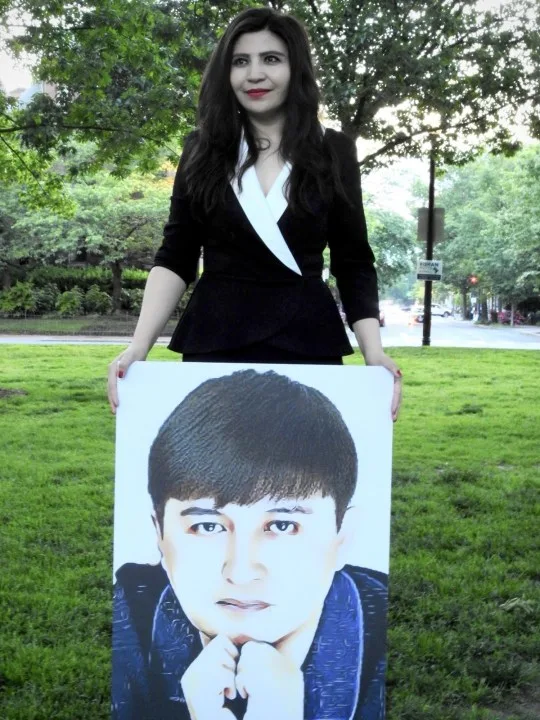
Rayhan Asat holds a picture of her brother, Ekpar, who went missing in 2016 after returning to Xinjiang from a trip to Washington, D.C., following participation in the State Department’s International Visitor Leadership Program.
“It just shows that sustained advocacy at a high level, it does work and diplomacy does work,” said Rayhan Asat, a Uyghur human rights lawyer whose brother is currently detained in China.
Trump, during his first term, determined the Chinese Communist Party was committing genocide in Xinjiang against its population of Uyghur Muslims and other ethnic groups, saying the campaign stretched to 2017.
Asat’s brother, Ekpar, disappeared 10 years ago upon returning to Xinjiang from a trip to Washington, D.C., following participation in the State Department’s International Visitor Leadership Program. Outspoken critics of the Chinese government often find their families targets in China, or themselves the victims of harassment — wherever they live — as part of China’s transnational repression efforts.
Asat has since met with officials at the State Department and White House, including in the second Trump administration, to advocate for her brother’s release.
“I’m very optimistic that my brother would be released,” Asat told The Hill. “But for that to happen President Trump needs to keep raising cases so we don’t lose momentum.”
A number of detained Chinese citizens have family members who are American citizens.
Dr. Gulshan Abbas, whose sister is Uyghur American activist Rushan Abbas, has been imprisoned in China since 2018. Gulshan Abbas vanished from her hometown of Urumqi, the capital of the Uyghur Autonomous Region, days after Rushan Abbas criticized the Chinese government’s treatment of the ethnic group during remarks at the Hudson Institute in Washington.
That type of transnational repression is a shared experience among families of loved ones detained in China.
Drexel said she and her U.S.-based mother have experienced harassment and surveillance.
In one chilling episode, her mother picked up a phishing phone call that transferred her to a police station in China. She’s had her tires slashed in a private garage, and Drexel said she’s observed people filming her.
Drexel quit her job as a Republican national security staffer on Capitol Hill to advocate for her father’s release full time.
“In a sense, that’s China’s long-arm in another way,” she said of leaving her job.
“When a family member has someone detained in China, there’s enormous pressure because you feel like you’re going against the whole state apparatus, which in this case, it was, the whole state apparatus is out to get you.”
Sarah Makin, who served as senior director on the National Security Council during Trump’s first term and works with the Abbas family and others who have loved ones imprisoned in China, said Trump’s positive relationship with Xi works in their favor.

Sarah Makin with Ziba Murat, the daughter of Gulshan Abbas, who has been imprisoned in China since 2018.
“The way that he has handled that relationship, has set us up for success here, and has set him up for success in getting as many people out as possible,” Makin said.
“On these cases in particular, this is the thing I’m focused on when it comes to China, and I think he’s the best guy for the job right now,” she added.
Still, she argued advocates for those imprisoned need to continuously put pressure on those around the president to help move the needle.
“Whether that’s people who have the president’s ear or groups or communities that he really listens to for moral guidance and clarity, we’ve got to get them to recognize how the [Chinese Communist Party] in this case is using these cases and these prisoners to hurt the American people,” Makin said.
Advocates say that if Xi fails to answer U.S. demands, Trump could take a number of actions to raise the pressure.
This includes raising the travel advisory against China from a Level 2 to a Level 3, which would urge Americans to reconsider travel. Advocates say adding a disclaimer that China is known to arbitrarily detain U.S. nationals adds even more pressure — causing businesses and academics to reconsider investment and travel in China and increasing insurance costs.
“Those things do have serious implications,” said Eric Lebson, chief strategy officer of the nonprofit Global Reach, which helps advocate for Americans unjustly detained and is working on Youlin Chen’s case.
A “nuclear option” is to label China a State Sponsor of Wrongful Detention, a new label created by Congress to deter U.S. hostage taking.
The Chinese came out against the U.S. creating that label at the time, when Chinese Foreign Ministry spokesperson Lin Jian was asked whether China could be targeted, and he rejected that it detains people for political purposes.
“When the U.S. designates somebody [as wrongfully detained], that never goes away. It’s going to be on the agenda of every senior leader engagement until it’s resolved,” Lebson said.
“I think there’s a lot of positives that the Chinese want from the U.S. or the U.S. wants from China, and hopefully the Chinese will see that … resolving it would be a gesture of goodwill to a president who has made it a hallmark of his second term to focus on bringing home Americans.”
Copyright 2026 Nexstar Media, Inc. All rights reserved. This material may not be published, broadcast, rewritten, or redistributed.For the latest news, weather, sports, and streaming video, head to The Hill.