

When Param Jaggi looked at the car ahead of him while waiting at a stop sign, he was less interested in the traffic than in what was coming out of its exhaust. Seeing exhaust coming from the car prompted the 17-year-old student from Plano, Texas, to ask whether a car could somehow use biology to deal with part of its own emissions.According to the US Environmental Protection Agency, Param Jaggi’s Algae-Mobile 3 was a student-designed system intended to use algae to remove carbon dioxide from automobile exhaust. The EPA recognised the project with its Patrick H. Hurd Sustainability Award at the 2011 Intel International Science and Engineering Fair. The award recognised Jaggi’s attempt to apply biological processes to an environmental problem and allowed him to participate in the EPA’s People, Prosperity and the Planet (P3) student design competition.An idea born behind the wheelJaggi had already been experimenting with environmental and energy technologies before the Algae Mobile took shape. But the inspiration for the device came from observing a familiar source of urban pollution at close range. Instead of treating carbon dioxide from a vehicle as something that had to be released directly into the atmosphere, Jaggi wanted to pass the gas through a small biological system containing algae.According to the US patent application record, the device, formally called Algae-Mobile 3: Bioactive Energy and Carbon Dioxide Filtration in the Exhaust of a Car, was designed as a bioactive carbon dioxide filter using a transparent canister, gas-permeable membranes and a solution containing living algae. The application explains that, in the presence of light, the algae could use carbon dioxide during photosynthesis while producing oxygen and sugars.What the algae was actually doingThe science behind Jaggi’s invention came from photosynthesis. Algae, like plants, can use light energy to convert carbon dioxide and water into organic material while releasing oxygen. In the Algae Mobile, the idea was to bring that natural process closer to the source of the emissions. Rather than growing algae in a pond or conventional bioreactor, Jaggi was attempting to create a compact system that could be connected to a moving vehicle.Contemporary reports described the device as a gas-permeable aluminium-alloy tube containing algae, while Jaggi’s patent later outlined a transparent canister-based design. The system evolved as he continued refining the concept, bringing an automobile’s exhaust system together with the biological process of photosynthesis.The concept, however, faced a practical challenge. Algae need light, water, nutrients and suitable temperatures to grow and photosynthesise, while vehicle exhaust systems expose them to hot gases and changing flow conditions. Adapting a biological process tested under controlled conditions to a compact device that could operate reliably on a moving vehicle presented a significant engineering challenge.
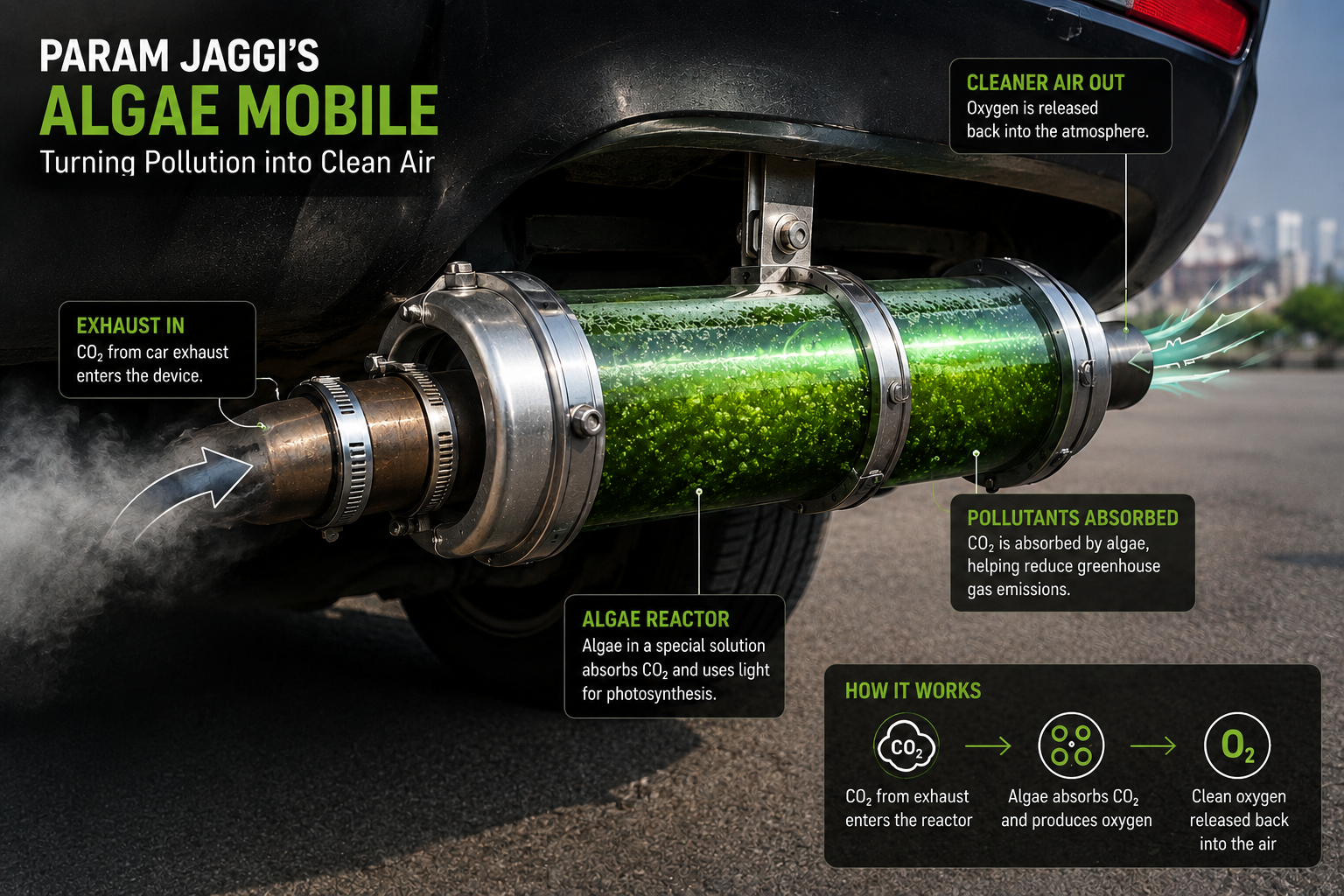
An illustration of Param Jaggi’s Algae Mobile concept, showing an algae-filled reactor connected to a car’s exhaust system to process carbon dioxide through photosynthesis. Image Credits: Wikimedia Commons.
From science-fair project to national recognitionAccording to the US Environmental Protection Agency, Jaggi’s Algae-Mobile 3 received the 2011 Patrick H. Hurd Sustainability Award at the Intel International Science and Engineering Fair. The award provided $2,000 for Jaggi and $2,000 for a chaperone to attend the EPA’s P3 student design competition in Washington, DC. The EPA also noted that more than 1,500 students from around the world took part in the science fair.The Algae Mobile showed how a simple observation could develop into an environmental engineering project. After learning to drive, Jaggi began thinking about the exhaust released by cars and whether biological processes could be used to address some of those emissions. What started as a question led to years of experimentation, eventually resulting in a patent, recognition at science competitions and the EPA’s sustainability award.