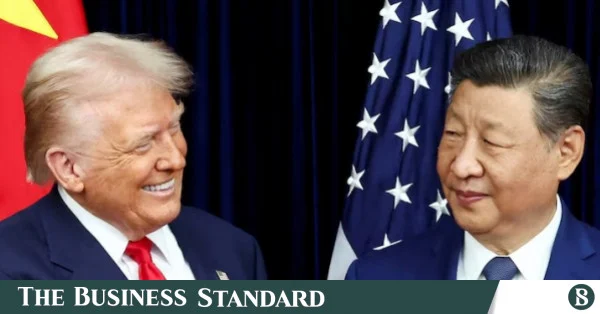
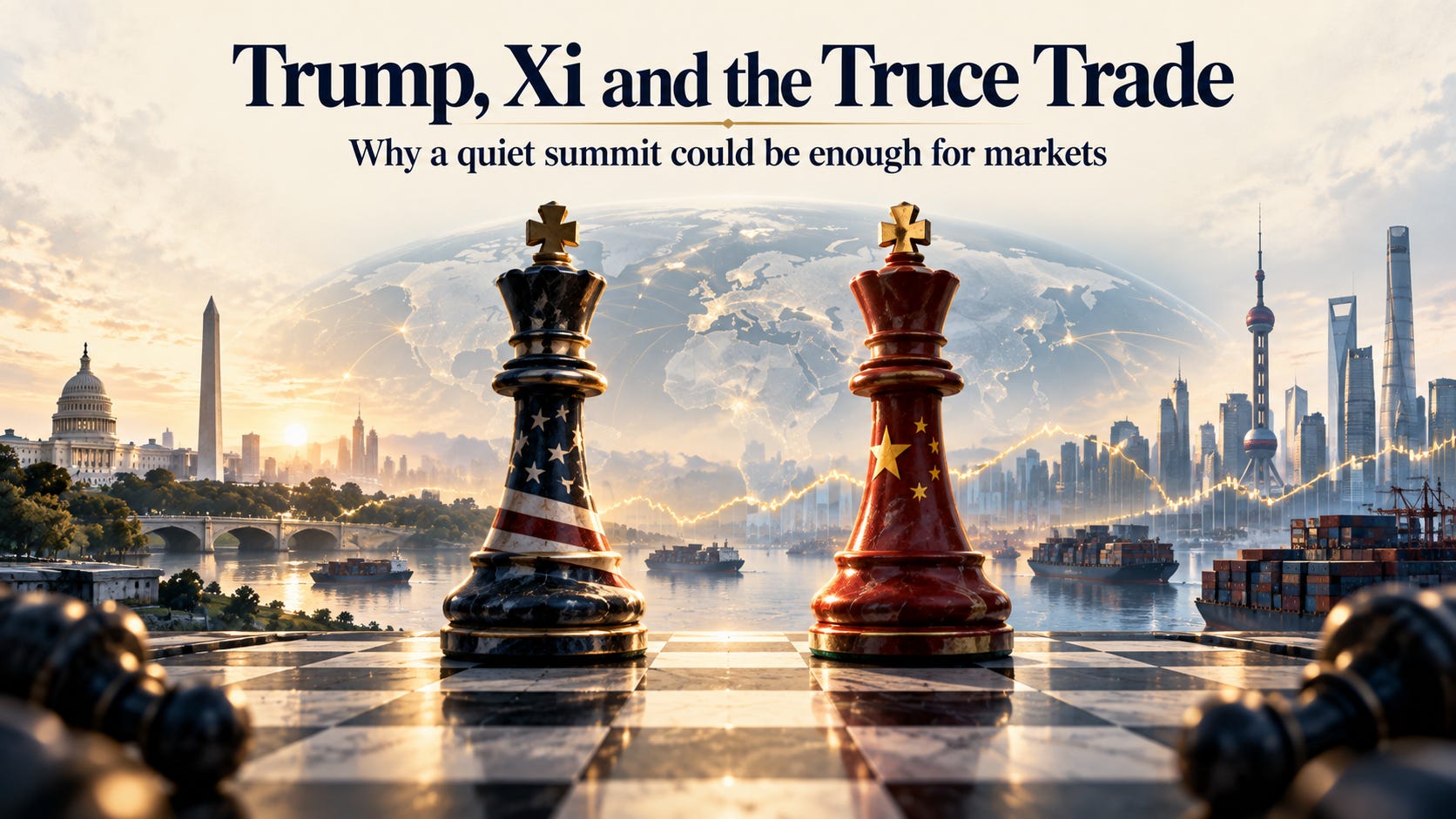
Deutsche Bank sees little prospect of a grand US-China bargain when Donald Trump and Xi Jinping meet in Washington on September 24. But that may miss the market point entirely. The realistic prize is a tactical truce that keeps the strategic rivalry contained, pushes the next economic collision further down the road and extends top-level stability into 2027.
Takeaways by Dark Side of the Boom™
-
Deutsche Bank expects positive optics but limited deliverables from the September 24 Trump-Xi summit, with tactical stability rather than structural reconciliation the realistic outcome.
-
The November US midterms may increase the administration’s incentive to secure narrower economic agreements around trade, agriculture and investment, although national security concerns continue to limit the scope for a broader bargain.
-
Trade restrictions and the technology contest remain firmly alive beneath the diplomatic surface, particularly around AI, Chinese supply chains and export controls.
-
For markets, the more important question may be whether Washington and Beijing can keep competition inside guardrails long enough to extend the current truce into 2027.
Markets have an old habit of demanding fireworks from summits when sometimes the most bullish outcome is simply that nobody lights the fuse.
That is essentially the message running through Miha Hribernik’s latest work from the Deutsche Bank Research Institute ahead of the September 24 meeting between President Donald Trump and President Xi Jinping in Washington. Deutsche Bank’s base case is not a breakthrough summit packed with sweeping agreements. It is a meeting heavy on optics, lighter on deliverables and ultimately useful precisely because expectations for a grand bargain should remain low. In DB’s formulation, a successful tactical summit within a much larger strategic competition could extend top-level stability into the first half of 2027 while reducing near-term risks of decoupling, another trade escalation, or a security confrontation.
That distinction matters.
Markets are tempted to treat US-China relations as a switch that flips between cooperation and confrontation. The reality looks much more like a dimmer. The rivalry remains. Technology restrictions remain. Supply chain pressure remains. Taiwan remains. Trade disputes remain. But the intensity can still be turned down enough to stop every political disagreement from immediately becoming a market event.
Reuters reporting ahead of the meeting similarly points to trade, artificial intelligence, rare earths, Taiwan and Iran among the subjects expected to feature, while expectations for a sweeping new economic settlement remain restrained.
The market therefore does not necessarily need a love story. It needs the divorce lawyers to stay out of the room.
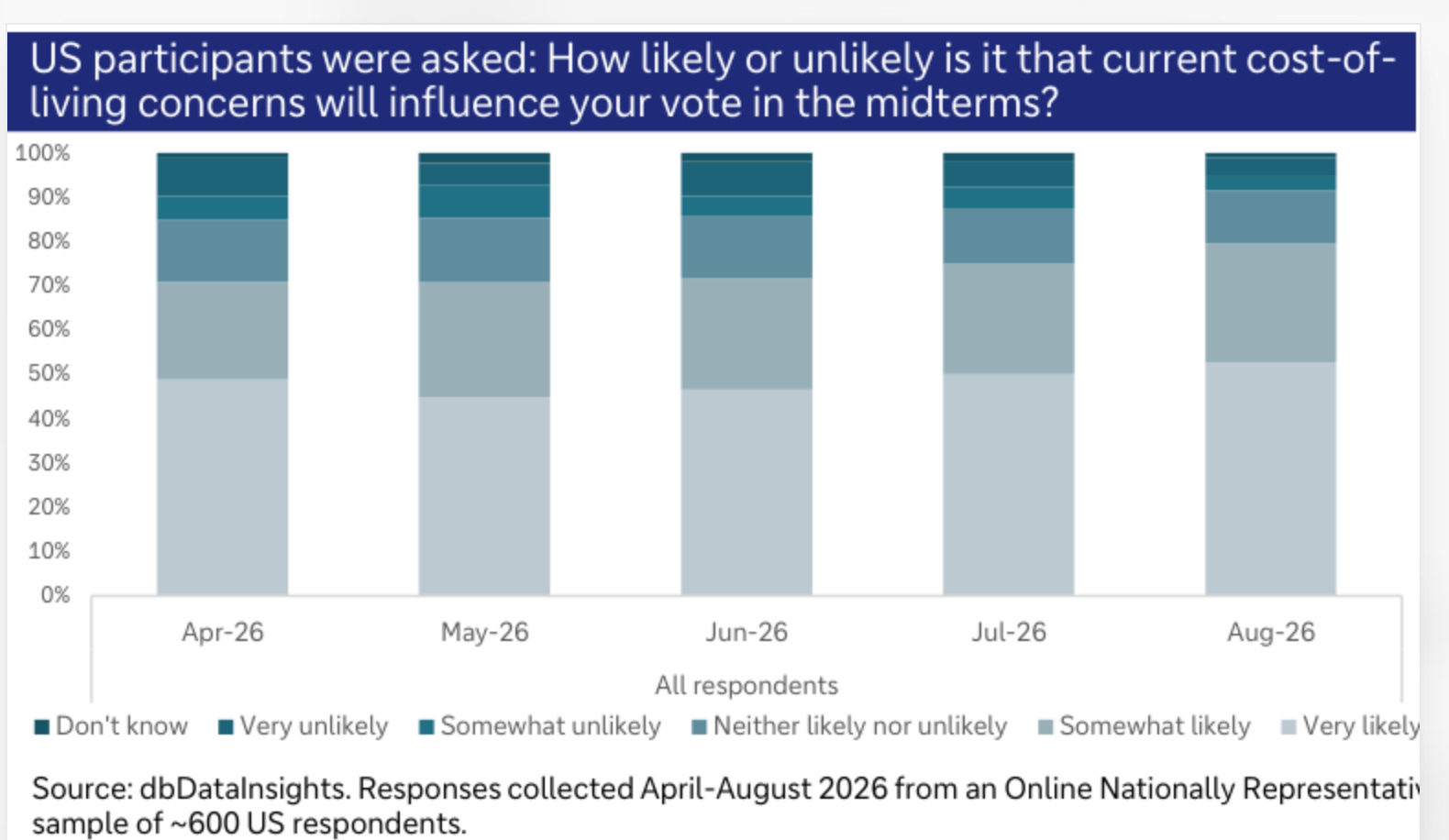
Deutsche Bank thinks domestic US politics may help produce exactly that kind of tactical pragmatism. The November 3 midterms are approaching with cost-of-living concerns elevated, and DB argues this could incentivize the Trump administration to secure visible but limited agreements. Possibilities include progress on a Board of Trade for less sensitive goods, additional Chinese agricultural purchases, targeted investment agreements and an extension of the 2025 Busan arrangements that delayed a series of mutual economic restrictions until November. DB expects that extension to be likely even if it is not formally delivered at the September summit itself.
The political interpretation belongs to Deutsche Bank, but the market mechanism is straightforward. When households are sensitive to prices, policymakers have less incentive to casually add another layer of tariffs or supply disruption to the inflation basket.
That is why the survey sitting beside DB’s argument is useful. It shows cost-of-living considerations remain an important factor for US respondents as the midterms approach. This is not an election forecast, and it does not tell us how people will vote. It tells us why the economic optics surrounding the summit matter.
The obvious trap would be to extrapolate that incentive into expectations for a major geopolitical reset.
Deutsche Bank does not.
Economic and national security considerations still put a hard ceiling on how far either side can travel. DB is cautious about a broad Board of Investment or sweeping bilateral investment framework despite the expected presence of a Chinese corporate delegation. Even areas that appear commercially straightforward can quickly run into political and regulatory barriers once they touch strategic industries, supply chains or national security.
That leaves this summit with two different clocks running simultaneously.
The short clock is tactical. Can Trump and Xi keep relations stable, extend existing arrangements, and find a handful of deliverables that let both governments walk away claiming progress?
The longer clock is structural. Can either side actually reverse the economic and technological separation that has been building for years?
On that second question, Deutsche Bank remains far more cautious.
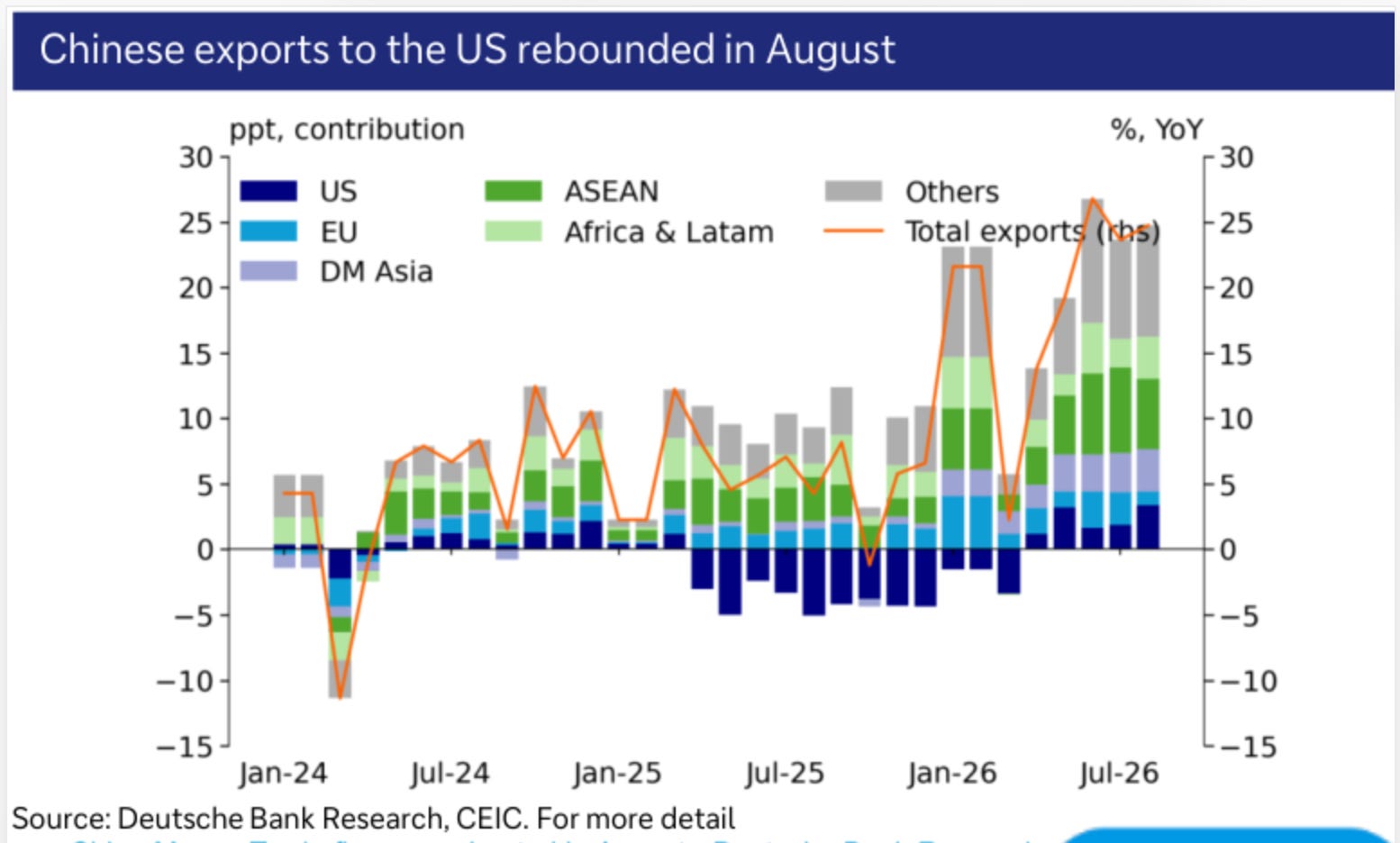
Trade is still unresolved. Chinese exports have rebounded, while Washington continues to consider measures aimed at overcapacity, transshipment, and Chinese inputs moving through North American supply chains. DB argues that even if a Board of Trade removes pressure from some less sensitive goods, the larger contest over production, market access and strategic dependency is unlikely to disappear.
The chart below the report makes the tension visible. Chinese exports have accelerated again, with the US once more contributing positively to the flow. That is economically constructive on one level, but politically it also means the trade imbalance debate has fresh oxygen.
This is where the summit begins to resemble a pressure valve rather than a peace treaty.
Trade between the two economies can recover even while Washington tries to reduce strategic dependencies. Tariffs can be softened in one corner while new restrictions appear in another. Companies can regain commercial access while governments tighten the fence around strategically sensitive technologies.
That contradiction is not a flaw in the current US-China relationship. It increasingly is the relationship.
Nowhere is that clearer than AI.
Deutsche Bank argues that the AI race is moving too quickly for summit diplomacy to meaningfully slow it. The two sides may find room to discuss obvious common interests, particularly misuse by non-state actors, but DB sees little prospect that high-level talks will reverse the broader escalation in the technological competition or unwind the restrictions already surrounding advanced technology.
That is probably the line markets should draw most carefully.
A large difference exists between agreeing that nobody wants an AI accident and agreeing to stop competing for technological supremacy.
The first is diplomacy.
The second would require rewriting the strategic map.
Current reporting supports the idea that AI will be part of the summit agenda, including potential discussion of safeguards and misuse, but little indicates that either government is preparing to abandon the broader technology competition.
Geopolitics creates the same ceiling. Deutsche Bank expects Iran and Taiwan to feature prominently but sees significant policy breakthroughs on either issue as unlikely. Its specific watchpoint is whether President Trump continues to use the timing of arms sales to Taiwan as part of negotiations with Beijing.
The useful market framework is therefore not rapprochement versus confrontation.
It is managed competition versus unmanaged competition.
That sounds like semantics until you remember what markets actually trade. They trade the distance between expectations and outcomes. If investors arrive expecting another grand bargain, a summit dominated by ceremony and carefully worded communiqués will disappoint. If investors arrive understanding that the structural rivalry is not going anywhere, simply keeping the temperature from rising can carry real value.
September 24 is not the finish line anyway. It is the opening marker in a busy fourth quarter.
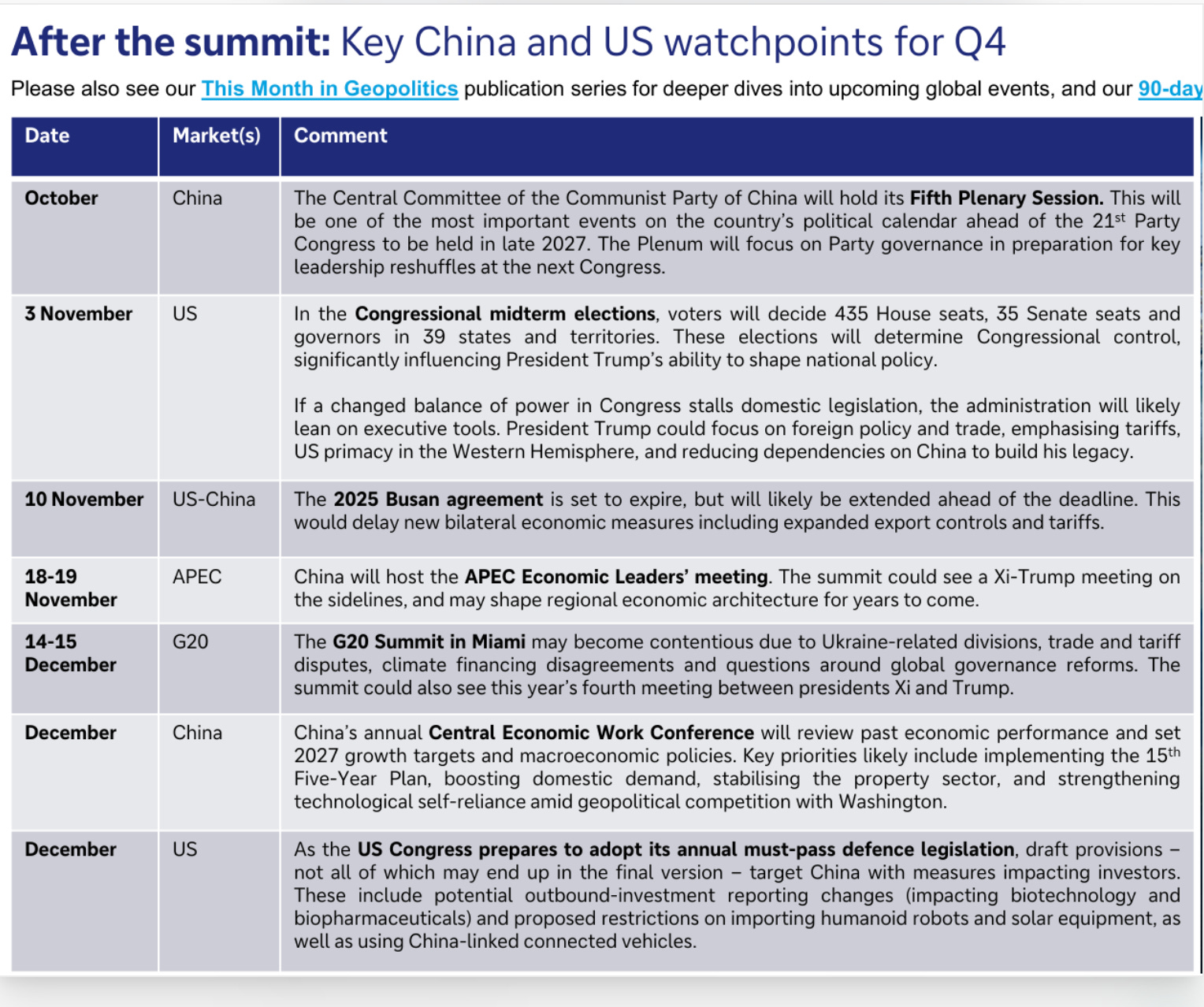
That calendar is probably more important than any single handshake next Wednesday.
A September truce does not remove the November deadline. An extension in November does not settle the AI race. A successful APEC meeting does not eliminate congressional pressure. And a warm photo in Washington does not change the fact that both countries increasingly view technology, supply chains and industrial capacity through a national security lens.
But markets rarely need every problem solved at once.
They need the next cliff moved far enough away that investors can stop staring over the edge.
That is why Deutsche Bank’s description of a quiet summit as a potential market positive is more interesting than it first appears. The bar for success is not a new era of US-China cooperation. It is avoiding a fresh deterioration while creating enough smaller economic deliverables to keep the relationship moving sideways rather than downward.
The trade war can remain unresolved.
The AI race can continue.
Strategic competition can remain firmly in place.
And markets can still breathe easier if Trump and Xi leave Washington having agreed, explicitly or otherwise, that neither side currently benefits from kicking the table over.
Sometimes the biggest geopolitical trade is not the breakthrough.
It is buying another six months before anyone needs one.