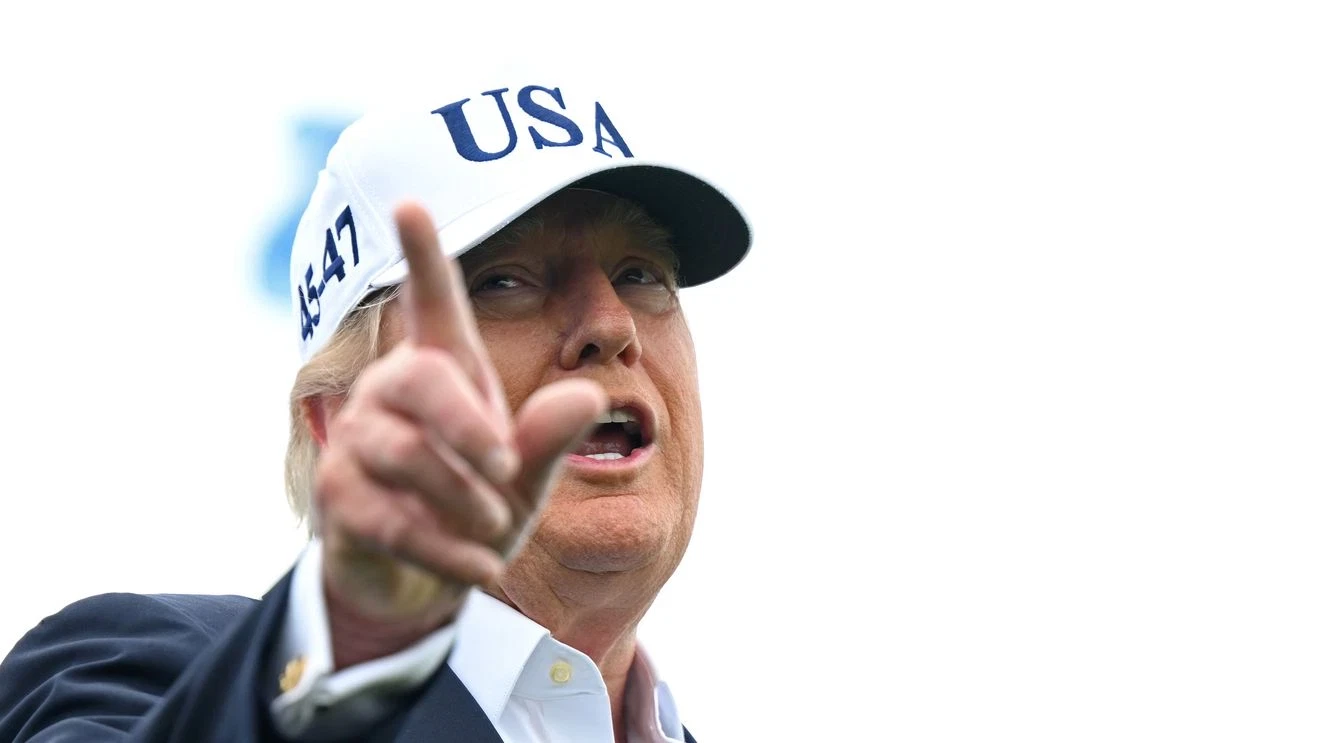
IRELAND (TNND) — U.S. President Donald Trump is set to watch the closing round of the Irish Open on Sunday alongside former First Minister of Northern Ireland and family friend Ian Paisley. The Taoiseach, the Irish Prime Minister, Micheál Martin, will also be in Trump’s tent on Sunday, with both leaders expressing that they will focus on golf.
Trump created waves in Irish politics after expressing his support for an Irish reunification, touching upon a sensitive subject bound to be asked by the media on Sunday.
Paisley appeared to downplay the president’s opinions on Irish unity on Saturday, saying, “everyone was entitled to a personal opinion even if it’s wrong.”
Prior to his comments on Saturday, Trump had avoided questions surrounding the sensitive topic in the past. Trump has mentioned a “merger” in past comments, but stopped shy of expressing his personal opinions on the complicated situation.
However, on Saturday, Trump, sitting alongside the taoiseach, predicted that a united Ireland will happen and he will “love to see it”. Trump also left the impression that he has discussed the topic of Irish unity with President Connolly and the taoiseach during their meetings.
British Prime Minister Andy Burnham expressed that his position on Irish unification remains unchanged, a spokesperson for his office said on Saturday, following Trump’s comments.
Responding to questions in parliament on Wednesday about a possible border poll in Northern Ireland, Burnham said: “I am not aware that there is majority public support for another referendum, and until that changes, there will not be one.”
The Republic of Ireland and Northern Ireland have remained partitioned since May 3, 1921, splitting the country into two self-governing political entities. The partitioning, which was intended as a temporary solution in the face of unrest, violence, and rebellion, is still in effect over a century later.
The island was deeply split between majority Catholic nationalists who wanted independence from British rule, and predominantly Protestant unionists in the northeast who wished to remain in the United Kingdom. To ease tensions and implement Home Rule, which would allow each to practice local self-governance, the British government created two separate territories, each with its own parliament.
Since the partition was implemented, all conversations surrounding any reunification prospects between the two regions have been met with heavy resistance.