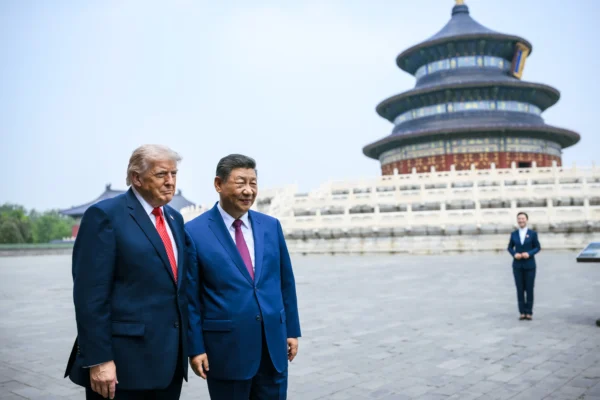
When U.S. President Donald Trump made his second state visit to China in May 2026, Xi Jinping escorted him through Beijing’s magisterial Temple of Heaven, where the Ming and Qing emperors performed rites that mediated between heaven and the earthly order. But when these two men with autocratic impulses and outsized egos strolled through the complex, it became not a Temple of Heaven but a Temple of Thymos – a stage for distributing recognition rather than cosmic concerns. Now, the neoclassical architecture of the White House provides the set for their September 23–25 encounter.
Readers of The Diplomat can find in it many articles on the “Thucydides Trap” popularized by the political scientist Graham Allison. The Thucydides Trap suggests that China and the United States are headed for inevitable conflict. Several scholars dispute Allison’s reading, and yet the ancient historian’s ghost still hovered as Xi and Trump moved through the temple, with the Chinese Communist Party’s general secretary, who has a pattern of citing Allison, even referencing the phrase.
I want to propose a lens for power rivalry that’s equally ancient but different and complementary: a Thymos Trap.
Thymos – also rendered thumos – is an ancient Greek word (θυμός) that expresses the desire for recognition. Both Xi and Trump display an unquenchable thymos and take pains to appear outwardly strong. But in fact, countries led by strongmen who build regimes around their personalities are only outwardly magnificent. Internally, they tend to be precarious. Anyone who assumes that the superficial strength of such regimes and leaders makes them permanently durable may be falling into a Thymos Trap.
As popularized by the political philosopher Francis Fukuyama, thymos is “the part of the soul that craves recognition of dignity.” It’s innate to all of us and not a marker of damaged, narcissistic men. But Fukuyama makes distinctions between isothymia (recognition as equal) and megalothymia (recognition as superior). The genius of liberal democracy is that it satisfies the human need for isothymia. But megalothymia can never be extinguished, because its fossil fuel is the trauma of prior humiliation, now powering a yearning for reversal. Nationalism can transfer that dynamic from individual to nation: Xi wears it on his sleeve as China’s “century of humiliation,” ensuing “hurt feelings of the Chinese people,” and his Chinese Dream of rejuvenation. Trump emblazons it on his “Make America Great Again” baseball caps.
This desire for status, as the journalist Will Storr explained in “The Status Game,” is pursued through dominance, virtue, or success. These differing tactics can depend on the cultures in which status-seeking individuals operate.
According to political philosopher Ye Xue, in the United States, where status is relative and must be defended, the cultural tendency is to pursue self-esteem through demands for honor. China, by contrast, is rooted in a stable hierarchy in which status is relational and harmony is sought. Trump and Xi represent these different cultural approaches to recognition perfectly; Trump’s is deeply individualistic and even antagonistic, while Xi’s is more concerned with a collective megalothymia that demands deference to China as a whole.
For all their differences, Xi and Trump share a common insistence on staking their own legitimacy on the nation’s self-esteem, updating French King Louis XIV’s apocryphal line, l’État, c’est moi (“I am the State”). But they do differ in noteworthy ways. Per Ye Xue’s research, Trump demands conspicuous displays of deference to him as an individual, while Xi is more concerned with displays of “face” – something he has fused with gestures toward China as a whole. In that way, Xi is a quintessentially Chinese statesman, in being tactful, understated, and formal.
Canadian Prime Minister Mark Carney reflected after a January 2026 meeting with Xi how the general secretary had said something to him to the effect of “don’t lecture me in public.” Xi wasn’t averse to hearing complaints, Carney implied, but to be seen being criticized was an unacceptable loss of face.
The U.S. president, meanwhile, has a grammar that is distinctly American. The historian Walter Russell Mead identified Trump as following in the line of President Andrew Jackson’s heirs: populist, informal, and quick to respond to insults. Trump must win visibly while Xi must not lose face. They are reflective of their different cultural traditions but are variations on the same substance. And they suffer from the same paradox of outward strength and inward fragility.
Despite the cultural variations, megalothymia is a perennial human temptation, which is why institutional safeguards are needed to prevent the emergence of strongmen. Liberal democracies have flourished through centuries by erecting exactly those guardrails. “Ambition must be made to counteract ambition,” wrote James Madison in “The Federalist Papers.”
The particulars vary, but the strongman style has clear commonalities. As the columnist Gideon Rachman outlined in “The Age of the Strongman,” it is defined by four overlapping traits: a cult of personality, contempt for the rule of law, populism, and a politics of fear and nationalism. The style runs along a continuum, ranging from unchallenged autocrats like Xi and North Korea’s Kim Jong Un through strongmen in hybrid regimes – think Russia’s Vladimir Putin – to wannabe dictators operating in democratic systems, such as Trump.
The insatiable need for recognition is the engine of these men who pretend to be (and perhaps wish to be) truly larger than life. But every actor needs a stage. And for strongmen, the summit provides that. All summits are manufactured encounters where protocol and positioning become deeply important displays of honor for both states and their statesmen. Particularly in China, a summit is as closely choreographed as a Broadway play or Peking opera. That’s why in May Trump’s effusive rhetoric – and Xi’s comparatively aloof demeanor – was so significant. The U.S. president described his counterpart as his “good friend” and “a man I admire greatly.” He even waxed poetic about receiving “the most beautiful roses anyone has ever seen.” It was a perfect example of political scientist Todd Hall’s research showing how affective ties – love, affection, attachment, and devotion – shape, constrain and manipulate leaders. China’s officials likely aimed to induce warm feelings from Trump through the summit’s flattery, and they succeeded.
Xi’s language didn’t approach Trump’s rhapsodizing. He did, however, oversee the lengthy Chinese readout of the meeting, which consisted of a new four-pillar framework of stability – what the Communist Party calls a tifa – centered on Taiwan. The White House readout, by contrast, was just one paragraph. That’s because, for the CCP, a summit that shows the U.S. president as an equal (or lesser) statesman is a crucial moment in a legitimating narrative of how it is returning China to greatness. That story is bolstered when a powerful foreign leader who is desperate for a sense of superiority feels flattered by the pageantry.
What kind of man is most susceptible to this theater, and most addicted to building one? Without direct clinical psychoanalysis, it would be inappropriate to presume any formal diagnosis. But there are psychological constructs that offer an interpretive framing for leaders who spend a lot of time in the public arena. The Dark Triad, fashioned by psychologists Delroy L. Paulhus and Kevin M. Williams, suggests that a combination of Machiavellianism, narcissism and psychopathy forms a unique personality construct. Psychologists have observed that Trump and Xi align well with these traits in some respects.
Long before he ran for the presidency, Trump gave a revealing interview in Playboy magazine in 1990, where he praised China’s leaders for their “strength” in crushing the previous year’s Tiananmen Square protests and conversely called Soviet leader Mikhail Gorbachev “weak” for his restraint. Similarly, analysts Ursula and Dennis Wilder have noted Xi’s “iron Machiavellian detachment.” Climbing to the apex of the Chinese Communist Party requires calculated ruthlessness. To be sure, this tidy mapping is a metaphor, not a psychological finding. But it pinpoints something very real.
These traits really become a lasting problem – a structural issue – once a man fuses himself with a state and a regime stakes its legitimacy on his recognition. That’s because, ironically, the institutionalization of megalothymia is what makes it particularly vulnerable. Eventually, the leaders of all personalist regimes tend to fall prey to the fatal sins of isolating themselves, suppressing bad news, overreaching, and overly centralizing decision-making. The very ego that builds the regime is precisely what hollows it out. The insatiable lust for status that represses critics makes critical feedback impossible. This is the Thymos Trap.
Internationally, it’s equally fragile, because when a regime stakes its legitimacy on delivering ever-more recognition to a lone individual, then foreign humiliation becomes a domestic survival threat. The insistence on recognition is not a personality footnote but essential to national identity, requiring displays of deference. In “The Red Emperor,” Michael Sheridan related an anecdote from 2011: Xi told a visiting U.S. Vice President Joe Biden the lesson he’d drawn from history was that China must never make concessions. But compromises, power-sharing, and diffused power centers are inherent to the nature of the modern state system, which means such perceived humiliations are inevitable.
As political scientist Milan W. Svolik has observed, most deposed dictators fall not to mass uprisings but to regime insiders who scent weakness or failure in their nation’s leader – precisely the type of thing that occurs when an ostensibly indestructible leader faces some sort of defeat abroad. As a keen reader of Josef Stalin, Xi’s response has been a ceaseless struggle against what John Garnaut memorably called the “calcification and putrefaction that inevitably corrodes and degrades every dictatorship.” The perpetual purges that have engulfed China’s military in the past few years illustrate not Xi’s strength but the regime’s brittleness; a succession crisis becomes far more possible and serious when competent rivals are absent.
The Thymos Trap is a tendency, not a forecast; a pattern, not a promise. For all that men like Trump, Xi, and Putin follow a script laid down by dictators and would-be dictators before them, each is an actor playing unique parts. Xi’s face-saving culture and lack of electoral cycles enable him to be more patient in service of delayed gains than Trump. Perhaps that explains the type of off-ramps Beijing has taken during trade disputes with Washington.
A trend like the Thymos Trap operates over the long term, and some caveats should be acknowledged. The serious disarray in what used to be called the Western alliance means that autocratic systems in China and Russia look more harmonious and even attractive to some doomsayers than liberal democracies. After the meeting in May between Xi and Trump, the headline on a Hal Brands column lamented that “Xi sets the terms for everyone now.”
The best understandings of the thymotic leaders recognize their recurring, ongoing appeal. The historian Stephen Kotkin, in a Foreign Affairs article aptly titled “The Weakness of the Strongmen,” recognized that such regimes “last far longer than generally anticipated” even as they “remain prone to sudden runs on their political banks.”
Another caveat in the Thymos Trap is that not all strongmen perfectly fit the mold. For all his predilections toward amassing power and ego, Trump is operating in a country with a rich democratic tradition. The United States Constitution has so many built-in checks and balances that most presidents have been frustrated by their inability to bend the country to their will. The U.S. has a vibrant civil society and a powerful opposition party. All of that constrains Trump’s Thymotic urges.
He has “autocrat envy,” as Fiona Hill, one of his former National Security Council officials, put it: praising all sorts of dictators and strongmen while insulting democratic leaders for their adherence to liberal democratic norms. But his palpable desire for the powers of autocrats is precisely what indicates that Trump cannot be one of them, much as he might want to be. Xi can be satisfied with modest gestures of face precisely because he actually is in the position that Trump wishes he was, with near-absolute control over the population over which he rules. Conversely, “Trump would love to have the situation that Viktor Orban has, but he doesn’t,” as his former ambassador to Hungary put it – not long before fed-up Hungarians decisively ejected that deeply thymotic and illiberal prime minister from office.
When Trump was escorted by Xi through the Temple of Heaven in May 2026, it is fair to assume that the U.S. president didn’t know the history of the structure before his host extolled it. But there was irony for Xi, too. According to Chinese cosmology, the emperor performed the Temple of Heaven rites because the Mandate of Heaven could be withdrawn. Magnificence and precarity are always linked in this tradition. So it is in reality. As Rachman put it, strongman rule is “an inherently flawed and unstable form of government” that “will ultimately collapse.” But he hastened to add, “there may be a lot of turmoil and suffering” before that happens.
The Communist Party leader radiates the confidence and gravitas of a man who appears to have mastered his thymos. But the Thymos Trap ensnares leaders because the fragility it engenders is structural, not peculiar to their individual pathology. Their regimes have the same architectural drawbacks, regardless of their national flavors. The same impulses that propel a one-man cult become the forces that bedevil it. The trap is that strongmen must keep appearing strong – and whether their opiate of choice is honor or face, the performance eventually consumes the substance. The counter-model to the thymos-doomed leader would be Marcus Aurelius, the Roman Emperor who interrogated his own status-hunger by wielding near-absolute power with a brake on it in the form of Stoicism. Xi styles himself as this sort of contemplative, omnipotent philosopher-king, and yet his heavily propagandized “Xi Jinping Thought” is most likely the ghost-written output of a CCP committee. Marcus is the inversion, the vanishingly rare leader who distrusts and even resists his own urges for recognition, challenging his own thymos in a private notebook. Leaders like that are few and far between, a tragic reality that only highlights the ever-present danger of the Thymos Trap.