Greater Manchester’s town halls are becoming increasingly dominated by men — and some politicians fear abuse, intimidation and sexism are driving women out of public life. Women remain heavily underrepresented on Greater Manchester’s councils, with fewer female councillors elected in this year’s local elections
Analysis by the Manchester Evening News revealed that men made up around 71 percent (152) of the 214 councillors, while women accounted for just 29 percent (62).
This marks a sharp drop from just two years ago, when there was a 60-40 split between male and female councillors elected. In 2021, 44 percent of councillors elected were female.
These findings have led some to raise “alarm bells”, and call for more to be done to encourage women in politics, while tackling the abuse some of them face.
Oldham saw the lowest proportion of women elected this year, at just five percent – down from 40 percent in 2024. This was followed by Salford and Rochdale, where 20 percent of elected candidates were women – down from 50 percent and 25 percent respectively in 2024.
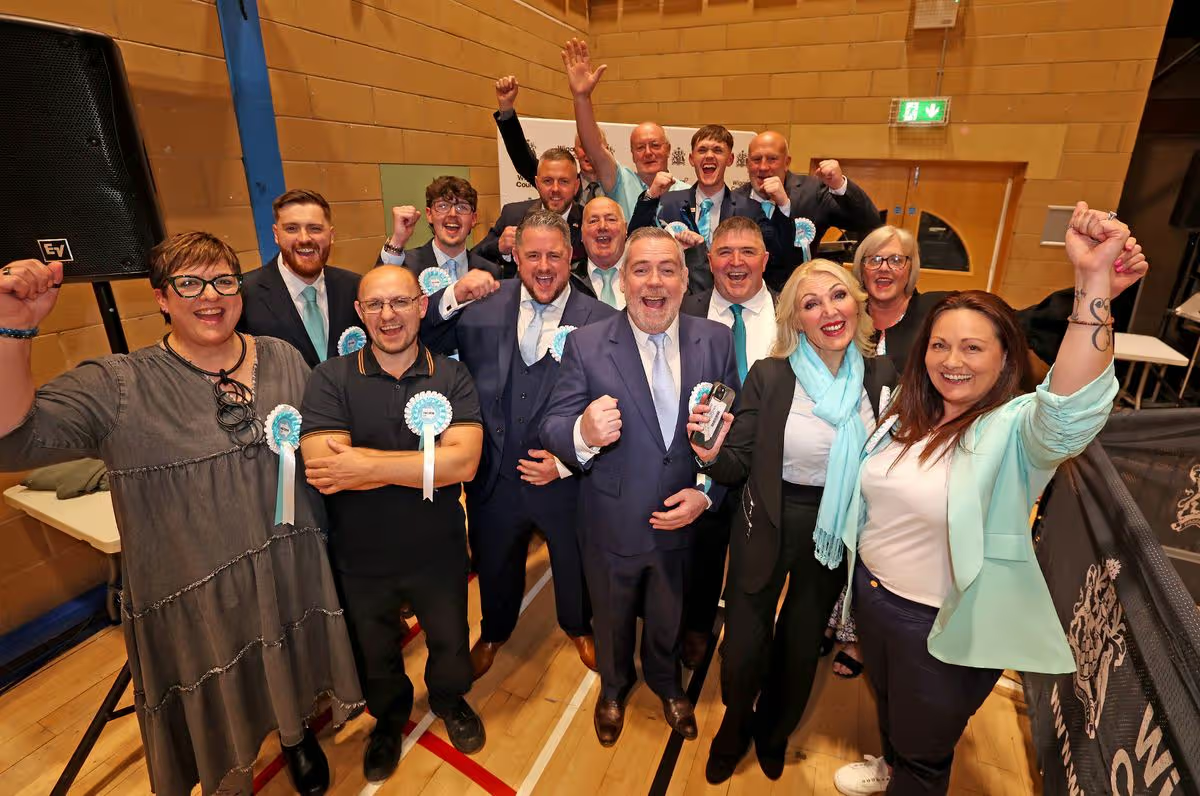
Only Stockport and Trafford had better female representation, at 57 percent and 43 percent respectively. The imbalance was particularly stark among Reform UK councillors following the party’s breakthrough in Greater Manchester. Of the 106 councillors elected in the region last week, just 18 are women — meaning more than four in five of the party’s new councillors are male.
The newly elected Reform councillors are collectively almost as likely to be called Paul, David or John as they are to be women.
The MEN approached Reform UK for a comment.
Labour elected 33 councillors, including 22 men and 11 women, meaning women make up roughly a third of the party’s successful candidates.
The Greens also saw women account for around a third of their elected councillors, with 10 women and 20 men elected this year.
Meanwhile, the Conservatives and small parties/independents had better representation, at 46 percent and 48 percent respectively.
The Lib Dems returned the highest proportion of female councillors among the major parties, with 58 percent being women.
Political analysts caution that election results can fluctuate, depending on which seats are being contested in a given year.
A Labour spokesperson told the MEN: “Labour North West is proud to have a strong tradition of championing women’s representation in politics and remains committed to improving gender balance at every level of public life.
“While we recognise that this year’s local election results show a lower proportion of women elected compared with 2024, it is important to note that Labour continues to return more women representatives than many other parties and remains firmly committed to increasing female participation in politics.”
Female representation across all 10 councils peaked in 2022 at 42 percent. Since then, there has been a gradual decline, with a significant drop to 35 percent in 2026, the lowest point in the seven-year period.
Dr Sarah Longlands, chief executive of the Centre for Local Economies think tank (CLES), said: “The MEN’s analysis should ring alarm bells across Greater Manchester. When local leaders don’t reflect the local population, and when women are excluded from decision making, then both our democracy and economy suffer.”
The disparities are marked when looking at the overall makeup of each council. Manchester City Council currently has the highest female representation, with women making up around 43 percent of councillors, followed by Trafford at 40 percent. But other boroughs remain far more male-dominated.
Oldham has one of the lowest gender representations – 27 percent are women – while Tameside sits at around 35 percent.
In Bury, women account for around 37 percent of councillors, while in Salford the figure is 30 percent. Rochdale stands at 32 percent, with Wigan also around 32 percent. Bolton recorded around 36 percent female representation.
Women in local government leadership positions have also historically been underrepresented
There were four female council leaders across Greater Manchester until Elise Wilson, leader of Stockport, stepped down in 2022. Now, only three remain –These are: Bev Craig for Manchester City; Eleanor Wills for Tameside and Arooj Shah of Oldham.
All three councillors have told the MEN that they have faced rising levels of abuse, which could be a contributing factor in why fewer women want to go into politics.
Coun Craig previously told the MEN that she wakes up to a thousand abusive messages on TikTok and spends her day deleting them.
“I’m resilient, but I do worry that the normalisation of abuse will put women off politics altogether,” she said at the time. “The internet has changed things, because if somebody said something abusive down the pub they’d probably get challenged, whereas online it just gets amplified.”
Coun Wills has shared screenshots with the MEN of the derogatory messages sent her way.
“I myself have had opposition members offer opinions on my parenting when carrying out my civic duties. I’ve seen my female members targeted in this vein also,” she said. “I’ve also had abuse around my appearance by members of the public and lots of questions surrounding my gender. The hostility and targeting that women face is disproportionately higher and it’s no coincidence that people don’t wish to put themselves forward and risk not only feeling unsafe personally, but also if they have children, as I do.”
Meanwhile, Coun Shah has announced that she will be stepping down from her role later this month, following Labour losing control of the town hall at this year’s elections.
The outgoing council leader has spoken candidly about the death threats she has received during her time in office. Her car was once firebombed outside her home and, earlier this year, she claimed a man at a petrol station threatened to kill her.
Ms Shah believes the abuse directed towards her is motivated by ‘misogyny and racism’. She described being denigrated as ‘Madame leader’ – a reference to women who run brothels – and regularly encountering sexist abuse both online and in person.
This, she suggested, was making it increasingly difficult to recruit women into local politics.
“I know that local leaders across the country have been leaving politics because of all the abuse they’ve been getting,” coun Shah told the LDRS. “It’s really hard for us to get candidates, especially women. Women have been massively put off – in Oldham specifically. We’ve struggled to get women on the panel. We’ve got less than a handful. I’ve proactively contacted women to see if they’d be interested and they’ve told me ‘no, we see what you go for, we don’t want that for us’.”
Emily Mort, Labour councillor for Tonge with the Haulgh ward in Bolton, said she was concerned about the “division, anger and hatred” that she is witnessing.
She posted on Facebook: “People have every right to disagree. They have every right to campaign, challenge decisions, ask questions and hold elected representatives to account.
But abuse, intimidation, misinformation and targeted hatred are not democracy. They lower the tone of public life, damage trust, and undermine the seriousness of elected office.
What worries me most is how normal this has started to feel. Behaviour that would never be acceptable face to face is being allowed to spread unchecked online, and in some cases it appears to cross serious lines around electoral conduct.”
The threats are not confined to local councillors.
In March, newly elected Gorton & Denton MP Hannah Spencer had to be escorted to safety after being aggressively confronted by activists during a rally in Manchester city centre.
The incident unfolded in Piccadilly Gardens, after the Green Party MP addressed the launch of Greater Manchester’s Together Alliance, an anti‑far‑right coalition.
In footage posted online, a man runs in front of the MP and shouts “you scabby traitor,” and “you f*****g dirty traitor” at her while filming.
Stockport councillors Anna Charles-Jones and Carole McCann have reportedly faced significant harassment in the past
Coun Charles-Jones, who is a wheelchair user, said comments have been made attacking her online with a ‘misogynistic undertone’, and her home address was publicised online.
She told the Local Democracy Reporting Service at the time. “It’s affecting our work because we’re taking time dealing with this, and on a personal level it can significantly impact your mental health.”
Over in West Lancashire, the council leader is stepping down from her role, saying she has been spat at and called a traitor.
Labour councillor Yvonne Gagen, who was the first woman to lead the council, said women are now being turned-off politics because of the current ‘nasty’ public atmosphere.
The Greens also saw fluctuations in female representation over recent elections. While only a third of this year’s elected councillors were women, this was a significant improvement from 2024, when 100 percent were male. This was still a sharp drop from 2022, when 75 percent of the elected councillors were female.
“It is very frustrating that in 2026 we are still not getting balanced representation,” said Geraldine Coggins, leader of the Green Party on Trafford Council. “We need to look at this issue intersectionally and try and get a balance of people who represent the population of Trafford more broadly. We in the Green Party are very aware we need to do better on this.”
Coun Coggins also cited factors such as the gender pay gap, stating that people with lower incomes may struggle with their council workload without cutting their hours at work.
“Council allowances vary quite a lot around Greater Manchester so in some places it may be very difficult for people with lower incomes to manage the workload without cutting their hours at work,” she said. “There is also no formal maternity leave for councillors.”
Stockport Labour group leader, Coun Rachel Wise, agreed with the sentiment, adding: “Women still undertake significantly more unpaid caring responsibilities, and while councils such as Stockport offer childcare reimbursement, there can be a fear that this itself becomes politicised,” she told the MEN. “At current allowance levels, it is also difficult to imagine how a single parent with school-aged children could realistically afford to become a councillor.”
Dr Longlands, from CLES, is urging political parties to do more to support their female candidates.
“We urgently need a culture change to make local politics less hostile to women,” she said.
(additional reporting by Charlotte Hall, Declan Carey, Hannah Richardson and George Lythgoe)