
Key Points
The debut of Space Exploration Technologies (NASDAQ: SPCX) on the Nasdaq has been nothing short of eventful. While SpaceX stock opened at $150 on its initial public offering (IPO) day, shares quickly surged as high as 50% in the days that followed. This impressive run reflects strong investor enthusiasm for SpaceX’s pioneering work across reusable rocketry, low-orbit satellites, and artificial intelligence (AI) infrastructure.
However, SpaceX’s rally came to a modest halt on June 17, with shares declining roughly 3% as of midday trading. This is the first such dip since last week’s offering. The sell-off prompts a closer examination of what SpaceX’s pullback signifies and how it might influence the stock’s trajectory. Notably, it also highlights patterns in other assets tied to SpaceX’s visionary leader, Elon Musk.
Where to invest $1,000 right now? Our analyst team just revealed what they believe are the 10 best stocks to buy right now, when you join Stock Advisor. See the stocks »
Image source: Getty Images.
What do stock dips reveal about investor sentiment?
The slight drop in SpaceX stock stands out not for its magnitude but because it interrupts a flawless streak of gains following the IPO. After a high-profile IPO, initial trading often features euphoric buying that propels valuations higher with each passing trading session. When these patterns break, it can signal that the market is beginning to adopt a more balanced view or that investors are securing profits after an abnormally rapid price appreciation.
For SpaceX, the sell-off could mean the initial excitement surrounding the IPO has started normalizing. A break in momentum is frequently an indicator that a stock may be entering a phase of consolidation rather than continued ascent — even if shares remain well above their opening level.
Examining the momentum characteristics of Musk-linked assets
Assets linked to Elon Musk tend to trade in a distinctly narrative-driven environment. What I mean by that is price action often hinges more on stories, media coverage, and investor sentiment as opposed to conventional financial benchmarks.
In particular, Tesla (NASDAQ: TSLA) and Dogecoin (CRYPTO: DOGE) are two assets whose prices have exhibited extreme volatility following comments or social media posts made by Musk. Taking this one step further, both Tesla stock and Dogecoin tend to witness successive days of gains reinforcing one another as buying interest builds on itself. With that said, both assets also experience periods of accelerating decline once selling pressure takes hold.
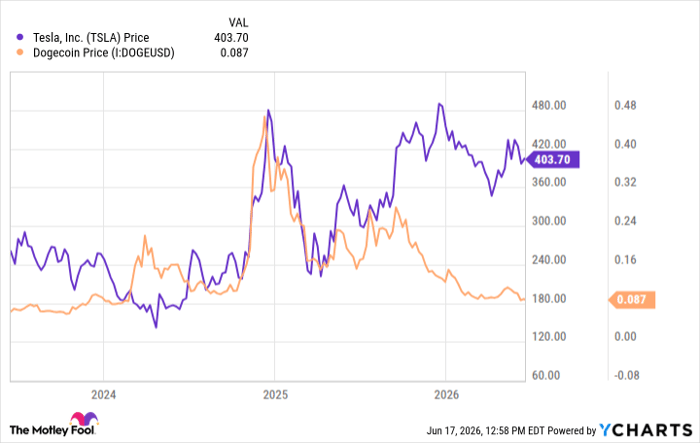
Data by YCharts.
While the sample size is clearly insignificant, SpaceX stock may already be sharing this association — rendering its price movements highly sensitive to the tone of public discourse or the latest catalyst that shapes perception.
Where is SpaceX stock headed from here?
Investors who have remained on the sidelines since the SpaceX IPO may want to treat this decline as a barometer rather than an isolated event. Given the established tendency of Musk-linked assets to follow successive momentum patterns, this dip in SpaceX stock could be the start of a reversion toward the IPO price or even lower.
Although SpaceX stock is still nearly 30% above its opening level, the break in the upward streak underscores how quickly narrative-driven stocks can correct. Investors should watch for confirmation of SpaceX’s new direction, whether through continued selling pressure or a swift rebound. Most importantly, smart investors should weigh SpaceX’s elevated volatility before committing capital.
In unpredictable environments that lack tangible positive developments, exercising patience and paying close attention to evolving storylines will prove more valuable than chasing prices on either side of the stock.
Should you buy stock in Space Exploration Technologies right now?
Before you buy stock in Space Exploration Technologies, consider this:
The Motley Fool Stock Advisor analyst team just identified what they believe are the 10 best stocks for investors to buy now… and Space Exploration Technologies wasn’t one of them. The 10 stocks that made the cut could produce monster returns in the coming years.
Consider when Netflix made this list on December 17, 2004… if you invested $1,000 at the time of our recommendation, you’d have $415,040!* Or when Nvidia made this list on April 15, 2005… if you invested $1,000 at the time of our recommendation, you’d have $1,256,076!*
Now, it’s worth noting Stock Advisor’s total average return is 923% — a market-crushing outperformance compared to 207% for the S&P 500. Don’t miss the latest top 10 list, available with Stock Advisor, and join an investing community built by individual investors for individual investors.
*Stock Advisor returns as of June 18, 2026.
Adam Spatacco has positions in Tesla. The Motley Fool has positions in and recommends Tesla. The Motley Fool has a disclosure policy.
The views and opinions expressed herein are the views and opinions of the author and do not necessarily reflect those of Nasdaq, Inc.