Key Points
-
The S&P 500 and Dow aren’t as tech-centeric as the Nasdaq Composite.
-
Alphabet has been punished for its AI spending.
-
Apple is soaring because its growth doesn’t depend on AI capital expenditures.
- 10 stocks we like better than Alphabet ›
In 2023, 2024, and 2025, the Nasdaq Composite (NASDAQINDEX: ^IXIC) outperformed the S&P 500 (SNPINDEX: ^GSPC), and both indexes outperformed the Dow Jones Industrial Average (DJINDICES: ^DJI). And until recently, the Nasdaq was outpacing the S&P 500 and Dow yet again in 2026.
But a sell-off in tech stocks has pushed the Nasdaq’s year-to-date total return (capital gains plus dividends) to 7.8%, underperforming the S&P 500’s 9% total return and the Dow’s 9.1%.
Where to invest $1,000 right now? Our analyst team just revealed what they believe are the 10 best stocks to buy right now, when you join Stock Advisor. See the stocks »
Here’s what you need to know about what’s driving the Nasdaq’s underperformance, and how it could be affecting your investment portfolio.
stock market data” src=”https://g.foolcdn.com/image/?url=https%3A%2F%2Fg.foolcdn.com%2Feditorial%2Fimages%2F880818%2Fan-abstract-image-featuring-bar-charts-overlapping-financial-and-stock-market-data.jpg&w=700″>
Image source: Getty Images.
Growth stock dominance is being tested
The Nasdaq lost around a third of its value in 2022 because of inflationary pressures and valuation concerns amid a post-pandemic recovery. But on Nov. 30, 2022, OpenAI introduced ChatGPT. And what followed was a largely artificial intelligence (AI)-driven rally in tech stocks, especially semiconductor companies.
|
Index |
2022 |
2023 |
2024 |
2025 |
2026 (as of Market Close July 27) |
|---|---|---|---|---|---|
|
Nasdaq Composite |
(32.5%) |
44.6% |
29.6% |
21.1% |
7.8% |
|
S&P 500 |
(18.1%) |
26.3% |
25% |
17.9% |
9% |
|
Dow Jones Industrial Average |
(6.9%) |
16.2% |
15% |
14.9% |
9.1% |
Data source: YCharts.
The Nasdaq is far more heavily weighted in tech stocks and tech-focused companies than the S&P 500 and the Dow, so it benefited more from AI-driven stock gains. Tech and tech-focused companies also have a heavier weighting in the S&P 500 than the Dow, although the Dow has become more representative of the modern market with the addition of several tech-focused companies — most recently Alphabet (NASDAQ: GOOG) (NASDAQ: GOOGL) in June.
Still, financials are by far the heaviest-weighted Dow sector. And the Dow has higher weightings in value-focused and cyclical sectors like industrials, healthcare, and consumer staples than the S&P 500. So when market leadership shifts from growth stocks to value stocks, like in 2022, the Dow tends to outperform the S&P 500 and Nasdaq.
Alphabet and Apple reflect current market sentiment
The Dow and S&P 500 overtaking the Nasdaq’s year-to-date return shows a shift in market leadership toward value-focused sectors. Earnings drive stock prices in the long term. But in the short term, narratives, emotion, and sentiment can play an even bigger role. Investors who maintain a long-term mindset by filtering out market noise and focusing on fundamentals are best positioned to build wealth.
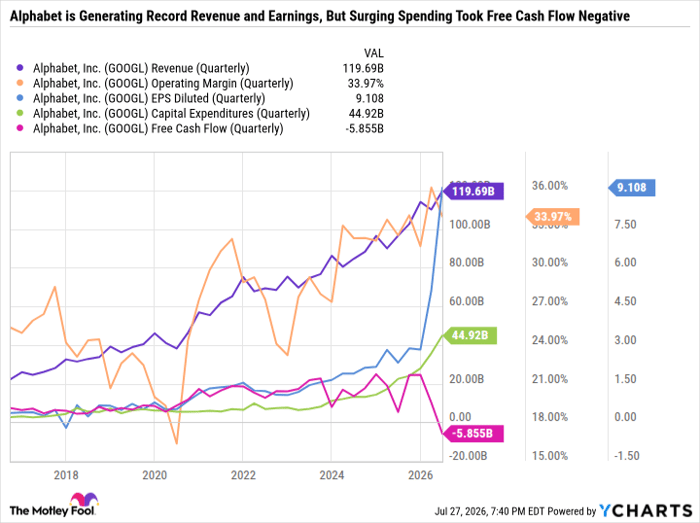
Alphabet’s earnings report from last week encapsulated current market sentiment. The results were nothing short of spectacular — record revenue, a big jump in earnings, and 34% operating margins. Despite all the positives, Alphabet sold off because of spending concerns.
GOOGL Revenue (Quarterly) data by YCharts
As you can see in the chart, Alphabet’s capital expenditures (capex) surged to $45.9 billion — driven by AI. And that increased capex caused Alphabet to report its first negative free cash flow (FCF) quarter in over a decade.
So, in just a few years, Alphabet transformed from a high-margin money-printing machine to a company that is now seeing more cash leave the business than enter it. And Alphabet shows no signs of slowing its spending, raising its full-year capex guidance in line with Amazon‘s and calling for even higher spending in 2027.
The sell-off in hyperscalers like Alphabet, Amazon, and Microsoft — and the broader pullback in semiconductor stocks — shows that some investors are growing skeptical of the return on investment of AI spending. Whereas just a couple of years ago, ramp-ups in AI spending were celebrated by Wall Street — demonstrating two contrasting reactions to the same news. Apple (NASDAQ: AAPL) shows the other side of the coin.
The narrative has totally flipped on Apple. Just last summer, Apple was in a steep sell-off as investors questioned its slowing growth and lack of AI investments. Now, investors are cheering Apple’s regimented approach to AI spending. Apple is in cat bird’s seat because it owns the devices that AI tools run on. It can simply partner with the best AI models rather than building its own. Apple is hovering around an all-time high because it is generating consistently decent growth that doesn’t depend on AI spending and still stands to benefit from AI long-term.
Buying quality companies on sale
Making informed investment decisions is easier when you know what’s driving the major indexes. But the indexes only tell part of the story. After all, Apple’s gains have benefited the Nasdaq more than the S&P 500 or the Dow, and yet the Nasdaq is still underperforming. So it’s important to look beyond the indexes for the complete picture.
Right now, the market is skeptical that AI spending will pay off — which is why Apple is trading at 38.5 times forward earnings, compared to just 16.5 for Alphabet. And to be fair, at least some of that skepticism is understandable considering it’s pretty shocking to see Alphabet’s FCF turn negative.
Investors who believe the spending will ultimately pay off are getting an excellent opportunity to scoop up shares of quality companies like Alphabet at a discount. However, it’s a mistake to assume that just because an AI stock has sold off, it’s a bargain, as many red-hot AI stocks are still priced for perfection.
Should you buy stock in Alphabet right now?
Before you buy stock in Alphabet, consider this:
The Motley Fool Stock Advisor analyst team just identified what they believe are the 10 best stocks for investors to buy now… and Alphabet wasn’t one of them. The 10 stocks that made the cut could produce monster returns in the coming years.
Consider when Netflix made this list on December 17, 2004… if you invested $1,000 at the time of our recommendation, you’d have $379,662!* Or when Nvidia made this list on April 15, 2005… if you invested $1,000 at the time of our recommendation, you’d have $1,206,116!*
Now, it’s worth noting Stock Advisor’s total average return is 886% — a market-crushing outperformance compared to 206% for the S&P 500. Don’t miss the latest top 10 list, available with Stock Advisor, and join an investing community built by individual investors for individual investors.
*Stock Advisor returns as of July 29, 2026.
Daniel Foelber has no position in any of the stocks mentioned. The Motley Fool has positions in and recommends Alphabet, Amazon, Apple, and Microsoft. The Motley Fool has a disclosure policy.
The views and opinions expressed herein are the views and opinions of the author and do not necessarily reflect those of Nasdaq, Inc.