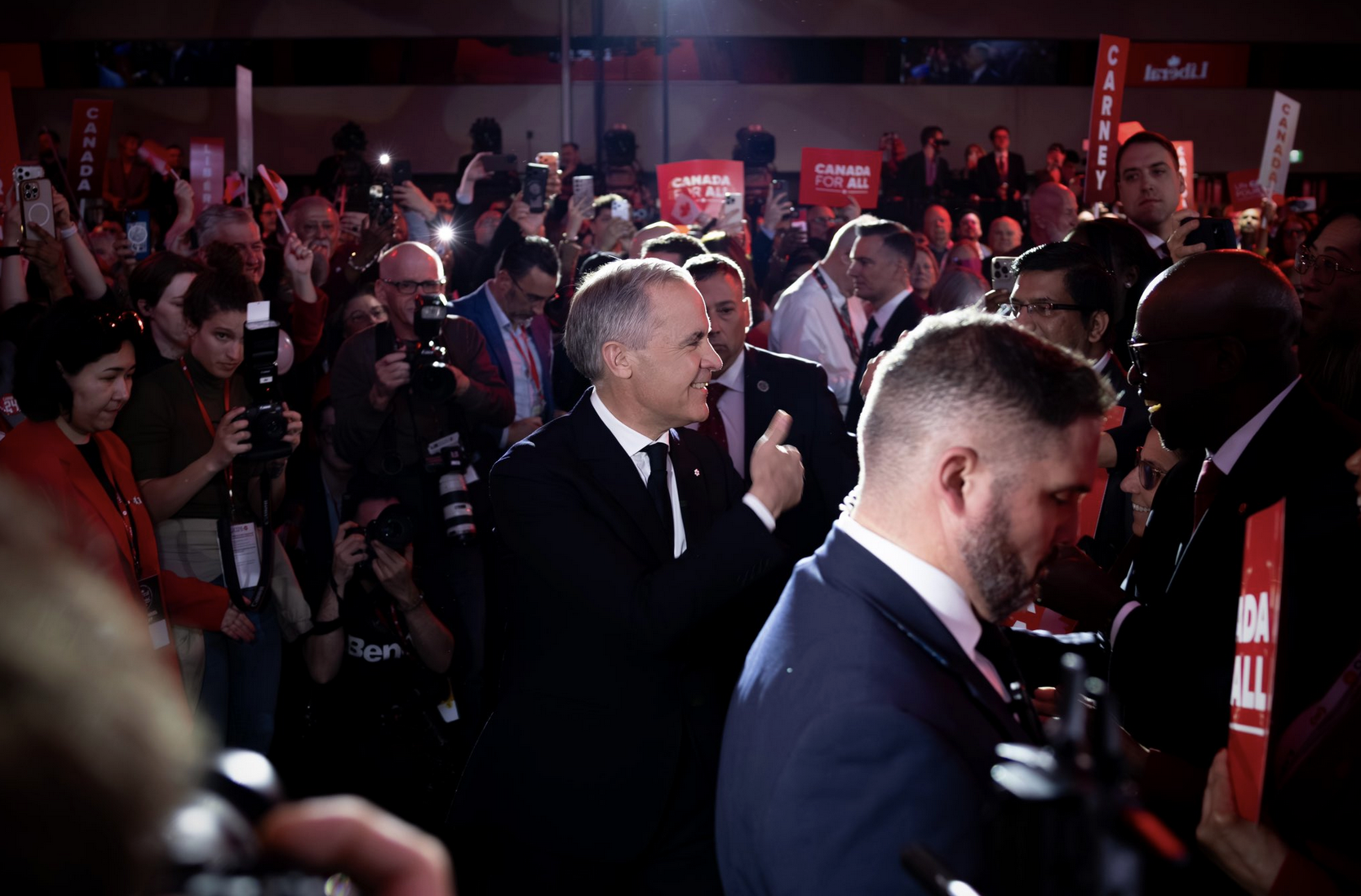
 Prime Minister Mark Carney at the Liberal Party policy convention in Montreal, April 11, 2026/PMO
This piece is part of our Policy series Carney’s Canada One Year Later.
By Daniel Béland
April 26, 2026
In a move that arguably said more about Conservative Leader Pierre Poilievre’s paucity of ammunition when it comes to smearing Prime Minister Mark Carney than it said about Carney, Poilievre recently depicted the only central banker to have ever served as governor in two G7 economies as “badly educated in economics.”
Which is a little like saying that Garry Kasparov is badly educated in chess — the only response it could possibly elicit is bafflement, which was the response it got from Carney, plus a joke about taking back a previous, graciously evasive answer when asked whether Poilievre should quit.
As an exercise in degrading an opponent’s strength, it slammed up against not only widespread disbelief but the paper wall of Carney’s resumé, his Harvard BA in economics, magna cum laude, and his DPhil/PhD in economics from Oxford.
When Carney formally entered the political arena for the first time at age 59 in January of 2025, the most irrefutable elements of his profile were his economic background and policy expertise.
Instead, and predictably, many voices expressed scepticism about his lack of political experience.
What was not supposed to happen was that, one year into this enterprise, Carney’s political skills would prove so impervious that Poilievre would be slamming him as an economist. The political education of Mark Carney — after a first year not without its gaffes (hello, Plains of Abraham) but which is ending on the high of a belatedly secured majority — has been notable for its alacrity.
On March 9, 2025, on the very day Carney won the Liberal leadership race, CBC journalist Aaron Wherry evoked the “cautionary tale” of Michael Ignatieff, to whom Carney had frequently been compared in the past, when speculation about him potentially running for political office began.
As Wherry reminded his readers: “The son of a Canadian diplomat, Ignatieff was a celebrated intellectual and author who was smart and worldly and decent and interesting. But he failed to master politics and couldn’t provide the leadership, organization or vision the Liberals desperately needed when he took the helm in 2008.”
Like Ignatieff, Carney was certainly “smart and worldly” but he also lacked political experience, a feature many perceived as a clear potential liability when facing a career politician like Pierre Poilievre during an actual election campaign, rather than during the mostly gentle and polite Liberal leadership race Carney won easily with more than 85% of support.
In addition to this stunning leadership victory, Wherry goes on to note a key difference between Ignatieff, the global academic and public intellectual, and Carney, the former central banker, who had been “involved with government at the highest levels and he would already seem to have a clearer idea than Ignatieff of what he wants to do in politics — namely, a focus on strengthening the Canadian economy.”
Clearly, Carney was not only a very well-educated economist but a policy wonk and a government insider, despite having never run for public office.
The political education of Mark Carney — after a first year not without its gaffes (hello, Plains of Abraham) but which is ending on the high of a belatedly secured majority — has been notable for its alacrity.
Yet, policy wonks and technocrats à la Carney, including former central bankers, do not necessarily make good politicians. Context here matters a great deal, as political leaders at least partly define themselves, and are defined by, the moment during which they rise to power and exercise it over time.
In other words, leadership and timing are closely intertwined, as political power, like everything else in society, is grounded in collectively shared historical processes.
The fact that Carney decided to step into the formal political arena in the aftermath of the second election of Donald Trump to the White House, his technocratic background, his judgment and thoughtful demeanour allowed his party to frame him as the steady hand the country needed to handle an unprecedented crisis.
Gradually, in contrast to Poilievre — whose populist style shares similarities with Trump’s — Carney and his team found a way to convince a growing segment of the electorate that he, rather than his Conservative counterpart, was “the right leader at the right time” to take on Trump and protect Canada in turbulent times.
At the same time, Poilievre, who was at his most effective when prosecuting Justin Trudeau and his policies during the cost-of-living crisis, appeared to be destabilized by his new political context. He has yet to recover, partly because of the enduring Trump threat that has defined Carney’s leadership and created the Catch-22 of Poilievre’s inability to alienate Trump without alienating part of his own base.
Meanwhile, Carney’s political skills have only expanded in ways that any superficial assessment might attribute to the application of a head for numbers to the math problem of a minority government. Within the first year of his prime ministership, Carney has secured a governing majority through the enlistment of four Conservatives and one NDP MP to join his caucus, which likely helped him win a clean sweep of three byelections on April 13, giving him a majority with a two-seat cushion.
A huge part of this can be explained by exceptional, previously unimaginable context — both bilateral and beyond.
As Policy Editor and Publisher Lisa Van Dusen puts it, in the shadow of the Trump administration and the type of authoritarian populism he embodies, “amid a global clash of values in which one side is brazenly, overwhelmingly defined by strategic corruption, intelligence-insulting cynicism, tactical bullying, and industrialized deception, Mark Carney represents the opposite of all of those things.”
This dichotomy helps Carney forge a broader coalition, including by attracting opposition MPs who seek to join an anti-Trump, pro-Canada movement, a situation also facilitated by his centrist and pragmatic approach, which serves as a “coalition magnet.”
That approach was on full display last week, when the Prime Minister appointed former Conservative politicians Jean Charest, Erin O’Toole, and Lisa Raitt to his new Advisory Committee on Canada-U.S. Economic Relations. In times of acute economic and geopolitical uncertainty in which the very future of the country seems to be at stake, this form of political and policy ecumenism is generally well perceived by voters.
As veteran pollster Bruce Anderson asserts: “This Prime Minister is taking a different approach, looking to make positive relationships wherever he can. Our polling shows that the country is seeing and appreciating the effort to build national unity.”
This perception could change based on any number of scenarios at a time when, evidently, no scenario can be ruled out. But for now, Carney’s skills seem to match the challenging moment Canada is facing in a way that many Canadians both understand and value.
A Fellow of the Royal Society of Canada, Daniel Béland is professor of political science and director of the McGill Institute for the Study of Canada at McGill University.