
Key Points
-
A flurry of corrections is adding to market volatility.
-
The corrections have been mere bumps along the way of a scorching-hot multiyear run in the Nasdaq Composite.
-
Expect more corrections so long as the Nasdaq is being driven by investor enthusiasm and stocks that are valued based on their future growth potential.
- 10 stocks we like better than NASDAQ Composite Index ›
Wednesday’s selloff sent the Nasdaq Composite (NASDAQINDEX: ^IXIC) down to its second correction of the year before it recovered Thursday. A correction is defined as a drop of 10% to 20% from recent highs in a major market index.
Here’s what investors need to know about the Nasdaq sell-off, how it compares to other major indexes, and how the index’s broader moves could be affecting their investment portfolios.
Where to invest $1,000 right now? Our analyst team just revealed what they believe are the 10 best stocks to buy right now, when you join Stock Advisor. See the stocks »
Image source: Getty Images.
An uptick in stock market corrections
Historically, stock market corrections in the S&P 500 (SNPINDEX: ^GSPC) occur about every one to two years. But there have been three corrections in the Nasdaq in the last 16 months.
In the Nasdaq’s latest correction, the index closed at 24,442.94 on July 29, down 10.1% from its June 1 high of 27,190.21. Previously, on March 30, the Nasdaq closed at 20,794.64, down 13.4% from its Oct. 29, 2025, high of 24,019.99. And the first in this series briefly entered crash territory — a rapid drop of more than 20% — as the market reacted to President Donald Trump’s initial round of tariffs. During the worst of it, the Nasdaq fell to an intraday low of 14,784.03 on April 7, which was down 26.5% from the Jan. 24, 2025, high of 20,118.61 — although the lowest the Nasdaq closed during that period was 15,267.91 (or a decline of 24.1%) on April 8.
Corrections are happening faster and more frequently. But the Nasdaq has also been roaring higher — outperforming the S&P 500 and Dow Jones Industrial Average (DJINDICES: ^DJI) in 2023, 2024, and 2025. In fact, each correction’s low has been higher than the high that preceded the prior correction. This pattern of higher highs and higher lows is typical of a bull market, where stock prices rise over the long term.
The S&P 500 and Dow haven’t been nearly as volatile as the Nasdaq. On July 29, the S&P 500 closed just 4% off its high. Despite falling 2.2% on July 29, the Dow closed down just 3.2% from its all-time high. However, the S&P 500 was hovering right around correction territory in March 2026, and all three indexes entered a correction in April 2025.
A semiconductor-led sell-off
Volatility is simply the price of admission for participating in a market driven by growth stocks. Many tech-focused companies that have contributed the bulk of index gains in recent years are also valued for what they will do in the future rather than where they are today. So if growth cools, sentiment changes, or investors just aren’t as confident in a thesis playing out — like artificial intelligence (AI) capital expenditures paying off — then growth stocks can fall just as quickly as they rose.
As an example, the semiconductor industry has been scorching hot in recent years. As of June 30, semiconductor, semiconductor materials, and semiconductor equipment companies made up 46.4% of the Vanguard Information Technology ETF — which tracks the tech sector. But concentration is a double-edged sword, as semiconductors are now leading the tech sector sell-off. In just two months, the tech sector, semiconductor industry, and many prominent chip stocks have gone from record highs to extreme sell-offs.
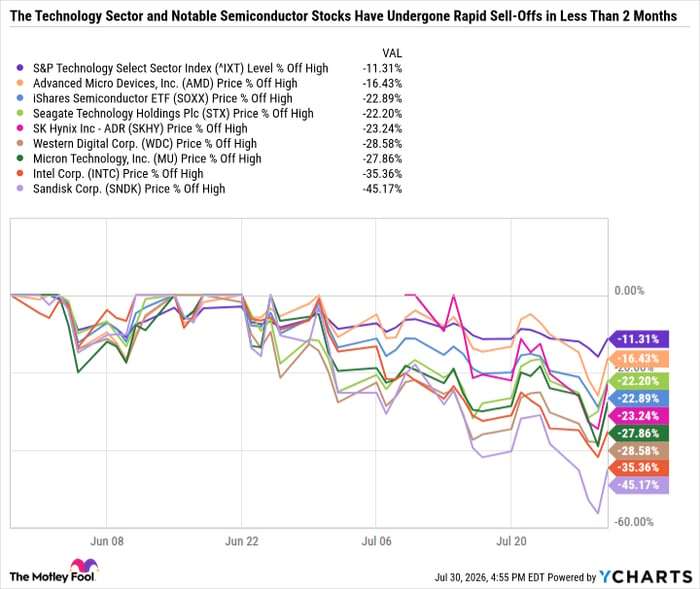
A similar dynamic is occurring at the index level. The Nasdaq has become increasingly concentrated on a few key themes and megacap companies, many of which depend on AI-driven growth. So if that narrative flips, the Nasdaq can sell off quickly even as most other sectors hold up well.
The S&P 500 and Dow Jones Industrial Average aren’t nearly as dependent on tech and tech-focused stocks as the Nasdaq. So resilience from other sectors of the stock market has helped limit index-wide drawdowns. However, tech still plays a significant role, and the Dow has added more tech-focused companies — most recently dropping Verizon Communications and adding Alphabet in June.
Expect more volatility
Even before the AI boom, companies listed on the Nasdaq and the New York Stock Exchange were already leading in global tech. AI-driven growth has made U.S. indexes even more exposed to tech, from semiconductor giants to companies like Apple that make the devices that AI tools run on, to software, hardware, cloud computing, and data center infrastructure — from server racks to energy giants to industrial picks and shovels players like Caterpillar and GE Vernova.
In sum, the Nasdaq embodies the risks and potential rewards of a tech-centered index. Whereas most other stock markets around the world aren’t nearly as tech-dominant. The S&P Europe 350 consists of 350 blue chip companies from 16 developed European markets. Financials make up 25.1% of that index, followed by industrials at 18.5%. Even healthcare, at 13.1%, has a larger weighting than tech, at 9.8%.
The advantage of being an individual investor is that your financial goals matter more than your performance relative to an index. So you don’t need to take on more risk than you’re comfortable with or feel like you need to conform to whatever the indexes are doing. Rather, a better solution is to understand what indexes are composed of and what will drive their performance, and then position your portfolio accordingly.
For some risk-tolerant investors who believe we are still in the early innings of AI innovation and adoption, that may mean building a portfolio around tech stocks and growth-focused exchange-traded funds. Whereas others may want to be less weighted in tech than the major indexes, which could lead to portfolio underperformance if AI continues pole-vaulting the major indexes to new heights, but it can also help limit drawdowns during tech-driven sell-offs like we are in now.
Should you buy stock in NASDAQ Composite Index right now?
Before you buy stock in NASDAQ Composite Index, consider this:
The Motley Fool Stock Advisor analyst team just identified what they believe are the 10 best stocks for investors to buy now… and NASDAQ Composite Index wasn’t one of them. The 10 stocks that made the cut could produce monster returns in the coming years.
Consider when Netflix made this list on December 17, 2004… if you invested $1,000 at the time of our recommendation, you’d have $397,081!* Or when Nvidia made this list on April 15, 2005… if you invested $1,000 at the time of our recommendation, you’d have $1,166,221!*
Now, it’s worth noting Stock Advisor’s total average return is 889% — a market-crushing outperformance compared to 203% for the S&P 500. Don’t miss the latest top 10 list, available with Stock Advisor, and join an investing community built by individual investors for individual investors.
*Stock Advisor returns as of July 31, 2026.
Daniel Foelber has no position in any of the stocks mentioned. The Motley Fool has positions in and recommends Advanced Micro Devices, Alphabet, Apple, Caterpillar, GE Vernova, Intel, Micron Technology, Western Digital, and iShares Trust-iShares Semiconductor ETF. The Motley Fool recommends Verizon Communications. The Motley Fool has a disclosure policy.
The views and opinions expressed herein are the views and opinions of the author and do not necessarily reflect those of Nasdaq, Inc.