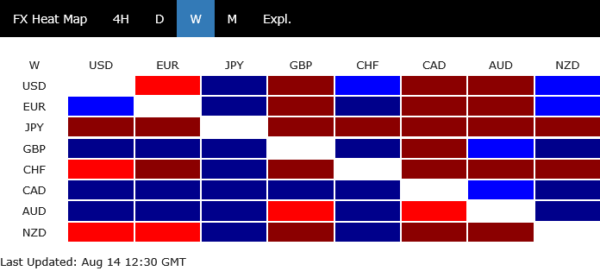
TL;DR: The Canadian dollar’s rally has accelerated sharply this week without help from oil, built instead on blowout GDP and jobs data — but whether this reflects genuine repositioning for a Bank of Canada hike or just a weak US Dollar remains unconfirmed.
A Rally That Stopped Being Quiet
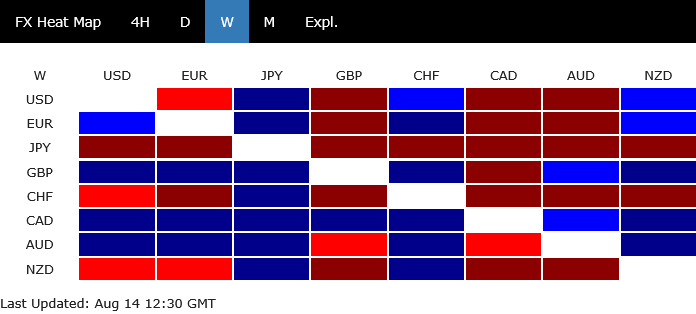
The Canadian dollar has been quietly outperforming for weeks. This week, it stopped being quiet. The US dollar’s slide against the Canadian dollar, already underway for a while, has accelerated sharply — not the kind of slow grind you’d expect from ordinary economic data doing its usual work, but a faster, more decisive move.
What makes this worth a second look is what isn’t driving it. Canada is a major oil producer, and its currency often rises and falls with crude prices. Not this time. Oil has actually stalled this week, with Brent crude capped below $90 a barrel even as the Canadian dollar keeps climbing. Whatever is pushing this rally, it isn’t coming from the oil market.
That raises an honest question worth asking rather than assuming an answer to: is this simply the market digesting two strong pieces of Canadian data plus a weak US inflation reading? Or has something shifted — traders starting to actively bet on where Canadian interest rates are headed, rather than just reacting to what’s already happened? The price action alone can’t answer that. But it’s worth laying out the case, and being honest about what’s still missing.
The Data Behind the Move
Two numbers are doing most of the talking. Canada’s economy grew at an annualized 3.4% in the second quarter — not just beating what economists expected, but beating what the Bank of Canada had itself been forecasting only weeks earlier. Then came the jobs report: Canada added roughly 75,000 jobs in July, more than four times what was expected, pulling the unemployment rate down.
Individually, either number would be a good headline. Together, arriving back to back, they tell a more compounding story: an economy that appears to be picking up speed, not just holding steady.
The Case That Something More Is Going On
Here’s where it gets interesting. This isn’t a case of the market being caught completely off guard. Even before the jobs report landed, traders in interest-rate markets were already leaning toward betting on a Bank of Canada rate hike by the end of the year — pricing in better-than-even odds. The jobs data didn’t create that expectation; it reinforced one that was already quietly building.
There’s also a mechanism worth spelling out, and it’s less about today’s inflation than about where inflation could be headed next. When an economy keeps beating growth forecasts the way Canada’s has, it usually means there’s less spare capacity left than assumed — fewer idle workers, less unused factory output. That matters to a central bank, because a shrinking cushion of slack is often exactly what allows inflation to build later, even while today’s numbers still look tame.
Strip out gasoline prices, which have been elevated everywhere because of the ongoing Middle East conflict, and Canadian inflation is in fact sitting close to the central bank’s target right now. So this wouldn’t be a central bank scrambling to catch up with inflation that’s already gotten away from it — it would be closer to a preemptive move, hiking ahead of a problem strong growth could eventually create, rather than reacting to one that already exists.
And the timing lines up with something happening on the other side of the border. A weaker-than-expected US inflation reading this week pushed down expectations for a September US rate rise. When Canada’s economy looks stronger at the exact moment America’s looks softer, the contrast between the two currencies gets sharper — and sharper contrasts tend to attract more aggressive bets, not just more cautious repricing.
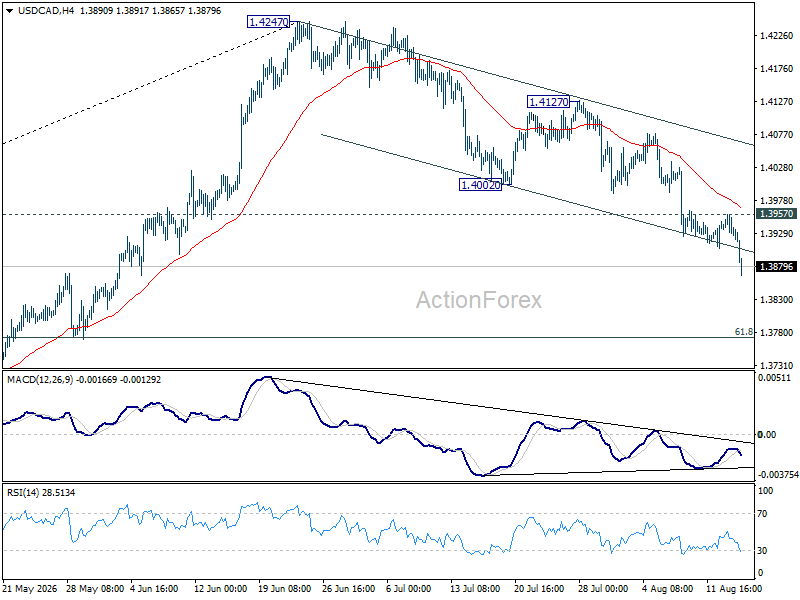
Put together, a chart-based case exists too: the US dollar against the Canadian dollar hasn’t just been drifting lower, it’s broken through a well-established support zone with real momentum — the kind of move that often reflects traders piling into a position, not just following data passively.
What’s Missing to Actually Confirm It
None of this proves speculative money is now driving the move. A few real gaps remain. There’s no direct evidence — no data on futures or options positioning — showing traders have actually built new bets on a Canadian rate hike this week. The case so far is built by inference from the currency’s price action, not from proof of what’s happening underneath it.
The Bank of Canada itself hasn’t said anything new since this data landed. The hawkish read exists entirely in what traders are pricing, not in anything officials have confirmed or pushed back against. No major bank has yet come out and explicitly called this a shift in how traders are positioning, rather than just a currency following strong data — a bank publicly changing its own rate forecast would be a much stronger signal than price action alone.
And it’s still unclear whether Canadian interest-rate expectations themselves are actually moving this week, or whether this is really a story about the US dollar weakening broadly, with the Canadian dollar simply benefiting more than others by coincidence of timing.
What to Watch Next
A few things would go a long way toward settling this. Canada’s next inflation report is the cleanest test available. A hot number would support the case that the market is right to expect a rate hike. A soft one would support the Bank of Canada’s more patient instincts, and would argue against the idea that a hike is truly coming.
Worth watching too: whether Canadian rate expectations themselves — not just the currency — actually shift further in the coming days, or whether they stay where they already were before this week’s rally. If the currency keeps moving while rate expectations stand still, that would suggest this is more about a weak US Dollar than a repriced Bank of Canada.
Any bank publicly revising its own rate forecast for Canada would be the strongest confirmation yet. So would any Bank of Canada official speaking publicly and addressing the recent data directly. And simply watching whether the currency’s move keeps accelerating, or starts to settle down, will tell its own story — a move that keeps building suggests something real is developing, while one that stabilizes suggests this week was simply the market catching up to good news, not the start of something bigger.
ActionForex’s Technical View on USD/CAD
The price action backs up how unusual this move looks. USD/CAD’s decline isn’t a one-week event — it’s the continuation of a pattern that’s been building for weeks. After clearing the round 1.40 level, a former floor that had held for much of the summer, the pair has now accelerated through a well-defined descending channel.
Zoom out to the bigger picture, and the case for further weakness looks stronger still. USD/CAD’s climb earlier this year, from a low near 1.3480 up to June’s high of 1.4247, increasingly looks less like the start of a lasting uptrend and more like a temporary rebound inside a longer decline — a read reinforced by the pair decisively breaking the 55-day EMA. If that’s the right way to read it, the next natural target is the 61.8% retracement of 1.3480 to 1.4247, at 1.3773, which might provide some support.
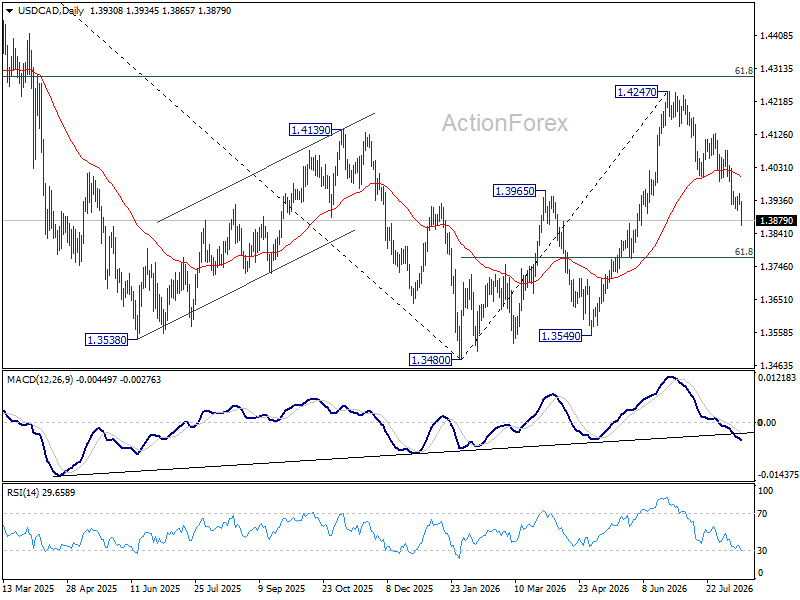
Should the case for a Bank of Canada rate hike keep building with incoming data, that level may not hold for long, opening the door to a deeper slide back toward the 1.3480 low set earlier this year.
The chart’s next move mirrors the fundamental question above. A continued decline through these levels with little pause would fit with the idea that real, sustained buying interest in the Canadian dollar is building. A sharp bounce back above 1.40, on the other hand, would suggest this week’s move ran ahead of itself — and that the currency’s real test is still ahead, most likely arriving with Canada’s next inflation report.
The Bottom Line
If this is the beginning of a genuine shift in how the market is positioning for the Bank of Canada, the Canadian dollar’s strength could extend well beyond what this week’s data alone would justify. If it’s simply strong data meeting a weak US Dollar at the same moment, the move may already be largely priced in — and the next inflation report, not this week’s price action, will be what actually decides which story is true.
Key Takeaways
- Canada’s Q2 GDP grew 3.4% annualized, beating both consensus and the Bank of Canada’s own forecast, followed by a jobs report that beat expectations by more than 4x.
- The rally is notably not oil-driven, since Brent has stalled below $90 even as the Canadian dollar keeps climbing.
- Ex-gasoline Canadian inflation sits close to target, suggesting a potential hike would be preemptive rather than reactive to an existing inflation problem.
- Direct confirmation is still missing: no positioning data, no BoC commentary, and no bank has yet revised its Canadian rate forecast in response to this week’s data.
- USD/CAD has broken its 55-day EMA and a key support zone; a break of 1.3773 would open the door toward the 1.3480 low, while a bounce back above 1.40 would suggest the move got ahead of itself.
Related Coverage
Central Bank Commentary
Global Data Deep Dives