Key Points
-
Tesla’s capital expenditures are set to rise significantly in 2026 and over the next few years.
-
Multiple new factories and projects are driving increased spending.
-
Free cash flow may not return until 2028, which could impact near-term cash reserves, but the potential for long-term recurring revenue from robotaxis makes the stock attractive.
- These 10 stocks could mint the next wave of millionaires ›
Tesla (NASDAQ: TSLA) investors will have to start discussing cash flow forecasts pretty soon. While robotaxis, Optimus robots, and unsupervised full self-driving (FSD) are far more exciting than poring over spreadsheets to estimate the relationship between Tesla’s cash reserves, capital spending requirements, and operating cash flow, the reality is that the investment case rests on the former’s influence on the latter.
Tesla is betting big on multiple projects
CEO Elon Musk has big ambitions, and he’s backing them by pushing an aggressive ramp-up in capital expenditures for Tesla.
Will AI create the world’s first trillionaire? Our team just released a report on the one little-known company, called an “Indispensable Monopoly” providing the critical technology Nvidia and Intel both need. Continue »
Image source: Tesla.
After telling investors to expect an increase in capital spending to more than $20 billion in 2026 on theearnings callin January, CFO Vaibhav Taneja increased the estimate to $25 billion on the latestearnings call a significant jump from previous years.
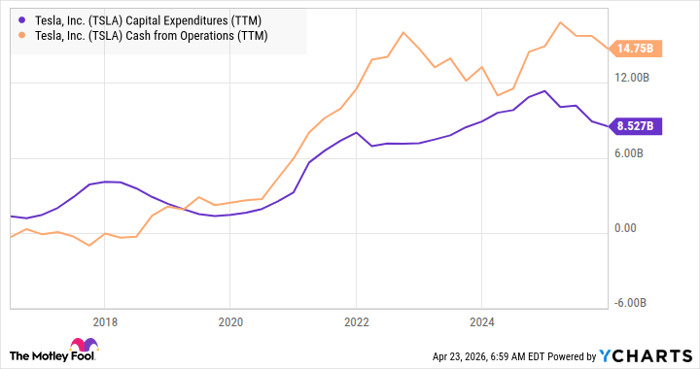
Data by YCharts.
The spending is for good reason: specifically, to put six factories into operation, which will drive future profitability for the company.
- A lithium refinery in Texas, currently in early development.
- A lithium iron phosphate (LFP) battery factory in Nevada, in early development.
- Cybercab production in Texas, in pilot production.
- Tesla Semi production in Nevada, in pilot production.
- A new Megafactory in Texas – The start of Megapack (large-scale energy storage systems) production is on track for later this year.
- Optimus production, in construction in California and Texas
However, given Tesla’s commitment, alongside xAI, SpaceX, and Intel, to partner with Terafab, a semiconductor fabrication plant that will make chips for Tesla (for use in Optimus and electric vehicles, including Cybercab), Tesla’s spending commitments are likely to increase. The current Wall Street consensus calls for $25.6 billion in capital spending in 2026, with $16 billion and $16.7 billion to follow in the next couple of years. As such, Tesla will burn cash in 2026 and possibly in 2027, with a return to free-cash-flow (FCF) generation in 2028 as operating cash flow covers capital expenditures.
What it means for investors
With the Wall Street consensus now calling for Tesla to end 2026 with $22.5 billion in net cash, the company can fund its spending commitments, and a return to FCF generation in the latter half of 2027 will help matters.
Still, with Tesla committing to significant capital spending and lingering uncertainty around the timing and magnitude of robotaxi revenue, investors will naturally focus on where cash flow is heading over the next few years. That cash flow will, at least in part, depend on growth in robotaxi revenue and, in time, Optimus, so any significant push-outs in revenue generation from those revenue catalysts will weigh on the stock and investors’ cash-flow projections.
That said, long-term investors won’t fret about such matters, as the whole point of capital spending is to maintain and grow the business, and Tesla looks capable of doing both given its net cash position. Still, the debate around its cash flow will guide the stock for the immediate future.
Don’t miss this second chance at a potentially lucrative opportunity
Ever feel like you missed the boat in buying the most successful stocks? Then you’ll want to hear this.
On rare occasions, our expert team of analysts issues a “Double Down” stock recommendation for companies that they think are about to pop. If you’re worried you’ve already missed your chance to invest, now is the best time to buy before it’s too late. And the numbers speak for themselves:
- Nvidia: if you invested $1,000 when we doubled down in 2009, you’d have $540,224!*
- Apple: if you invested $1,000 when we doubled down in 2008, you’d have $51,615!*
- Netflix: if you invested $1,000 when we doubled down in 2004, you’d have $498,522!*
Right now, we’re issuing “Double Down” alerts for three incredible companies, available when you join Stock Advisor, and there may not be another chance like this anytime soon.
*Stock Advisor returns as of April 26, 2026.
Lee Samaha has no position in any of the stocks mentioned. The Motley Fool has positions in and recommends Tesla. The Motley Fool has a disclosure policy.
The views and opinions expressed herein are the views and opinions of the author and do not necessarily reflect those of Nasdaq, Inc.