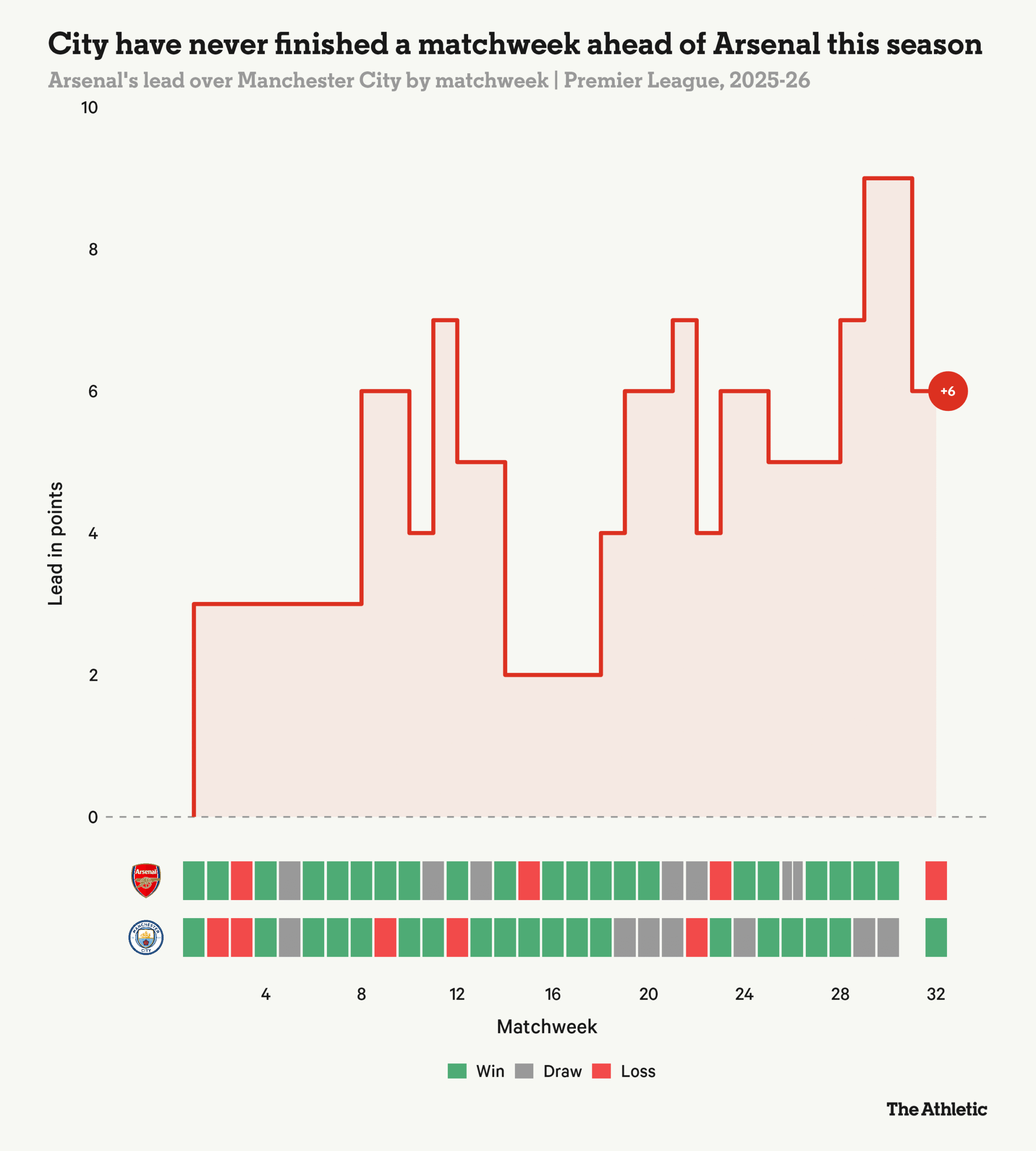
The title race nears a dramatic climax later today as leaders Arsenal travel to second-placed Manchester City. The stage could scarcely be more enticing. By losing 2-1 to Bournemouth last Saturday, Arsenal have offered City a golden lifeline.
A win would move them to three points behind Arsenal with a game in hand, leaving open the possibility that if they also win that fixture, only goal difference would separate the two sides.
But how did we arrive at this fever-pitch crescendo? The story has played out over around 95 combined hours of league football involving the two rivals.
Assuming that you have more pressing demands on your time than painstakingly poring over this footage, The Athletic has boiled it down into a series of data graphics, picking out the key narrative checkpoints and tactical decisions that have shaped this title tussle.
Closing the gap
For City, the race has been one of perpetual catch-up.
They have been stuck in Arsenal’s rearview mirror since a 2-0 home defeat to Tottenham in the second gameweek, which put them three points behind the league leaders.
Since then, that gap has fluctuated but never closed. It shrank to a tantalising two points after Arsenal’s 2-1 defeat away to Aston Villa in December, before stretching back to four on New Year’s Day, when City were held to a goalless draw by Sunderland.
So far in 2026, Arsenal have kept City at arm’s length, with the gap never dropping below four points. In the 26th gameweek, Arsenal had two fixtures, but actually lost ground, drawing twice as City won 3-0 against Fulham.
City have yet to make up their game in hand, with their match against Crystal Palace postponed for the League Cup final and still to be rescheduled, leaving the table a frustratingly distorted picture of the current state of play.
It leaves open the cruel possibility of Arsenal being pipped to the prize right at the end of the season, despite leading for the majority of it. In 2022-23, they topped the table for 248 days before City hunted them down.

In total, including 205 days so far this season, Arsenal have led the Premier League for 1,517 days under Arteta. Over the same period, City have led for 1,201 days, yet the title count reads four to them and none to Arsenal.
Arsenal’s April wobbles
April really is the cruellest month for Arteta. Defeat to Bournemouth on Saturday leaves him with 1.54 points per game in April (40 points from 26 matches), his lowest monthly return excluding the three games played in June during the Covid-disrupted 2019-20 season.
The graphic below shows how Arsenal’s form, measured by their five-game rolling average of points, ebbs and flows under the Spaniard. Sunday’s game is their 33rd of the season, the stage at which that average dips to its lowest points.

Arsenal’s title bid unravelled with a 4-1 defeat to City in their 33rd match of the 2022-23 season. April has proved a revitalising elixir for Guardiola, averaging 2.71 points per game in the time since Arteta took charge of Arsenal.
The evidence suggests that City build up a head of steam in the second half of the season, while Arsenal run out of it. But this season has not quite panned out the same way (see below)
City’s end-of-season flourish is missing
Under Guardiola, City sides have followed a familiar, tried-and-tested script. They start slowly out of the blocks, with unconvincing form leaving the door ajar for rivals. Then, after Christmas, they emphatically slam it shut, reeling off extended winning runs as they steamroll all-comers.
This season, a new-look City side, stripped of many of its experienced title-winners, has not found that same late-season gear. The graphic below shows how they are earning fewer points, creating fewer chances, scoring fewer goals, and conceding more in the second half of this campaign.

Previous City iterations would have probably reeled Arsenal in by now, but this is no longer the same inevitable, ominous title force.
The underlying attacking and defensive numbers
The dynamics of this title race have, somewhat crudely, been framed as a clash between City’s free-flowing attack in one corner and Arsenal’s watertight defence in the other. This dichotomy is not entirely wide of the mark. The graphic below shows the 10-game rolling expected goals for and against, with Arsenal’s defence clearly superior throughout the season.

City have had the edge going forward, but that advantage has not been as clear-cut, with Arsenal at times shading the attacking numbers. Both peaked offensively in mid-season, but going into Sunday’s crunch tie, it is City who carry the more recent attacking momentum.
How offside numbers reveal their contrasting approaches
The differences between these sides are many and nuanced, but if they are to be reduced to a single statistic, look no further than the offside flag. Arsenal have caught their opponents offside just 23 times this season, three fewer than the total offsides racked up by Bournemouth forward Evanilson.
This works out at 0.72 offsides provoked per game, lower than any other Premier League side in the last seven seasons.
Typically, featuring towards the lower end of this metric is indicative of a deep-lying, more limited side, with the bottom 10 including Cardiff City’s relegation campaign of 2018-19.

While Arsenal are no strangers to sitting deep when required, their low offside count stems from their excellent rest defence, which refers to the team’s shape behind the ball while in possession. It makes them extremely hard to counterattack against, smothering potential breaks at source. Finding space behind Arsenal’s defence, legally or otherwise, is incredibly rare. Not even Arsenal could shackle the blistering physicality of Erling Haaland, though, conceding their only counter-attacking goal when he scored in the 1-1 draw at the Emirates in September.
City, meanwhile, are more expansive in attack, but also more porous at the back. Under Guardiola, they have long operated a high defensive line, catching their opponents offside more than any other team this season.
It leaves them vulnerable to fast breaks, which were their Achilles’ heel last season, with City conceding 8.05 expected goals from these attacks, more than any side except relegated Leicester City. The issue has reared its head again in recent weeks, with the spike in their 10-game rolling xG conceded from fast breaks shown below.

Set-piece again
Set pieces are an important chapter in every title story. Minutes before Sergio Aguero’s iconic winner sealed City’s first Premier League title in a 3-2 win over QPR in 2012, his strike partner Edin Dzeko had equalised from a corner.
This season, dead-ball situations have taken on a much more prominent role. There have been 234 set-piece goals, more than in any of the past seven seasons. For Arteta’s side, they have been fruitful, with a league-leading 21 goals.

With set-piece coach Nicolas Jover at the helm, Arsenal are widely considered the gold standard for set-piece innovation and efficiency. On a goals-per-100-set-pieces basis, they trail Manchester United, but remain comfortably clear of City in this department.
While much of the league has embraced the long-throw revolution, Guardiola has only dipped his toe in the water, finding the temperature not to his taste: his side have attempted just four this season compared to Arsenal’s 50.
With a less physical set of players, City often prefer to go short, working the ball intricately into the box, as seen in the build-up to Marc Guehi’s goal against Chelsea last weekend.
Marauding full-backs
Both managers give their full-backs so much positional freedom that the label itself is almost meaningless. Arsenal fans can point to the league-high 179 touches by their full-backs in the opposition box this season as a rebuttal to claims that their football is dull or unadventurous. They boast a deep pool of high-quality options here, with Jurrien Timber, Myles Lewis-Skelly, Riccardo Calafiori, Piero Hincapie, and Ben White all featuring at different points.

It is a physically dominant yet highly technical group, and Arteta encourages them to overlap, underlap, attack crosses, and step into midfield. Six per cent of their right-back’s touches come in the opposition box, twice the share as in their own.
Meanwhile, City left-back Nico O’Reilly has scored six times in his last 10 games, opening the scoring at Stamford Bridge last weekend and netting both in City’s 2-0 League Cup final win.
Cutback kings
While Arteta’s style differs greatly from Guardiola’s, there are still areas of overlap. One is an affinity for cutback goals. City have long been masters of working the ball to the byline and cutting it back to onrushing attackers.
Having worked as Guardiola’s assistant for three years from 2016 to 2019, Arteta would have clearly noticed how effective this particular attacking pattern was and has wisely included it in his own tactical playbook.
This is driven by the advanced positioning of the full-backs mentioned earlier, who are often the architects of these chances. Arsenal lead the league with 66 cutback chances, while City have scored a league-high 11 goals from them.