Key Points
-
AI chip stocks have sold off this month amid fears that custom silicon could erode the leaders’ pricing power.
-
Taiwan Semiconductor’s second-quarter net income rose 77% year over year, and its gross margin expanded for a fourth straight quarter.
-
Management raised its 2026 revenue growth outlook to slightly above 40%.
- 10 stocks we like better than Taiwan Semiconductor Manufacturing ›
The AI chip trade has cracked this month. Micron Technology has dropped about 32% in three weeks. Broadcom sits roughly 24% below its 52-week high. Even Nvidia (NASDAQ: NVDA), which has held up better than most, is down about 12% from its high as of this writing.
The fear isn’t weak demand so much as who captures it. Chinese AI lab DeepSeek is reportedly developing its own AI chip to reduce its reliance on Nvidia, according to a July 7 Reuters report. OpenAI recently unveiled a custom inference chip of its own, designed with Broadcom. And the big cloud companies keep scaling their in-house silicon programs.
Where to invest $1,000 right now? Our analyst team just revealed what they believe are the 10 best stocks to buy right now, when you join Stock Advisor. See the stocks »
Investors are suddenly asking which chip designer keeps its pricing power in a world where every major AI player wants alternatives.
I’d rather skip that argument entirely. The AI chip stock I’d buy hand over fist in this sell-off is Taiwan Semiconductor Manufacturing (NYSE: TSM), the company that manufactures leading-edge chips for nearly every side of the fight.
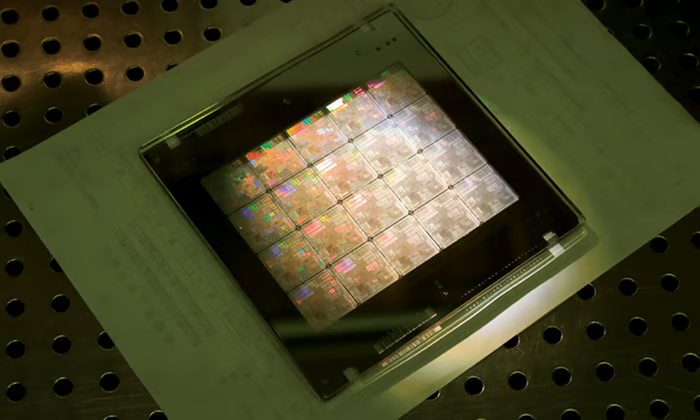
Image source: TSMC.
A record quarter the market shrugged at
Taiwan Semi reported second-quarter results on Thursday, and they were exceptional. Revenue rose 33.7% year over year to $40.2 billion. Net income jumped 77.4% year over year, reaching a fresh record. Gross margin came in at 67.7%, its fourth straight quarter of expansion, up from 59.5% in the third quarter of 2025.
The trajectory matters as much as the levels. TSMC’s year-over-year net income growth has accelerated from 35% in the fourth quarter of 2025 to 58.3% in the first quarter of 2026 and now 77.4%. Management expects the momentum to continue, too, guiding for third-quarter revenue of $44.6 billion to $45.8 billion, or roughly 37% year-over-year growth at the midpoint. On theearnings call management also raised its full-year 2026 revenue growth outlook to slightly more than 40%, up from its earlier call for growth of more than 30%.
Driving all of this is the company’s grip on leading-edge manufacturing. Chips built on 7-nanometer processes and smaller accounted for 77% of wafer revenue in the quarter. And the next wave is just beginning.
“Moving into third quarter 2026, we expect our business to be supported by continued strong demand for our leading-edge process technologies, including the steep ramp-up of our 2-nanometer technology,” said chief financial officer Wendell Huang in the company’s second-quarter earnings release.
Why not Nvidia?
To be clear, I like Nvidia’s business. But this particular sell-off is aimed at the exact thing that makes Nvidia’s stock work: its pricing power. If DeepSeek, OpenAI, and the cloud giants succeed in designing around Nvidia’s graphics processing units (GPUs), Nvidia’s growth could slow.
Taiwan Semi doesn’t have that problem. After all, those custom chips still have to be manufactured somewhere, and the leading-edge capacity to build them is overwhelmingly TSMC’s.
The company manufactured 12,682 products for 534 customers in 2025. Owning the stock is a bet on AI computing demand itself, not on any one design winning.
What about the cheaper, harder-hit names? Micron trades at about 6 times forward earnings after its plunge. But memory is a deeply cyclical business, and buying it here is a bet that today’s unusually strong memory pricing holds.
Broadcom, a genuine winner in custom AI chips, is arguably the closer call. But even down 24%, it trades at about 21 times forward earnings, with its custom-chip momentum already priced in.
Taiwan Semi, meanwhile, trades at about 30 times trailing earnings at its price of around $410 as of this writing — roughly in line with Nvidia, for a business whose profit growth is accelerating and whose margins keep expanding.
Of course, there are reasons the market hesitated on Thursday. Alongside the record results, management raised its 2026 capital spending plan to $60 billion to $64 billion, at least $4 billion above its prior forecast, and pledged an additional $100 billion investment in Arizona. Spending at that scale could pressure margins over time.
The bigger risks are older ones. Most of the company’s production still sits in Taiwan, with all the geopolitical uncertainty that entails. And the semiconductor industry has never stopped being cyclical.
But at this valuation, I think investors are getting the company that manufactures nearly every leading-edge AI chip, at close to Nvidia’s multiple, without having to guess which designs win.
With that said, I’d size the position with the geopolitical risk in mind.
Should you buy stock in Taiwan Semiconductor Manufacturing right now?
Before you buy stock in Taiwan Semiconductor Manufacturing, consider this:
The Motley Fool Stock Advisor analyst team just identified what they believe are the 10 best stocks for investors to buy now… and Taiwan Semiconductor Manufacturing wasn’t one of them. The 10 stocks that made the cut could produce monster returns in the coming years.
Consider when Netflix made this list on December 17, 2004… if you invested $1,000 at the time of our recommendation, you’d have $371,842!* Or when Nvidia made this list on April 15, 2005… if you invested $1,000 at the time of our recommendation, you’d have $1,244,783!*
Now, it’s worth noting Stock Advisor’s total average return is 900% — a market-crushing outperformance compared to 207% for the S&P 500. Don’t miss the latest top 10 list, available with Stock Advisor, and join an investing community built by individual investors for individual investors.
*Stock Advisor returns as of July 18, 2026.
Daniel Sparks and his clients do not have positions in any of the stocks mentioned. The Motley Fool has positions in and recommends Broadcom, Micron Technology, Nvidia, and Taiwan Semiconductor Manufacturing. The Motley Fool has a disclosure policy.
The views and opinions expressed herein are the views and opinions of the author and do not necessarily reflect those of Nasdaq, Inc.