Tesla is struggling mightily in India, reportedly selling just 350 Model Y’s in India since it debuted last year, according to Reuters. But now the company is debuting a new version of the Model Y to help goose sales in the burgeoning EV market.
Pricing due to heavy tariffs means Tesla still has a lot of work to do to succeed on the subcontinent, but CEO Elon Musk arguably isn’t making it easy for his company.
Last year, as Tesla was looking to break into the Indian market, Musk got into a back-and-forth of insults with an Indian-origin billionaire and amplified a controversial post claiming, “If Indians set foot in England and become English. Then the English who set foot in India became Indian. Therefore the English did not rule India…”
I won’t waste space explaining the difference between colonization and immigration because none of TheStreet’s readers are that obtuse, but safe to say Tesla has struggled mightily so far in India, and only time will tell if an expensive new version of the Y will help change things.
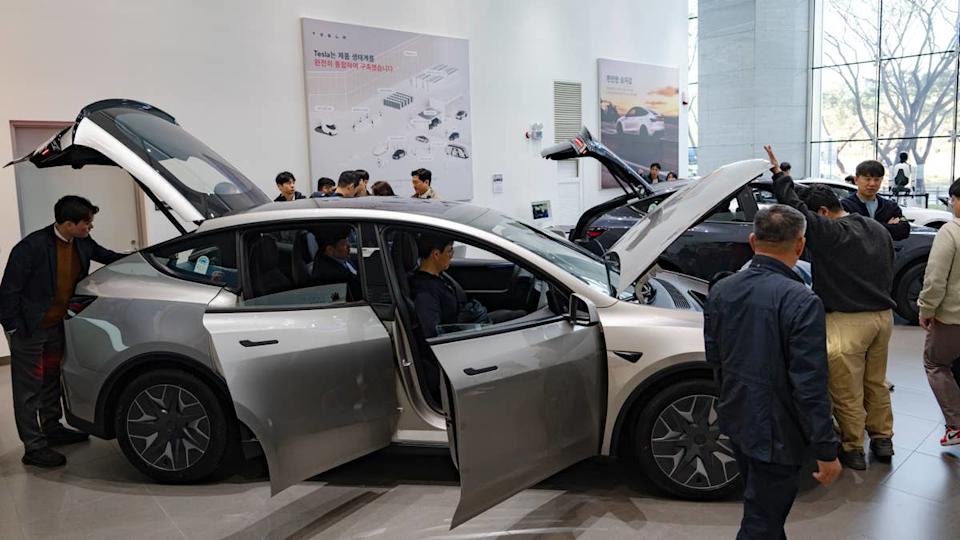
Tesla Model Y L has more range and more seats. Photo by NurPhoto on Getty Images
On Wednesday, Tesla launched a new six-seater version of the Model Y that is popular around the globe, just not in India.
The Model Y L has third row seating, between 500 and 681 km of range and a price tag of about Rs 61.99 lakh (6.2 million rupees or $66,000), according to Overdrive Magazine. While the $66,000 price tag for an all-wheel-drive Model Y seems like a bargain compared to the regular Model Y’s $64,000 price, the average price of an electric vehicle in India is currently much lower. For instance, BYD‘s Model Y competitor, the BYD Sealion 7, costs the equivalent of about $53,000 to $59,000 USD there.
For perspective, Tesla introduced the Model Y L in China last year at a starting price of about $49,700.
Related: Ford CEO Jim Farley takes unexpected turn on EVs
The reason for Tesla’s higher prices is the nearly 100% tariff it pays on imported vehicles.
In February, the U.S. and India announced that they had reached a “framework for an interim agreement” on trade that included India eliminating or reducing tariffs with an emphasis on U.S. food and agricultural products, including dried distillers’ grains, red sorghum for animal feed, soybean oil, and other U.S. staple crops.
Officials also said that India would cut tariffs on high-end American cars to 30% from as high as 110%. India will also eliminate tariffs on Harley-Davidson motorcycles under the interim agreement.
However, India did not make any concessions on electric vehicles, despite the government’s claim that it wants to boost EVs from the current 5% to 30% of the country’s automotive sector by 2030.
So far, Musk has unsuccessfully lobbied the Indian government for years to lower its tariffs on EVs, but the government has balked, stating that if Tesla wants unfettered access to the market, it needs to build the vehicles in India.
Tesla recently scrapped plans to build a factory there, opting instead to ship vehicles from China.
Tesla is scheduled to report its first-quarter earnings results on Wednesday, April 22, after the closing bell.
Earlier this year, Tesla shared it was pulling the plug on the Model S and Model X and would replace that production capacity with Optimus humanoid robots as part of the company’s plan to build 1 million of them per year.
That plan may worry investors, since there is currently no discernible market for humanoid robots, and selling 10,000 of them in a year would be impressive. But the vehicle models the company is getting rid of haven’t sold, either, so it may be a wash in the end.
Still, analysts at BNP Paribas aren’t taking this Tesla experiment lightly because the company is also spending a lot of money to make it happen.
According to BNP, the other models that combined delivered 16,000 vehicles in the quarter benefited from demand that was artificially inflated, so once again, moving off of them makes sense.
However, Musk has made some pretty big promises about what Optimus and Robotaxi can do, and the firm says it’s time for Tesla to “put up or shut up” in 2026.
“We view 1Q26’s deliveries — modestly below consensus — as yet another input to the TSLA stock’s challenged setup for this year, with EGS storage deployments also meaningfully light,” BNP analysts said.
“A critical factor to this year is the Co.’s progress rate in its active Robotaxi fleet, which is climbing yet still limited to just two cities. The core catalysts for TSLA center on its ability to show meaningful progress toward its AI-defined future, inclusive of Robotaxi fleet expansion (targeting seven new cities in 1H26) and commercialized production of Optimus by year-end.”
BNP reiterated its underperform rating and $280 price target on Tesla shares.
Related: Tesla Full Self-Driving faces its biggest challenge yet