Key Points
-
Tesla delivered 480,126 vehicles in the second quarter, up 25% year over year.
-
Wells Fargo raised its price target to $130 last week, a level implying a 67% drop from today’s price.
-
The stock trades at about 360 times earnings heading into Wednesday’s report.
- These 10 stocks could mint the next wave of millionaires ›
Tesla (NASDAQ: TSLA) heads into its second-quarter earnings report this Wednesday, July 22, carrying two stories that can’t both be right. The electric-car maker just delivered 480,126 vehicles in Q2, up 25% year over year and its highest quarterly total since the third quarter of 2025. Yet the stock sits at about $391 as of this writing, down 22% from its 52-week high of $498.83.
And one Wall Street firm thinks the decline is just getting started. Last week, Wells Fargo raised its Tesla price target to $130 from $125 while keeping its underweight rating. From today’s price, that target implies a drop of about 67%.
Missed Nvidia in 2009? This Rare Signal Is Flashing Again. In 2009, a “Double Down” signal flashed for a little-known chipmaker called Nvidia. For the first time in years, that same “Total Conviction” signal is flashing for a company 1/100th the size of Nvidia. Continue »
The firm’s reasoning, in essence, is that Tesla is selling more cars than it has in any quarter since the third quarter of 2025 but earning less on each one, with price cuts and rising input costs (memory chips, copper, and lithium among them) eating away the gains.
So, who’s right?
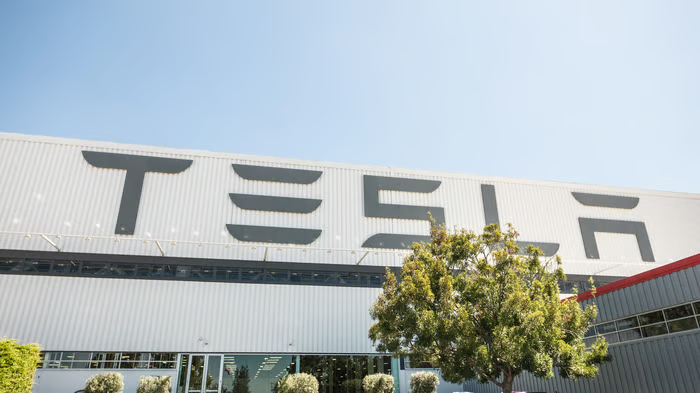
Image source: The Motley Fool.
The bull case is already public
The strongest evidence for the bulls is volume. Tesla’s 480,126 second-quarter deliveries were up 25% from the 384,122 vehicles it delivered in the year-ago quarter.
Delivery growth is also accelerating, up from a 6% year-over-year increase in the first quarter. After a long stretch of shrinking vehicle sales, growth is back.
The rest of the business is moving again, too. First-quarter revenue rose 16% year over year to $22.4 billion, with services and other revenue climbing 42%.
And after a soft first quarter in which energy revenue fell 12% year over year, energy storage deployments rebounded to 13.5 gigawatt-hours in Q2, up 41% from the year-ago period and up sharply from 8.8 gigawatt-hours in Q1.
Even the businesses investors are really paying up for are progressing. Tesla launched unsupervised robotaxi rides in Dallas and Houston in April, and it received approval for Full Self-Driving (Supervised) in the Netherlands the same month. Its active Full Self-Driving (Supervised) subscriptions reached 1.28 million in the first quarter, up 51% year over year.
And the company has the resources to keep funding its ambitions in autonomy and robotics. Tesla ended Q1 with $44.7 billion in cash, cash equivalents, and short-term investments, up from $44.1 billion at the end of 2025.
That’s an improving picture, and I don’t think the bears can dismiss it.
The bear case, in numbers
The problem, as Wells Fargo frames it, is what all of that volume actually earns.
Tesla’s first-quarter operating margin was just 4.2%, down from 5.7% in the fourth quarter of 2025. Net income was $477 million on $22.4 billion of revenue, which works out to earnings per share of $0.13. Over the trailing 12 months, Tesla has earned $1.09 per share.
At about $391, then, the stock trades at about 360 times earnings.
That is the entire debate in one number. A multiple like that isn’t pricing in a good quarter on Wednesday. It’s pricing in years of things going right, including a robotaxi business that scales into a major profit stream while the core car business stays healthy the whole way.
And consider this detail. Even at Wells Fargo’s $130 target, Tesla would still trade at about 120 times earnings. In other words, even the bear case values Tesla like a premium growth company — that’s how much optimism is baked into today’s price.
The honest answer is that Wednesday’s report can’t fully settle this. After all, the bear case is about profits, and the bull case, so far, is mostly about volume. But the report should show which way the gap is closing.
Watch whether operating margin recovers from Q1’s 4.2%. Watch what the second-quarter deliveries did to pricing. And watch energy, where a second-quarter rebound in deployments needs to show up in revenue and profit, too.
I don’t expect a 67% plunge. A decline like that would probably require the market to stop paying for Tesla’s autonomy story almost entirely, and the company keeps making measurable progress on it. But Wells Fargo’s underlying framing, I think, is the right one. At this valuation, deliveries alone aren’t enough. Profits have to follow.
Until they do, I wouldn’t buy the stock ahead of Wednesday’s report.
If Tesla can show margins turning up while deliveries grow, the bulls will have earned the next word. If it can’t, a 22% discount from the high may not turn out to be much of a discount at all.
Don’t miss this second chance at a potentially lucrative opportunity
Ever feel like you missed the boat in buying the most successful stocks? Then you’ll want to hear this.
On rare occasions, our expert team of analysts issues a “Double Down” stock recommendation for companies that they think are about to pop. If you’re worried you’ve already missed your chance to invest, now is the best time to buy before it’s too late. And the numbers speak for themselves:
- Nvidia: if you invested $1,000 when we doubled down in 2009, you’d have $526,675!*
- Apple: if you invested $1,000 when we doubled down in 2008, you’d have $63,609!*
- Netflix: if you invested $1,000 when we doubled down in 2004, you’d have $371,842!*
Right now, we’re issuing “Double Down” alerts for three incredible companies, available when you join Stock Advisor, and there may not be another chance like this anytime soon.
*Stock Advisor returns as of July 19, 2026.
Wells Fargo is an advertising partner of Motley Fool Money. Daniel Sparks has clients with positions in Tesla. The Motley Fool has positions in and recommends Tesla. The Motley Fool has a disclosure policy.
The views and opinions expressed herein are the views and opinions of the author and do not necessarily reflect those of Nasdaq, Inc.