The S&P 500 (^GSPC +0.21%) and Nasdaq Composite (^IXIC -0.22%) are up 8% and 6%, respectively, year to date. But whether the stock market can maintain its momentum is questionable.
Investors recently got some bad news about President Trump’s economy: As of July 28, oil prices have risen 30% month to date amid renewed hostilities between the U.S. and Iran, and the market now anticipates two interest rate hikes from the Federal Reserve this year.
History suggests that a shift in monetary policy will drag the S&P 500 and Nasdaq Composite into correction territory. Here are the important details.
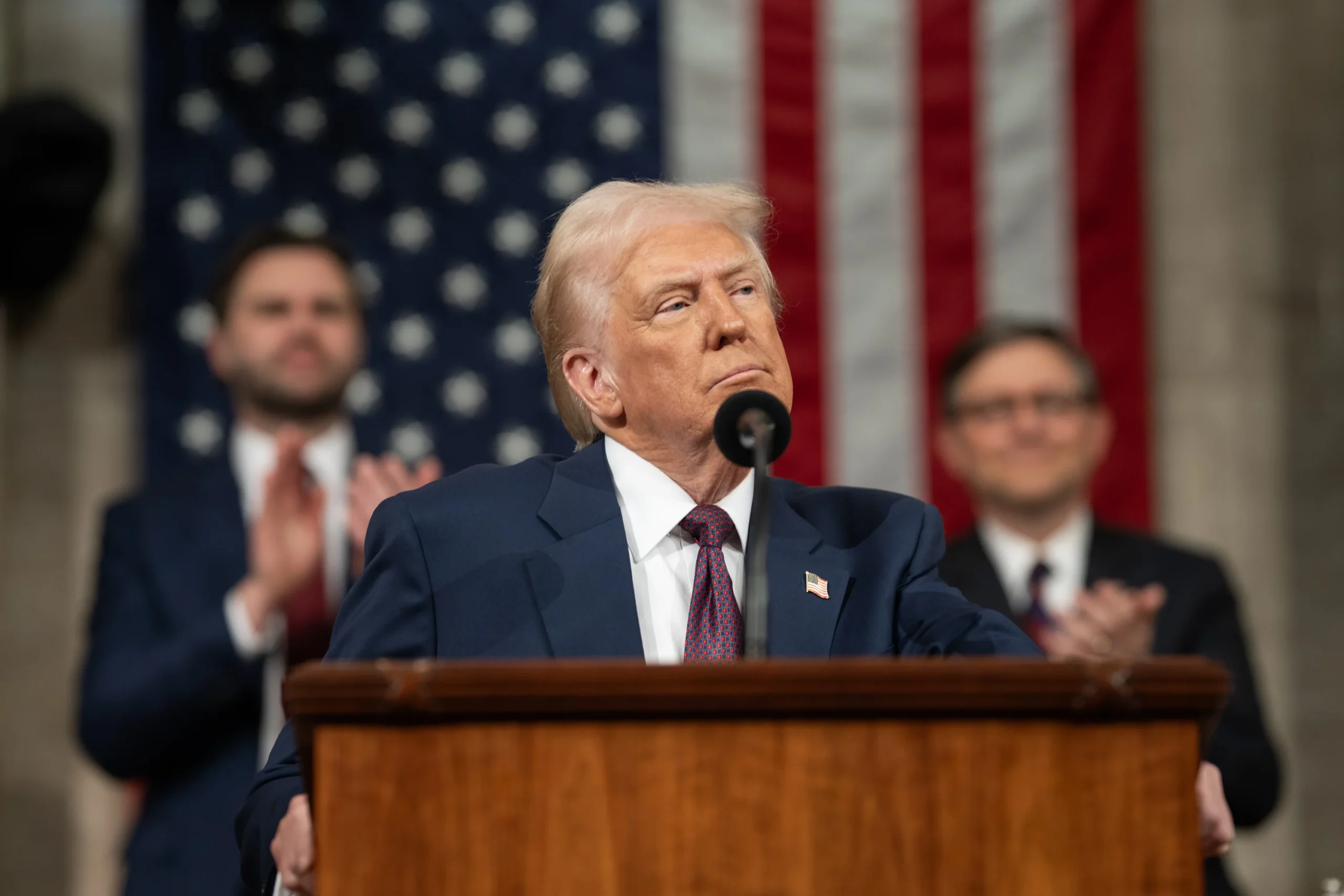
President Donald J. Trump addresses Congress. Image source: Official White House Photo.
Investors expect the Federal Reserve to raise interest rates twice by December
CME Group‘s FedWatch tool uses futures prices (tied to the federal funds rate) to calculate the odds of future monetary policy decisions. In other words, it translates what traders are willing to pay for futures contracts into percentage probabilities that the Federal Reserve will raise, lower, or keep interest rates steady at future meetings.
In January, the market expected two quarter-point rate cuts this year. In March, the case for rate cuts began to crumble as the Iran conflict caused the largest oil supply disruption in history, driving inflation to a multiyear high. By May, the probability of rate cuts had fallen to zero, and investors were betting the Fed would hold rates steady.
Today, the FedWatch tool signals two quarter-point rate hikes before year’s end, one at the FOMC meeting in September and another at the meeting in December. That’s because the Iran conflict reescalated after a short-lived ceasefire collapsed earlier this month, such that Brent crude oil prices (an international benchmark) have increased about 30% in the last 30 days.
Frank Flight, head of macro strategy at Citadel Securities, expects the Fed to raise rates at the meeting that ends on July 29. “The market may once again be underestimating the extent of the hawkish shift at the Fed,” he wrote in a note to clients. Flight argues that a rate hike would help restore price stability while also refuting the idea that President Trump compromised the Fed’s independence through his nomination of Kevin Warsh.
When the Fed pivots to rate hikes, stock market corrections often follow
If the Federal Reserve raises interest rates this year, it will mark the onset of the fifth tightening cycle (i.e., a period where rates are rising) since 1999. Past performance is never a guarantee of future results, but we can make an educated guess about where the stock market is headed by examining previous cycles.
The table shows the start date for the last four tightening cycles. It also lists the maximum drop in the S&P 500 and the Nasdaq Composite during the three months following the first rate hike in each cycle.
|
Fed Starts Raising Rates |
Max Drop in S&P 500 |
Max Drop in Nasdaq Composite |
|---|---|---|
|
June 1999 |
(8%) |
(7%) |
|
June 2004 |
(7%) |
(14%) |
|
December 2015 |
(10%) |
(15%) |
|
March 2022 |
(17%) |
(22%) |
|
Average |
(10%) |
(15%) |
Data source: Federal Reserve, YCharts. The table shows the maximum drawdown in the S&P 500 and Nasdaq Composite during the three months following the Fed’s first rate hike in a tightening cycle.
As shown, following the first interest rate hike in a tightening cycle, the S&P 500 and Nasdaq Composite have fallen by an average of 10% and 15%, respectively, at some point in the next three months. Put differently, both major stock indexes have typically entered correction territory when the Fed has pivoted from rate cuts to rate hikes.
Here’s the big picture: The Federal Reserve may raise interest rates once, or even twice, this year, and history suggests the pivot to tighter monetary policy could sink the stock market. But investors should be prepared to buy the dip should a correction materialize. The S&P 500 and Nasdaq Composite have recovered from every past decline, and there is no reason to think the next one will be any different.