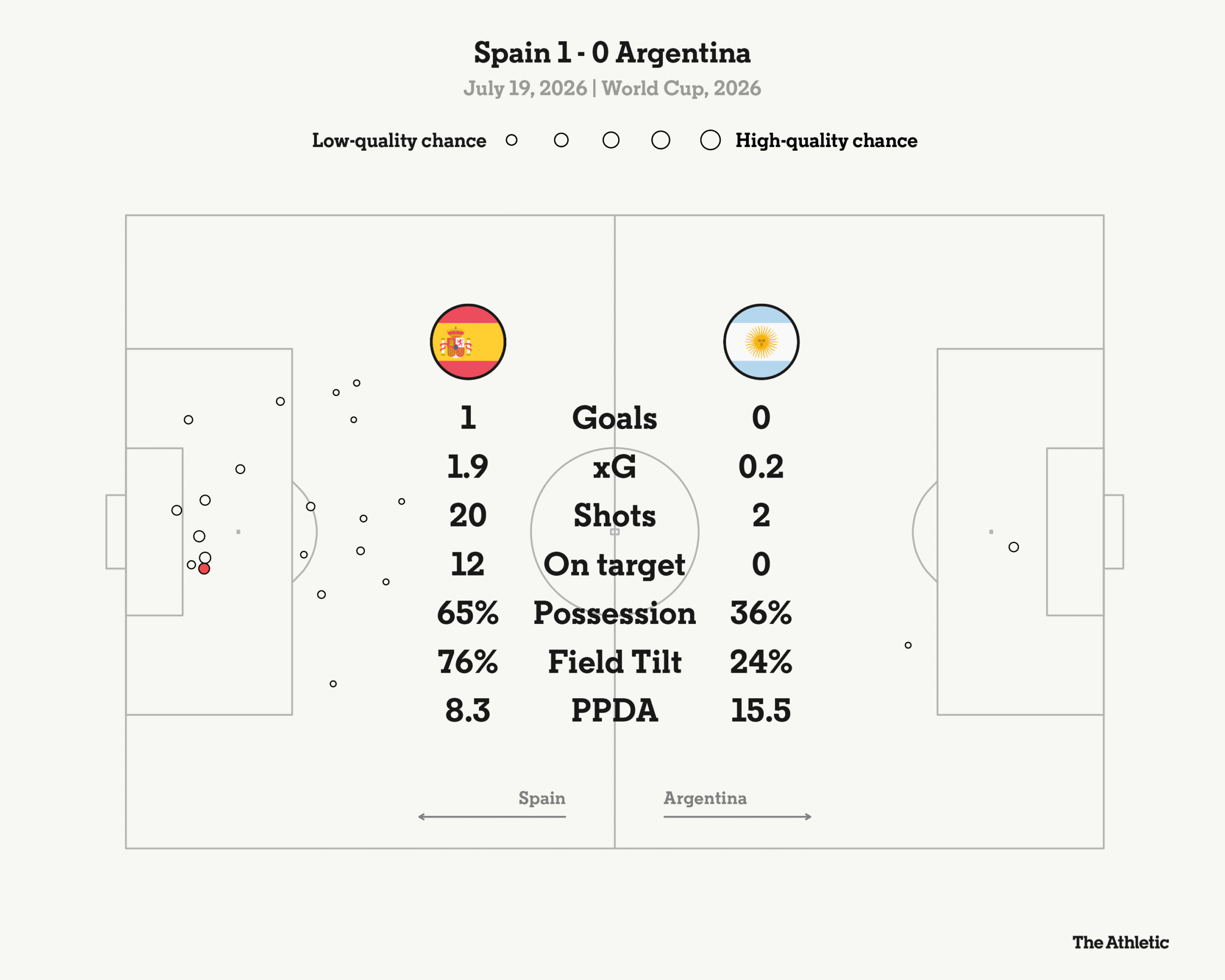
Spain won their first World Cup in extra time in 2010 and they did the same on Sunday against Argentina to become world champions for a second time.
The substitute Ferran Torres was Spain’s hero, shooting past Emiliano Martinez in the 106th minute of the game to break Argentina hearts and stop Lionel Messi and his team winning back-to-back World Cups.
The 39-year-old Messi had his quietest game of the tournament, with just a single touch in the opening 15 minutes — and that was from the kick-off. Argentina didn’t have a shot in the first half and struggled to test Spain, who were the better team throughout but failed to find a breakthrough until Torres finished off an excellent move.
The stop-start nature of the game was not helped by a 27-minute half-time show featuring Madonna, BTS, Justin Bieber and Shakira, among many, many others.
Argentina were already second-best in the game when, as proceedings were heading for extra time, they had Enzo Fernandez sent off for a second yellow card after he sent the young Spain defender Pau Cubarsi catapulting into the sky at MetLife Stadium in New York, New Jersey.
And with a player advantage in the 30 extra minutes, Spain began to exert even greater control, and after having one goal ruled out for a soft foul on the Argentina centre-back Nicolas Otamendi, Torres’ goal was enough to win the World Cup.
Jack Lang, Tim Spiers, Dermot Corrigan, Conor O’Neill and Graham Scott analyse the key talking points…
The moment Spain won it
Spain kept pushing, probing, attacking and asking incessant questions of the Argentina rearguard.
It was one-way traffic when Argentina had 11 players, let alone when they had 10, but as Argentina kept fouling, spoiling and slowing the game, penalties seemed inevitable.
Then, finally, in the 106th minute and with their 20th shot, Spain broke through.
As was the case in their quarter-final victory over Belgium and their semi-final win against France, Pedro Porro played a pivotal role, with his deep cross finding Nico Williams at the back stick, with the Athletic Club forward arching his neck to direct a perfect header back into the path of Torres, who lashed his shot past a despairing Martinez dive.

(Jewel SAMAD / AFP via Getty Images)
Their pressure had finally told and, given how they improved as the tournament went on, played as a complete team, knocked out the free-scoring favourites France and then overcame and didn’t stoop to Argentina’s rough-house tactics, Spain deserved it.
They had the best defence, conceding just one goal all tournament. They had a clearly defined, consistent playing style that didn’t lean heavily on their star player Lamine Yamal. And, like when they last won it in 2010, they dominated the final against aggressive opponents and scored the winner in extra time.
Tim Spiers
A bleak ending to Messi’s World Cup career?
There was a moment, in the dying embers of regular time, when Messi sprang to life. He had spent most of the preceding 90 minutes in glorious isolation, watching from afar as Spain passed the Argentina defence into a state of hypnosis. He had barely touched the ball, let alone managed to weave the usual magic with it. But a player of Messi’s class never stays quiet for long.
And so, just after Fernandez’s red card, he dug deep… and grassed Marc Cucurella up for speaking to him with his hand over his mouth. The referee was not moved.


Messi has put in some of the great World Cup performances. A few of them have come this summer. This was not even within a million miles of being one of them. This is a vanishingly rare thing to say about Messi — something that feels close to sacrilegious — but he simply did not influence this match. His one shot of note came deep into extra time and was blocked before it tested the Spain goalkeeper Unai Simon.
There is a bit to unpack here. In so many matches, Messi has dragged Argentina out of holes. Sometimes it has seemed like their entire system is just giving the ball to him. When you have the best player ever, that makes a kind of sense. Here, though, it was not enough. Messi was well marshalled. And Argentina had nothing else.

It will go down as a bleak, unfitting ending. It also carried a few resonances. A decade ago, Messi walked out of the MetLife Stadium convinced he’d played his final international game, Argentina having lost the 2016 Copa America final to Chile. “It’s over,” he said after that match. He was not, at that point, universally loved in his homeland.
It wasn’t over. Messi’s second act has been magnificent. It has yielded a World Cup and two Copa America titles. It has cemented his legacy, especially at home. He was hoping, in New Jersey, for the perfect finale.
But for once, fate did not smile on Argentina’s talisman.
Jack Lang
What happened after the full-time whistle?
There were ugly scenes after the final whistle as scuffles broke out between Argentina and Spain players.
As the Spain players rushed on to the pitch in celebration, Nahuel Molina appeared to try and catch the substituted Rodri with his hand as he ran past. The Manchester City midfielder went to confront Molina, who squared up to him, before Spain’s Eric Garcia pushed the defender away.


An argument then developed between Garcia and Leandro Paredes, who pushed the Barcelona defender in the throat as Lionel Scaloni attempted to intervene. Thiago Almada seemed to wrestle with Gavi and Paredes then went for the midfielder too, grabbing him by his substitute’s bib and pushing him down.


Paredes was eventually drawn away from the melee, but it was a sorry way for Argentina’s tournament to end.
Tomas Hill Lopez-Menchero
How much did Fernandez’s red card cost Argentina?
It took just over 10 minutes for Fernandez to write himself into the history books — for all the wrong reasons.
The Argentina midfielder was first booked for dissent. After being eased off the ball by Rodri in the centre circle, he collapsed to the floor and appealed for a foul. When the referee Slavko Vincic ignored his pleas, he aggressively swung his arms, showing his disgust. Vincic brandished a yellow card.
In added time at the end of 90 minutes. A loose ball landed between Fernandez and Spain defender Cubarsi. The latter was always the favourite for it and got there first. Fernandez should have pulled out but didn’t, sending Cubarsi’s body tumbling through the air.

(Jewel SAMAD / AFP via Getty Images)
It was beyond brainless from the Chelsea midfielder. It also forced Argentina into a change of shape. Initially, Julian Alvarez dropped even deeper than he had already been playing. Then, as Spain tightened their grip in extra time, Lionel Scaloni threw on an extra defender, leaving Messi alone up front.
From that point, it was penalties or nothing from Argentina. And when Torres scored, Fernandez’s idiocy only came into greater focus.
Jack Lang
How did it take until the 41st minute for the referee to show a yellow card?
Referee Slavko Vincic adopted a low-key approach to the World Cup final in the first half, but a decision not to show a yellow card to Alexis Mac Allister could have come back to haunt him.
The Liverpool midfielder’s tackle on the halfway line early in the first half was late, involved both feet and could only be described as reckless. The fourth official had the perfect view, and should have been able to describe what he saw in such terms that Vincic would have shown a card.


Mac Allister clatters into Olmo, who had moved the ball away from the lunging Argentina midfielder (REUTERS/Carlos Barria)
Top referees always want their first yellow to be for an offence that no one can dispute, which sometimes leads to borderline tackles being excused early in the match. But Mac Allister crossed the line in the 15th minute and should have been punished.
Vincic might have regretted his leniency had Mac Allister later committed another yellow-card offence that had a major impact on the game, such as stopping a significant Spain attack.
Argentina’s Nicolas Tagliafico could easily have received a yellow card when he deliberately brought down Spain’s Lamine Yamal. He was saved by the presence nearby of Lisandro Martinez, but the challenge was so unorthodox, clumsy and deliberate that many referees would have cautioned the defender.

The first yellow card was eventually shown to Martinez for a deliberate foul in the 41st minute, which was equally indisputable, as Spain were breaking at pace.

Martinez was booked for flying through the back of Oyarzabal (Kevin C. Cox/Getty Images)
Refereeing finals and other major matches involves striking a careful balance between asserting authority while allowing the players to take centre stage.
No referee wants to reduce a team to 10 players unless it is for an offence that everyone watching would agree left the ref with no choice. Already on a yellow card, Fernandez fulfilled that brief with his wild tackle on Pau Cubarsi. Vincic duly showed him his second yellow and sent him off.
The Chelsea midfielder’s tackle happened at such a pace that Cubarsi was sent spiralling into the air, which made me wonder if Vincic might show a straight red. But a yellow card was the correct call, as Fernandez’s studs were pointing down and the point of contact was low. Fernandez was left to rue the earlier caution he received for a visible show of dissent.
Graham Scott, a former Premier League referee
How did Spain stop Messi — and Argentina?
Shackle Messi, shackle Argentina.
Spain are the first side to keep the tournament’s star player quiet, a feat that nullified the rest of Scaloni’s attack. He took just 15 touches in the first half, his lowest tally across the last three World Cups, with his pass from kick-off his sole contribution in the opening quarter of an hour.

By dominating possession and ferociously hunting it back, Spain smothered Argentina, cutting off the supply line to their talisman. Thierry Henry, speaking on Fox Sports, described what it is like playing against this intense style. “You feel like your head is underwater. You feel like you’re suffocating,” he said.
Aware that Messi, for all his gifts, has lost that explosive yard of pace at 39 years old, Spain pushed their defensive line high, condensing the pitch. When Messi was played through early on, goalkeeper Unai Simon raced off his line, reaching the ball first near the centre circle.
Against this pressure, Messi, as he does, scanned the pitch for dangerous pockets of space, but was cut off each time. Just before the hydration break in the first half, he finally received the ball on the turn in midfield, only for Rodri to barge into him and concede a foul.

(MAURO PIMENTEL / AFP via Getty Images)
Against England and Egypt, Messi had turned the game by drifting out to the right, a tactic he tried again here. Spain were wise to it, quickly doubling up and crowding him out.
But Messi’s lack of influence owed less to his own ineffectiveness than to Spain’s dominance, which starved him of the ball, leaving him to feed off scraps.
Conor O’Neill
Was Rodri the most influential player at the World Cup?
Messi has had the greatest individual impact on this World Cup, especially during those fantastic late comebacks by Argentina. But Spain midfielder Rodri has arguably been the most influential player through the tournament, with his outstanding passing and pressing key to Spain’s semi-final victory against France.
The 30-year-old Manchester City man was easily the central figure of the final. Rodri was everywhere — nipping in cleverly to intercept a dangerous Argentina pass near the halfway line, arriving right on time to provide a passing option to a team-mate in trouble and surging forward to set up a dangerous Spain attack.
It was a scandalously good performance by the 2024 Ballon d’Or winner — with his reading of the game so good that the ball seemed attracted to him. He was not afraid of getting stuck in either — when Messi threatened to break at one point, a neat tug on the Argentina No 10’s shirt stopped any danger.

Moments later in the first half, Rodri was at the centre of a dazzling passing move as Spain pinged the ball forward, with midfield colleagues Dani Olmo and Fabian Ruiz also involved, leading to a half-chance that Mikel Oyarzabal hit too close to Argentina goalkeeper Emiliano Martinez.
Argentina’s players’ aggressive approach continued after the break, with Leandro Paredes booked for a cynical elbow into Rodri’s back. It was a sign they felt they needed to do something to try and interrupt his control of proceedings but, once back to his feet, Rodri continued to direct almost constant, one-way traffic towards the Argentina goal. Messi was barely involved in the play, and Argentina had zero shots on goal with normal time almost over.
Superstar forwards have dominated the headlines at this World Cup, but Rodri — a player who prefers not to have any social media presence — has tactically and technically been its most significant performer.
Dermot Corrigan
Was a 27-minute half-time show really needed?
For the first time in World Cup history, half-time lasted longer than 15 minutes (27 minutes and 23 seconds, to be precise) to allow for an all-singing, all-dancing musical performance — AKA a Super Bowl-style half-time show.
The undoubted star (sponsored by Topps) from a football point of view was an awkward, grinning, goofy Ronaldo Nazario, accompanied by his old Brazil team-mate Ronaldinho, driving a buggy into the stadium with Madonna in the back singing her song Music. Welcome to an American World Cup.

Ronaldinho, Madonna and Ronaldo during the half-time show (REUTERS/Hannah Mckay)
The rest of the show featured South Korean boyband BTS, Shakira, Burna Boy, Ted Lasso, Justin Bieber, The Muppets, the New York Philharmonic Orchestra and the Simon Bolivar Symphony Orchestra of Venezuela (obviously)… and Coldplay, who ended the whole thing with a schmaltzy cacophony of music, colour and the word love.
Was there much to do with football? Well, they did a short bit on the Norwegian row, as performed by their fans and players at this tournament, and an orchestral version of Seven Nation Army, but there were no mentions of Spain’s fluent passing game or Kylian Mbappe’s excellent tournament goalscoring record.
As a show, fine, it was actually great (apart from the bum Bieber note, a solo acoustic number that went on far too long), extremely well choreographed, slick, fun and entertaining.
But was it worth interrupting the World Cup final for 27 minutes? Absolutely not.
This isn’t the Super Bowl. Do it before or after the game next time, please, FIFA.
Tim Spiers