
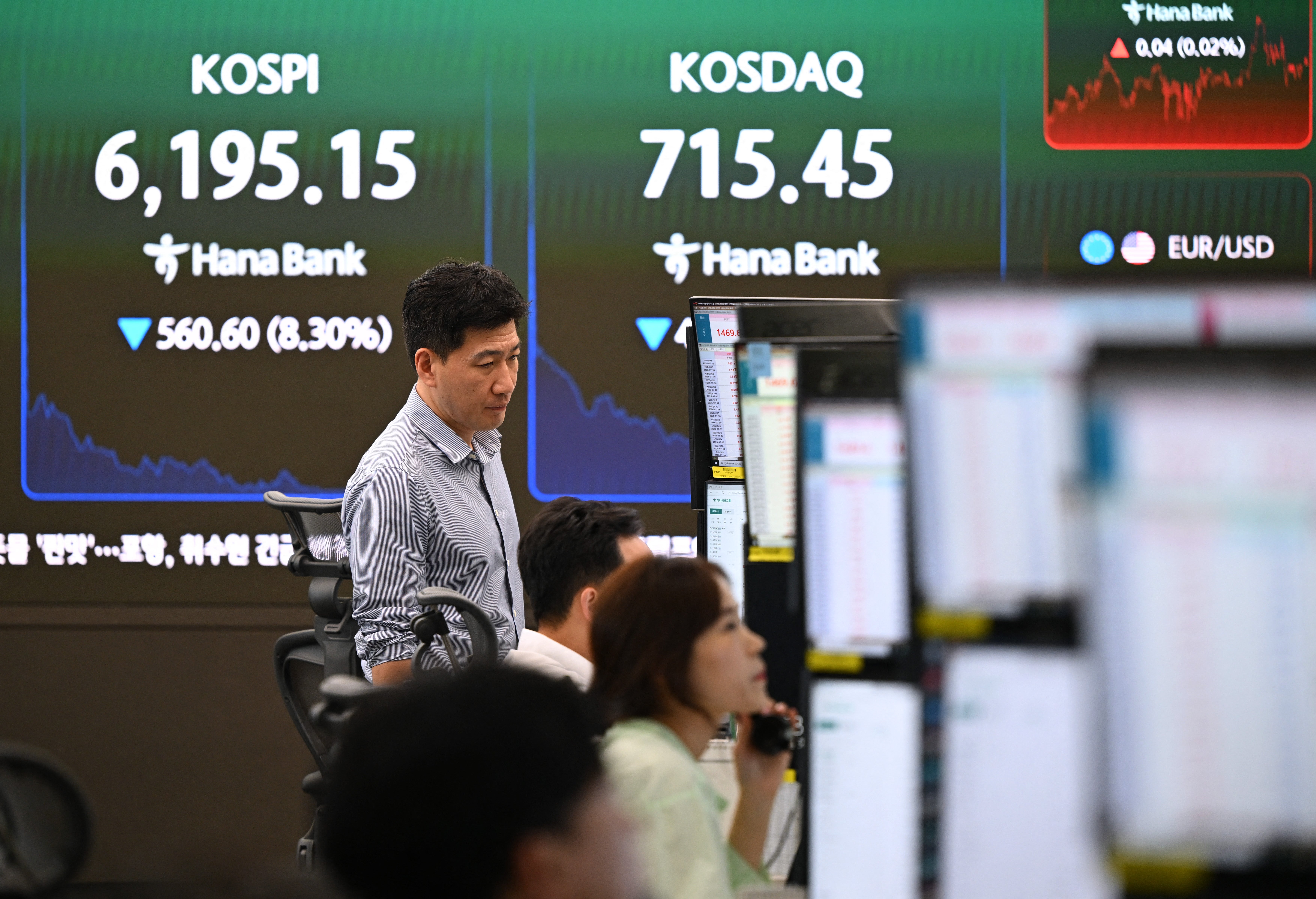
Asian semiconductor stocks tumbled on Tuesday, with South Korea leading the regional selloff, as investors questioned lofty valuations amid concerns over AI infrastructure financing and intensifying competition from China.
Shares in memory-chip giants Samsung Electronics and SK Hynix plunged as much as 13.4 per cent and 14 per cent, respectively, amplifying the decline in Seoul.
Together, they account for nearly half of the benchmark KOSPI which was down about 10 per cent as of 5.05GMT.
Japanese flash memory-chip maker Kioxia Holdings slumped nearly 18 per cent, while Taiwanese chip designer MediaTek fell more than 9 per cent in morning trade.
SK Hynix’s US shares closed 7.5 per cent lower overnight at $143.02, the first time below their $149 initial public offering price since debuting this month, highlighting how quickly sentiment has turned against one of the biggest beneficiaries of the AI boom.
“We seem to be at the despair part of the selloff, where tech investors are rushing for the exit because the Nasdaq says so,” said Matt Simpson, a senior analyst at StoneX.
“But right now the KOSPI is setting the tone for sentiment in Asia, and it looks ugly.”
Hynix, a key supplier of high-bandwidth memory chips to Nvidia, has been one of the biggest beneficiaries of the AI spending boom, making its shares particularly sensitive to shifts in investor sentiment toward the sector.
Analysts said the selloff reflected a combination of concerns over AI infrastructure financing, China’s technological advances and rising competition from Chinese firms.
Han Ji-young, an analyst at Kiwoom Securities, said reports that Chinese companies were developing domestic deep ultraviolet (DUV) lithography equipment had reignited concerns that Chinese memory-chip makers could accelerate capacity expansion, intensifying competition in the global memory market.
While details such as the companies involved, equipment performance and commercialisation timelines had yet to be disclosed, the news had cooled investor sentiment as the investment narrative for semiconductor stocks had already weakened, he said.
Mr Han added that investors were becoming increasingly cautious ahead of a string of earnings reports due later this week.
“Despite stronger-than-expected earnings from Samsung Electronics earlier this month and Alphabet last week, semiconductor shares experienced sharp declines after the results,” he said.
Separately, a Wall Street Journal report that Nvidia could provide a roughly $250bn financial backstop for an OpenAI data-centre project sent Nvidia shares down nearly 5 per cent, with investors questioning the extent to which the AI chip leader may be financing its own customers.
Further weighing on sentiment, the growing popularity of low-cost Chinese open-source AI models such as Kimi K3 raised questions about whether future AI workloads could prove less intensive than previously expected – meaning less demand for advanced AI chips and HBM.
Chinese memory-chip maker CXMT’s strong stock-market debut on Monday added to concerns about intensifying competition in the global memory industry.
“CXMT is going to be one of the big index weights. As that’s going on, people have to dump more of their existing stocks,” said Hao Hong, managing partner and chief investment officer at Lotus Asset Management in Hong Kong.
The listing also reinforced concerns that CXMT could emerge as a more formidable memory supplier, increasing the risk of oversupply and weaker pricing, said Ryu Young-ho, a senior analyst at NH Investment & Securities.
The CXMT listing came after reports that Apple had been lobbying the Trump administration to allow the use of Chinese-made chips in some of its products, further unsettling investors already concerned about China’s growing technological capabilities.

