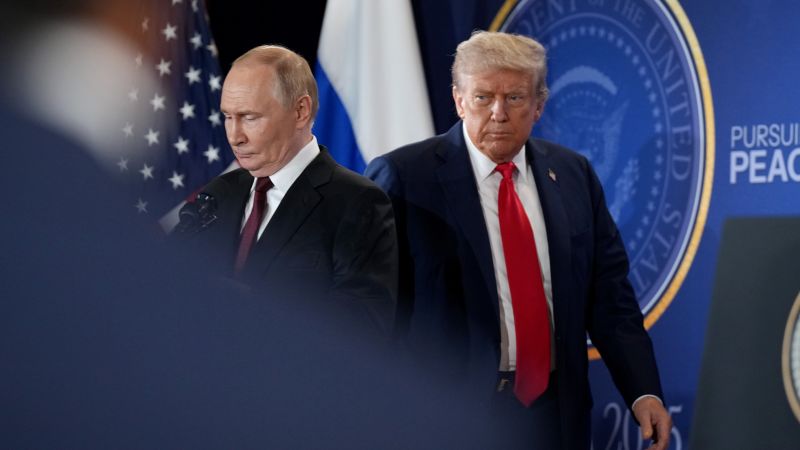
Russia’s harrowing history has bred a dark sense of humor in its citizens.
CIA Director John Ratcliffe’s hosts therefore surely appreciated the irony when he flew into Moscow this week, reportedly to tell the Russians that they are losing their debacle of a war in Ukraine.
Russian spy chiefs might have pointed out that President Donald Trump, like President Vladimir Putin, is also embroiled in a war — in Iran — that he can’t win and can’t end.
Two leaders in two different conflicts face a similar dilemma: They can’t achieve their war ends. But they can’t walk away and save face.
Each launched hostilities after apparently underestimating the tenacity and capacity of adversaries whose militaries were dwarfed by the conventional power and matériel of US and Russian forces.
Both Putin and Trump saw their tactical military advantage undermined by unconventional asymmetrical tactics by Ukraine and Iran that pioneered cheap new technologies like drones and a new era of warfare.
In its report describing Ratcliffe’s visit, the New York Times noted a concern long shared by many in the Washington foreign policy community that Putin is not getting honest assessments of the war’s trajectory. Many observers wonder whether Trump’s sunny assessments of US victory in Iran mean he’s also poorly served by an inner circle unwilling to give him bad news.
Washington and Moscow are no strangers to costly foreign entanglements; both, for example, were humbled by wars in Afghanistan. Russia’s disaster in Ukraine in some way recalls the US defeat in Vietnam.
Still, the parallels between two strongman leaders now stuck in wars they started, while apt, only go so far.
Trump has not copied Putin’s grave error of pouring ground troops into a quagmire — a decision that has left more than 1.4 million young Russians dead, injured or missing, according to the Center for Strategic and International Studies.
Putin, a true authoritarian leader, is less constrained than Trump by domestic dynamics. Such a toll would be politically unsustainable in the US.
And while Putin is raining terror and death on Ukrainian cities and power plants with missile and drone raids, Trump has largely avoided deliberately targeting civilians and civil infrastructure in his war. He has declined, however, a full public accounting of a missile strike that hit an Iranian school in February, killing nearly 200 children and adults, which apparently resulted from the use of outdated intelligence.

Ratcliffe’s surprise visit to Russia came at a moment of flux and somber omens in international relations as the wars in Ukraine and Iran destabilize the wider Middle East, entangle the world’s great powers and raise fears of widening geopolitical conflict.
The CIA chief had a broad agenda.
He warned Russia against any overt or covert attacks on NATO territory amid growing fears in Europe that Putin might test the alliance’s defenses, two people familiar with the matter told CNN. Ratcliffe also used his meetings with Russian espionage officials to encourage Russia to cut off economic and military support for Iran.
His mission could offer a measure of relief to US allies who’ve long fretted about Trump’s commitment to NATO and its security guarantees. And a fresh US attempt to end the Ukraine war would be widely welcomed, even if the president’s downgrading of military aid to President Volodymyr Zelensky’s government raises suspicions about his motives. Trump still hasn’t followed through on an apparent offer this summer to allow Ukraine to license the production of Patriot anti-missile systems.
Trump once predicted he could end the war in Ukraine in 24 hours, but his peace efforts have gone nowhere. His repeated claim that Putin wants to make peace is incessantly disproved by events.
The United States has been an arm’s-length player in the Ukraine war since the start. Russia has its own over-the-horizon role in the Iran war.
US missteps in Iran are especially in the spotlight this week because the war has hit its six-month mark as the administration turns from military action to all-out economic warfare.
Russia may have little strategic interest in easing Trump’s plight in Iran. Any quid pro quo involving Ukraine would founder on the US president’s previous failure to browbeat Kyiv into territorial concessions.
CNN reported in March that Russia has provided Iran with intelligence about the locations and movements of American troops, ships and aircraft, according to multiple people familiar with US intelligence reporting on the issue. Much of the intelligence Russia has shared with Iran has been imagery from Moscow’s sophisticated constellation of overhead satellites.
Putin’s anti-Western posture means Russia is constantly combating US and Western influence in the Middle East and elsewhere. He’s likely playing a longer game than Trump, whose term ends in two-and-a-half years.
Still, Washington could use the help of Moscow — and Beijing — with its new policy of utter economic isolation for Iran.
“For the economic pressure to bear fruit, (Trump) has to be able to get some cooperation with the Chinese, the Russians, and other regional actors that are the main trading partners for the Iranians,” Firas Maksad, Eurasia Group managing director for the Middle East and North Africa, told CNN International on Thursday. “I think he’s going to have a real hard time getting the Chinese to cooperate … It’s a similar situation with Russia.”

As the implications of Ratcliffe’s trip sunk in Thursday, the Washington Post reported that his visit was preceded by fresh US intelligence suggesting the Kremlin sees the US as weakened by the Iran war.
Trump’s failure to decisively win the conflict has not only bruised US credibility; it has also depleted munitions and strained naval and air forces. It would not be surprising therefore if US adversaries like Russia and China question Washington’s capacity for or interest in responding to any crisis in Europe or Asia.
“Because Donald Trump decided to go to war against the Iranians, without a strategic goal, without a plan, without a timeline, without a way out, and now he is stuck — yes, sure, that helps the Russians,” Democratic Sen. Mark Kelly of Arizona told CNN’s Brianna Keilar on Thursday. “And by the way, the Russians are helping the Iranians.”
Trump, however, argues that his friendly relationship with Putin makes the world safer. He insisted on Thursday that there was no danger of Putin taking any action that could cause a conflict with the West. “I’ve had good talks with him. He’s not going to be attacking a NATO territory,” he told CNN’s Kristen Holmes in the Oval Office.
Still, multiple layers of intrigue surrounding Ratcliffe’s trip to Moscow represent a fascinating new twist in the extraordinary relations between two leaders who face a common strategic conundrum that may define their legacies.
The Iran war may not be as existential for Trump’s political and personal survival as the conflict in Ukraine is for Putin. But like his friend in the Kremlin, he’s cornered by his own war.