By now, millions of people use wearables to track what their bodies are doing, measuring everything from heart rate and sleep to blood oxygen, movement, and more. Medical implants can go a step further, sensing or treating problems from inside the body. But getting all these devices to communicate with one another is surprisingly difficult.
Researchers at Georgia Tech have an idea to bypass that. They want to stop treating the body as an obstacle to wireless communication and start using it as part of the network.
So if, say, a sensor on your arm detects that something has changed in your body, instead of sending the information over Bluetooth, it can send a tiny electrical signal through your tissues. Somewhere else, an implanted device receives the signal and responds, perhaps by stimulating a nerve or eventually releasing a drug.
In a new study published in Science, researchers showed how this could be done, allowing wearable sensors and implanted devices in different parts of the body to exchange simple commands without relying on external channels like Bluetooth.
Bluetooth isn’t great inside a body
Plenty of medical implants already communicate wirelessly. But human tissue isn’t particularly friendly to radio waves.
Bluetooth and similar systems require antennas, communication electronics and power. For a smartwatch, that’s manageable. For something researchers want to inject deep beneath the skin or place in the stomach, every millimeter and every bit of battery consumption matters. You’d need safe materials, a way to recharge, and that comes with a whole range of challenges as well.
Near-field communication, or NFC (the tech you use to pay contactless with your phone), can use less power, but typically operates over relatively short distances and requires the transmitter and receiver to be positioned appropriately.
The new system takes a different approach.
Instead of trying to send radio waves through the body, it uses the fact that our tissues contain water and dissolved ions and therefore conduct electricity.
The researchers call it SWANS, for Smart Wireless Autonomous Networking System.
The body becomes the wire
The whole process is safe because the electrical currents are too small to cause damage. A wearable hub introduces very small electrical pulses into the tissue. Those pulses generate a voltage gradient through the body.
An implant contains conductive pads and a simple transistor circuit that detects this change. Once the signal exceeds the transistor’s threshold, the device switches on.
There’s an added advantage that different implants can be designed to respond to different combinations of voltage and pulse duration. That means the system doesn’t simply shout “turn on” to every device at once. One electrical pulse might activate implant A, while a different pulse activates implant B.
The result is closer to a simple electronic system than to conventional wireless networking. It’s just that the body becomes a part of the wiring.

And because an implant doesn’t need to constantly listen for Bluetooth transmissions, its communication hardware can remain extremely small and consume almost no power while waiting.
The researchers report that their communication components are more than 15 times as power-efficient as Bluetooth and NFC-based alternatives and has more than ten times the tissue communication coverage of Bluetooth.
They made a rat’s legs communicate

To demonstrate that the idea really works, the researchers created a network spanning much of a rat’s body.
They attached flexible strain sensors to the animal’s front limbs. These sensors detected movement. Then, a wearable electronic hub translated that information into an electrical pulse sent through the animal’s tissues.
Implanted devices near the hind limbs detected the signal.
Those implants were connected to cuffs around the sciatic nerves. When the correct implant switched on, it stimulated the nerve and caused the corresponding hind leg to move.
So movement at one end of the animal automatically triggered an electronic intervention at the other.
The proof-of-concept experiments involved three rats, with repeated trials demonstrating selective hind-leg activation.
The device hasn’t been demonstrated in humans yet.
Working in rats is strong evidence that the concept can function in a living body, but it is not enough to assume it will work equally well in humans. Human bodies are much larger, with thicker and more variable layers of fat, muscle and other tissues that change how electrical signals propagate, and the system would also need to prove long-term safety, reliability and consistent performance across different people.
Tiny implants, simple signals
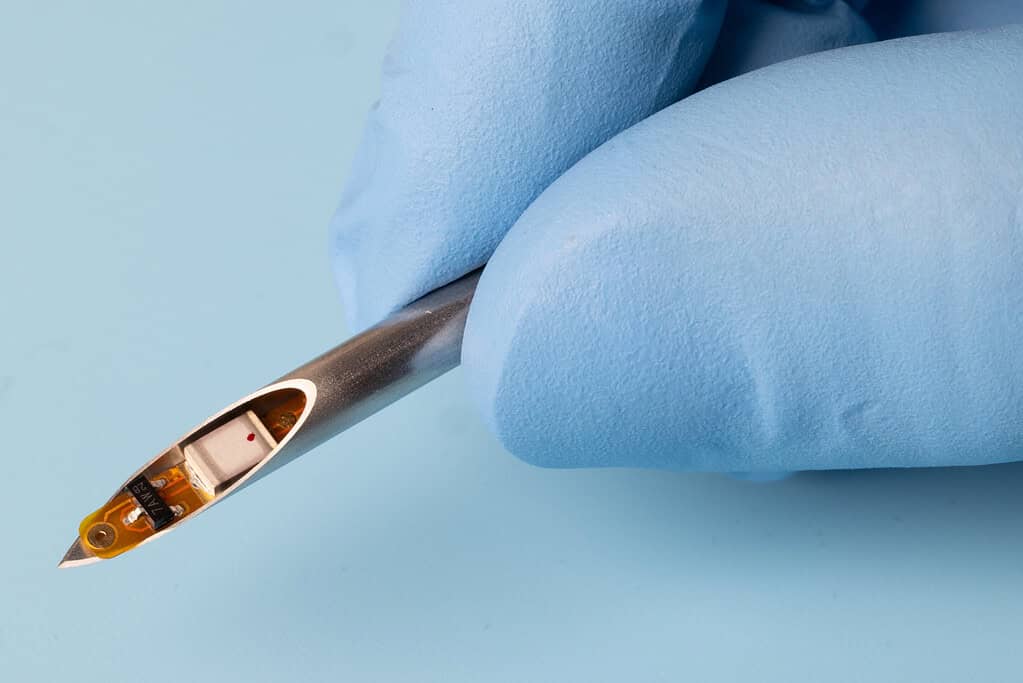
Miniaturization is one of SWANS’ biggest strong points. Some versions of the communication electronics are under three millimeters across and small enough to pass through a 16-gauge needle, potentially allowing devices to be injected rather than surgically implanted. The researchers also tested communication beneath the skin, in the abdominal cavity and through the gastrointestinal tract.
The idea isn’t to stream large amounts of data through the body, but to let distributed sensors and implants exchange simple commands while more complex processing happens in an external wearable.
“With our system, you can now place sensors in the best possible place to detect a biological signal and place actuators in the best possible place to perform a therapeutic action,” senior author Alex Abramson said.
The setup also keeps power use low. The researchers estimate that a small actuator triggered about once a day could run for roughly a year, and their tests found no detectable tissue damage from the electrical pulses under the conditions studied.
There are still major hurdles before this reaches people. The most advanced demonstration was in rats, and differences in tissue thickness and electrical properties already required some individual adjustment. Human bodies would make that challenge considerably harder.
Still, the study points to an appealing alternative to squeezing ever-smaller Bluetooth systems into implants. As the researchers effectively ask: why not use the body itself as the network?
Journal Reference: Ramy Ghanim et al, An in-body networking system for communication between wearable and implantable therapeutics, Science (2026). DOI: 10.1126/science.adz5300. www.science.org/doi/10.1126/science.adz5300