Russia is so vast that some citizens living in remote parts of the Far East may not even know their country is at war.
Residents of Belgorod certainly can’t enjoy such blissful ignorance. The Russian region, which sits immediately north of Ukraine’s Kharkiv and contains key supply routes for Vladimir Putin’s forces engaged across the border, now faces incessant Ukrainian drone attacks.
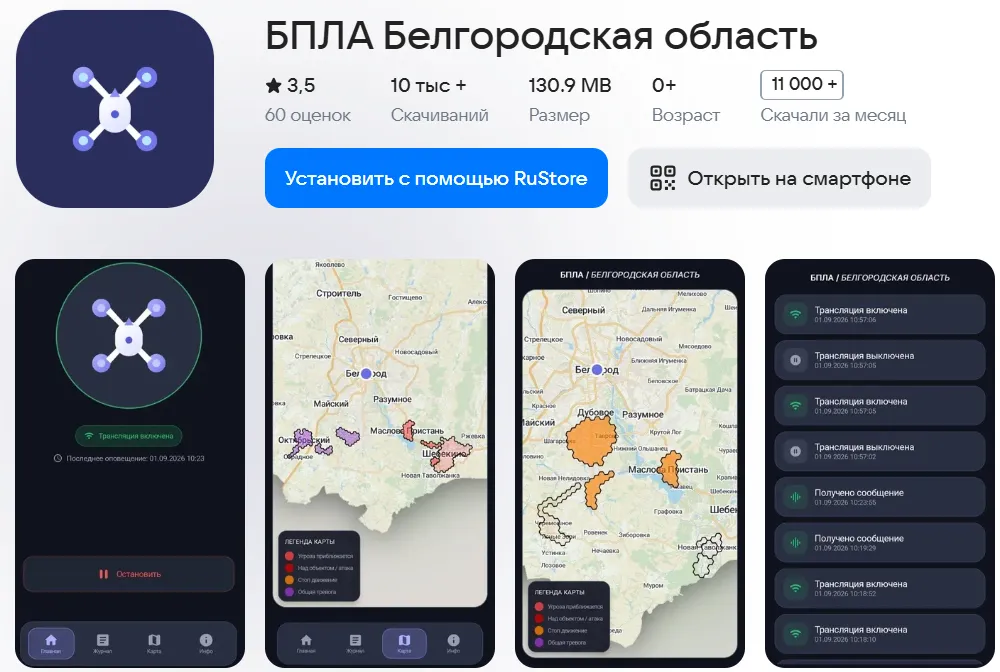
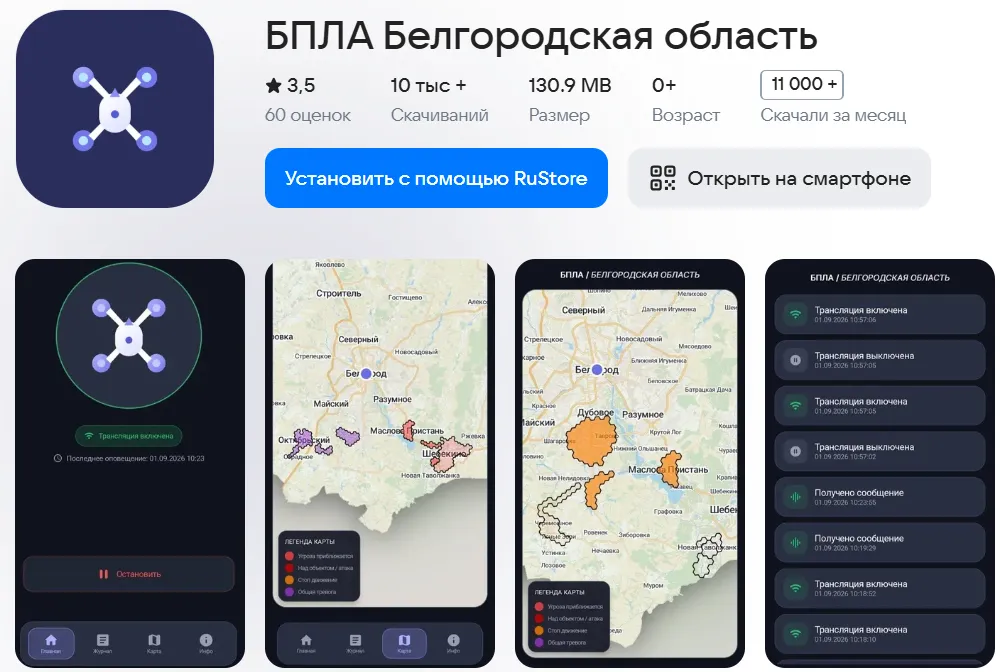
To protect civilians from the strikes, Belgorod’s Digital Development Ministry did a commendable thing: it launched an app to warn residents of oncoming UAVs and show threatened areas on a map.
Then, the state blocked it from working properly.
It’s the latest perverse example of how Russian civilians are paying the cost for Putin’s special military operation. Russian officials are scrambling to protect civilians from a problem created by the invasion of Ukraine, only to discover that one supposed countermeasure has cancelled out another.
Solving the Solution to the Problem
The app, called “BPLA Belgorod Region”—BPLA is the Russian acronym for UAV—appeared on Russia’s RuStore marketplace on September 1.
Its design is simple. Upon installation, the app stores a map of Belgorod onto the user’s smartphone, then warns users of possible drone strikes via push and audible alerts, highlighting areas under threat.
Belgorod needs it. On September 6 alone, the region’s operational headquarters said 269 Ukrainian drones attacked 17 municipalities. Three civilians were killed and seven more were injured.
Unfortunately, smartphone apps have one fairly traditional requirement to function properly: an internet connection. In Putin’s Russia, that can be hard to come by, because authorities have imposed widespread restrictions on mobile internet since May last year.
The official justification is security; Russian authorities restrict mobile internet during drone threats ostensibly because cellular networks and SIM cards can potentially assist drones with navigation and communications.
There is, however, another convenient feature—it gives the state extraordinary influence over what the Russian public can see and share online.
When viewed in tandem with Russia’s crackdown on private and foreign social media and messaging apps, and attacks on VPN providers, the mobile internet blackouts represent another lever the Kremlin can pull to centralize control of the information space.
To prevent Russians from being completely cut off, authorities maintain “whitelists”—a small set of approved websites and domains that remain accessible to the public during a shutdown. But, judging by several user reviews on RuStore, Belgorod’s drone warning app has not yet made the cut.
“The app is good, and most importantly, it’s USEFUL! But there’s one big BUT: whitelisting! As soon as whitelisting is enabled, the app immediately becomes useless. PLEASE whitelist this app or allow VPN use,” Vyacheslav wrote.
Some reviewers very pleasantly pointed out that there’s not much point in having an app that only warns you to take shelter when you’re already at home, taking shelter.
“Hello, dear app developers. Your app works perfectly on Wi-Fi and even sends voice messages,” one kindly user wrote. “But as soon as I switch to mobile data, the broadcast immediately disappears. Can you make the app work without internet, because when you’re traveling, there’s not always internet.”
Others were slightly less polite. “The app has major flaws, it doesn’t work on mobile, it’s useless!” one review said. “It refuses to connect over mobile data. What’s the point of such an app?”
“Total crap!!! Nothing works!!!” another read.
Whatever combination of drone defense and digital control is driving the system, the result in Belgorod is as amusing as it is tragic. For the civilians living there, it’s potentially lethal.
Patching Putin’s War
The official line that mobile internet blackouts are designed to counter Ukrainian drones does not hold up to scrutiny.
Na Svyazi, an independent Russian monitoring group tracking connectivity disruptions, has documented thousands of mobile internet shutdowns per month in 2026 across all of Russia, including in far eastern regions under no threat of drone strikes.
Mobile internet restrictions are not the app’s only problem, either.
Users have complained about Wi-Fi connections, disappearing signals, startup failures and missing sound notifications. Several users reported that the app simply would not open, and the developers have separately acknowledged a bug affecting some Android devices.
These shortcomings indicate just how ignorant and underprepared Russian authorities were when Putin ordered the special military operation on February 24, 2022.
On March 1 of this year, Ukraine celebrated the fourth anniversary of Air Alert – the state-backed app developed to warn citizens of Russian strikes nationwide. Ukraine’s developers built and released the app in a matter of days, even as Russian tanks were bearing down on Kyiv. Within a week, it had been downloaded 2 million times.
Four-and-a-half years into the war, and Belgorod’s citizens have a barely functioning app, even though the region has suffered intermittent attacks since 2023, and regular barrages since early 2025.
This is a symptom of a government rapidly patching software for a reality it never expected its civilians to inhabit. But it’s by no means the only ragged improvisation to cope with the unexpected domestic consequences of war.
Last week, the Russian government quietly passed a resolution that amended the official equipment list for federal postal organizations.
Alongside the traditional security gear, from Saturday postal service officials may be equipped with “special technical systems for countering unmanned aircraft”, as well as “surface and underwater craft, driverless vehicles and other automated unmanned systems”.
Yes, you read that right – Russia’s postal service has formally entered the air defense and counter-drone business.
The Kremlin once sold the invasion as something Russians could watch largely from a distance: a corrective, almost disciplinary measure applied to keep an unruly Ukrainian junior in line.
But in Belgorod and beyond, what little distance there was between the civilians and the reality of modern war is long gone.

