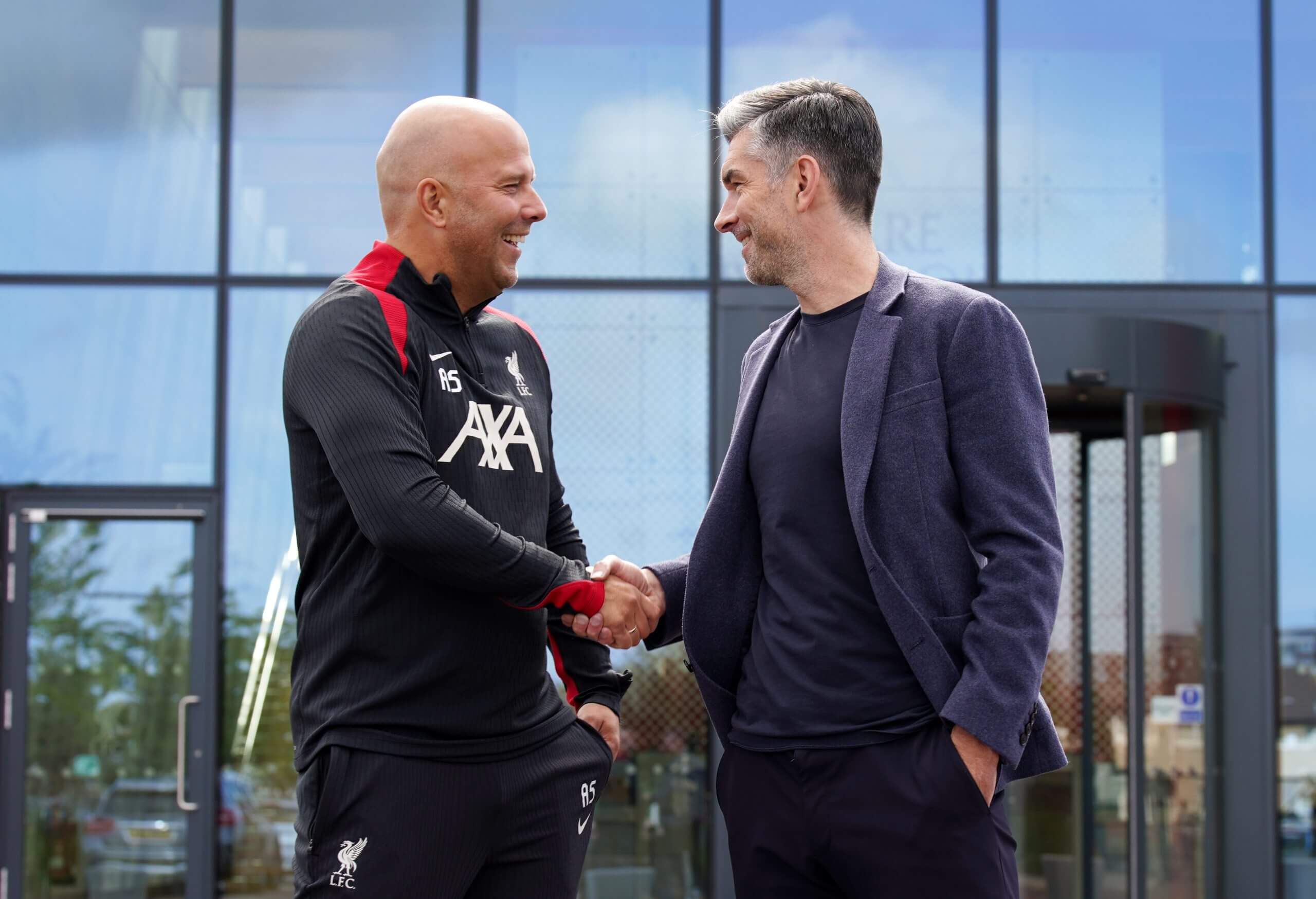
It was on the eve of Liverpool’s title-defending season when supporters sensed an opportunity to get close to Richard Hughes.
The sporting director was the flavour of the month, having handpicked the man who masterminded the title, and then successfully negotiated transfers with another record-breaking deal on the way.
During a warm and informal pre-season evening at Anfield, fans who managed to get within selfie-taking distance were quick to express their appreciation for his work and their optimism for what lay ahead. The admiration extended online, where Hughes was hailed as a “king”, with supporters sharing edited images of him sitting on a throne or puffing on a cigar.
It seemed Hughes could do little wrong. Yet 10 months on, the mood is very different. The sporting director is being scrutinised for less positive reasons and the appointment of Andoni Iraola will either make or break him.
It was Hughes who informed Arne Slot that his time at Liverpool had come to an end, and it was Hughes who drove the decision to hire Iraola. Fairly or not, the Spaniard is likely to be viewed as Hughes’ man — courtesy of their time working together at Bournemouth and the fact that they maintained a social relationship even after the Scot left the club, with Hughes having kept his home on the south coast.
Richard Hughes played an important role in Arne Slot’s departure (Peter Byrne/PA Images via Getty Images)
Of course that’s a misguided suggestion, as Iraola has fully earned the opportunity to test his coaching skills at a club like Liverpool due to the success relative to the size of his previous clubs, Rayo Vallecano and Bournemouth.
But so have others, and that’s where it will get tricky if things go wrong. Ultimately, there’s no hiding from the fact that Liverpool have gone all-in on Iraola, largely because of Hughes’ recommendation.
Context is important in football, yet is rarely afforded. Former Liverpool managing director Christian Purslow discovered that when, as Aston Villa’s chief executive, he appointed Steven Gerrard — who he knew well from their time together at Anfield — as manager in November 2o21.
Back then, it was only a matter of time before a Premier League club gave Gerrard an opportunity after impressive work at Rangers. Purslow’s thinking, after interviewing other candidates of a similar level, was to go with the man who had impressed the most, even if it later backfired.
Liverpool’s approach with Iraola is more nuanced but similar. For all the Spaniard’s impressive work with Bournemouth, he’s still inexperienced at the top level and has yet to deal with the type of demands that will be placed upon him on Merseyside.
Clearly, Hughes and Michael Edwards — the CEO of football for owner Fenway Sports Group — believe that won’t be an obstacle. But if it is, the blame will quickly head in their direction.
The decision to change was fuelled by last season’s failings, when after spending almost £450million ($600m) on new players, Liverpool performed significantly worse than the season before. FSG placed significant faith in Hughes and Edwards to revamp a title-winning squad last year but it is yet to see a return on that investment. Allowing such freedom with the latest head coach appointment feels like the final roll of the dice, with both men out of contract in 2027.
Suggestions that Hughes, 46, could join Saudi Pro League side Al Hilal started in March but have eased off. An April takeover at Al Hilal complicated matters, but still, Liverpool didn’t anticipate an exit. The expectation was for Hughes to oversee business across this summer at least, and linking up again with Iraola adds to that feeling.

Hughes with Andoni Iraola during their time at Bournemouth (Robin Jones – AFC Bournemouth via Getty Images)
 The flip side is that this is the start of a new era. If Iraola is as good as so many people say he is, then the future looks bright. If not, it’s back to the drawing board, and perhaps a sharper focus on a figure with a history of winning. When Gerrard failed at Villa, the club’s co-owner, Nassef Sawiris, did everything possible to bring in Unai Emery. The uplift since has justified that call.
Next season will be one of opportunity and Liverpool need to be well-equipped to pounce. Granted, Arsenal will be difficult to beat and should be able to recruit from a position of strength. But how will Manchester City get on without Pep Guardiola and will European football make life harder for Manchester United in the Premier League? Aston Villa need to nail their recruitment to progress and Chelsea still have more concerns than strengths as they prepare for a first season under Xabi Alonso, the man many Liverpool fans hoped may have ended up back on Merseyside. There is no reason Liverpool shouldn’t be setting their sights high.
Hughes, entering the final year of his contract, will know that the pressure is on, having overseen one sensational season and another of huge disappointment.
To secure it, Iraola — a coach known for getting the best out of players, albeit at clubs where expectations are reasonably low — has to get a tune out of the underperforming, expensively assembled group that Hughes has his fingerprints on.
The bond between the two should help, not only in deciding future transfer targets but also in balancing the squad and bringing the best out of new arrivals — something Slot struggled to achieve in his second season.
It shouldn’t be forgotten that Hughes was handed a hospital pass on his arrival with Jurgen Klopp leaving, key players out of contract and the club’s finances still recovering from a season out of the Champions League.
The work that followed was impressive but last season was a regression. There was some mitigation for that, too, but there can be no excuses this time. Hughes’ legacy is on the line.