By Imran Ahmed
Key Takeaways:
- Expanded Bilateral Cooperation: During his first overseas visit as prime minister (22–26 June 2026), Tarique Rahman signed 15 MoUs, two agreements, and a joint communiqué with China covering trade, investment, connectivity, and strategic issues; China pledged about US$300 million in grants and the two sides agreed to explore a 2+2 foreign-and-defence dialogue.
- Debate over Strategic Direction: Some observers interpret the visit and the elevation of ties to a “China-Bangladesh community with a shared future” as a historic pivot toward Beijing, while others—and the prime minister himself—frame it as pragmatic economic diplomacy and “Bangladesh First” non-alignment rather than exclusive alignment.
- Potential Long-Term Implications: Deeper Chinese involvement in ports, the Teesta project, industrial relocation, defence supplies, and regional connectivity could create lasting dependencies and affect Bangladesh’s strategic autonomy as well as India’s regional security calculations.
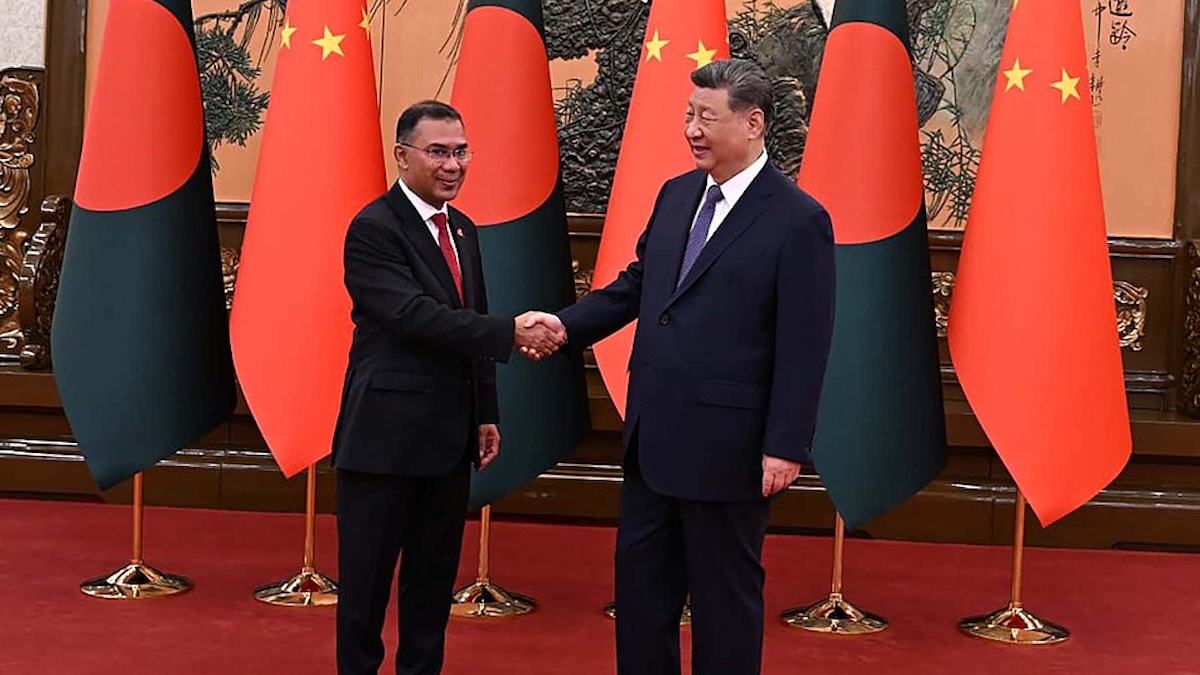
Bangladesh Prime Minister Tarique Rahman visited China from 22 to 26 June 2026 on his first overseas tour since taking office in February 2026. The visit resulted in 15 memorandums of understanding, two agreements and a joint communiqué covering diplomacy, trade, investment, connectivity and strategic cooperation. China pledged approximately US$300 million (S$387 million) in grant assistance while the two countries agreed to explore a 2+2 dialogue involving their foreign and defence ministries. The proposed 2+2 dialogue would establish a regular institutional mechanism for Bangladesh and China to discuss diplomatic and security issues. Although it does not amount to a military alliance, it would make defence and strategic cooperation more structured and consistent than the current ad hoc engagement.
The two sides also discussed Chinese industrial relocation, the Teesta River project, modernisation of Chattogram and Mongla ports, and a proposed China-Myanmar-Bangladesh Economic Corridor. China additionally supported Bangladesh’s application to become a partner of the Shanghai Cooperation Organization and pledged assistance with Rohingya repatriation negotiations. What emerged from the visit, in other words, was a significant broadening of bilateral relations beyond their traditional economic focus. The joint communiqué between the two countries stated, “Both sides agreed to elevate their comprehensive strategic cooperative partnership to jointly build a China-Bangladesh community with a shared future in the new era.” Chinese President Xi Jinping also reaffirmed his country’s long-term commitment to the relationship, stating that “no matter how the world changes, China will not waver in its commitment to the overall direction of China-Bangladesh friendly relations and will always be a trustworthy good friend, good neighbor and good partner of Bangladesh.”
These developments have since intensified debate over the direction of Bangladesh’s foreign policy. The elevation of bilateral relations, the proposed foreign affairs and defence dialogue and the expansion of cooperation across trade, infrastructure, connectivity and security have been interpreted by some as evidence of a strategic pivot towards China. In an article titled ‘Tarique Rahman’s Beijing Visit Cements a Historic Pivot East’, South Asia expert Liu Zongyi argues that Tarique Rahman’s visit “signals Bangladesh’s diplomatic priorities”. He suggests that the proposed diplomatic and defence 2+2 dialogue mechanism indicates that “bilateral political mutual trust and strategic cooperation have reached an unprecedented level”.
Yet, some commentators argue that the visit does not necessarily represent an exclusive strategic turn towards Beijing. Much of the visit was driven by practical economic concerns, including Bangladesh’s substantial trade deficit, the need for foreign investment and the search for new markets and transport routes. This broader pattern is also evident in Bangladesh’s defence relationships. Although China remains its principal supplier of military equipment and negotiations are underway for the acquisition of fighter aircrafts, Dhaka has simultaneously sought to diversify its sources of defence technology. Bangladesh and Türkiye have discussed the procurement of the SIPER long-range air defence system, the joint production of military equipment and combat drones and the establishment of a ministerial-level 2+2 mechanism. Bangladesh has also acquired a French radar system and a British naval vessel while reportedly discussing military logistics and information-sharing agreements with the United States. Former Bangladeshi Ambassador Mohammad Sufiur Rahman maintains that the relationship with China is better understood as ‘soft alignment’, through which Bangladesh seeks to enhance its security and strategic options without formally bandwagoning with Beijing. ‘Viewed together’, Sufiur Rahman writes, “these arrangements would not bind Bangladesh to any military bloc or alliance but are intended to enhance operational flexibility and interoperability”.
The Bangladeshi prime minister himself rejected suggestions that the visit reflected alignment with any particular power. In a statement to parliament following his return, he argued that the guiding principle of his foreign policy was ‘Bangladesh First’ and emphasised that the agreements reached in China were intended to advance Bangladesh’s national interests rather than any geopolitical agenda. He described the outcomes of the visit not as a personal or partisan achievement, but as gains for the country as a whole.
While analysts differ over whether the visit represents a strategic pivot towards Beijing or a pragmatic exercise in strategic autonomy, the expansion of Bangladesh-China relations raise important questions about the future direction of Dhaka’s foreign policy. In particular, it remains to be seen whether Bangladesh can sustain its stated policy of non-alignment as the commitments announced during Tarique Rahman’s visit move from diplomatic declarations towards implementation. Deeper cooperation in defence, infrastructure and regional connectivity could create long-term dependencies that complicate Bangladesh’s efforts to maintain strategic autonomy. Greater Chinese involvement in ports, water management and defence could also affect India’s security calculations and shape how other regional and global powers approach their relations with Dhaka.
- About the author: Dr Imran Ahmed is a Research Fellow at the Institute of South Asian Studies (ISAS), an autonomous research institute at the National University of Singapore (NUS). He can be contacted at [email protected]. The author bears full responsibility for the facts cited and opinions expressed in this paper.
- Source: This article was published by the Institute of South Asian Studies (ISAS)