Get free access to the most comprehensive World Cup coverage in The Athletic app.
The biggest World Cup in history is in full flow, as are some of the biggest stars.
Lionel Messi’s hat-trick against Algeria in the Kansas City dusk got reigning champions Argentina off to a flyer, followed up by a brace against Austria and a sixth of the tournament against Jordan; Kylian Mbappe scored four across France’s three group games while Erling Haaland matched that in Norway’s first two matches before being rested in the third; Harry Kane, another world-leading striker, notched a brace in England’s opening victory and got another against Panama on Saturday.
They, and the sheer amount of football on show, have largely shifted headlines away from the myriad off-field issues which have plagued this summer’s tournament. FIFA will doubtless be happy for footballers to take centre stage.
The World Cup is routinely held up as a showcase of football’s best players and, in theory, the bloating of the tournament from 32 to 48 competing teams should embolden the argument. More teams equals less chance of the best missing out.
Identifying who ‘the best’ is, especially in football, an exercise in subjectivity. Who chooses how one player betters another, particularly when the simple fact of playing in a different position can make direct comparison impossible?
One way to quantify it is to turn to a resource football seems exponentially in thrall to: money. In a game governed by cash, it stands to reason the most valuable players in the world should also be held up as the best.
To fathom where the most value resides, The Athletic has enlisted the help of Twenty First Group (TFG), a sports intelligence firm which includes high-profile clubs, leagues and more among its client base and holds enough football data to make your head spin.
Our request? TFG’s pre-tournament list of the 200 most valuable players on the planet, please.
An important methodological interlude:
- ‘Value’ does not equate to ‘price’.
- What Twenty First Group value a player at may differ materially from the same player’s projected price.
- Value is driven by intrinsic matters, agnostic of market factors — age, position, experience, to name just three.
- A player’s price incorporates aspects which impact what his existing club could expect to receive for him in a given transaction — think remaining contract length, wealth of the buyer, wealth of the seller, and so on.
- Value, not price, has been used here.
For reasons of both efficiency and data propriety, we haven’t unspooled the full list of sampled players. But a look at even the top 20 is instructive.
Of those, 17 — and all of the top 10 — have been present in the U.S., Mexico and Canada across June and July, and only one of the three missing, England’s Cole Palmer (ranked 16th, valued at £112.6million), has been absent simply because his national team didn’t pick him.
That gives credence to the World Cup as a showcase of the best, but it is notable all of the 40 most valuable players have already come together in one very recent competition: the 2025-26 UEFA Champions League.
That point is circular — performing well in the world’s best club competition naturally bumps up a player’s intrinsic value — and it underlines the dominance of European clubs in the world game.
Present in both that tournament and this World Cup is a man that few (just about) would quibble with as the world’s most valuable player.
Lamine Yamal, 18, Barcelona talisman and Spain’s great hope, is valued at an eye-watering £266.1million, £83m and 45 per cent higher than anyone else.
While that would represent a world-record transfer fee by some distance, around £66million more than Paris Saint-Germain spent on Neymar in 2017, it’s not especially contentious. Other valuers of players routinely put Yamal atop their lists too, his age and raw talent translating to as close to priceless as a player can be.
In Spain, the 2026 World Cup is broadly being viewed as Yamal’s World Cup. Nursing a muscle injury meant he was limited to a bit-part role in his country’s 0-0 draw with Cape Verde but it took just 10 minutes for him to make a dent in the tournament, catalysing his side’s comfortable win against Saudi Arabia with an opening goal. It won’t be his last.
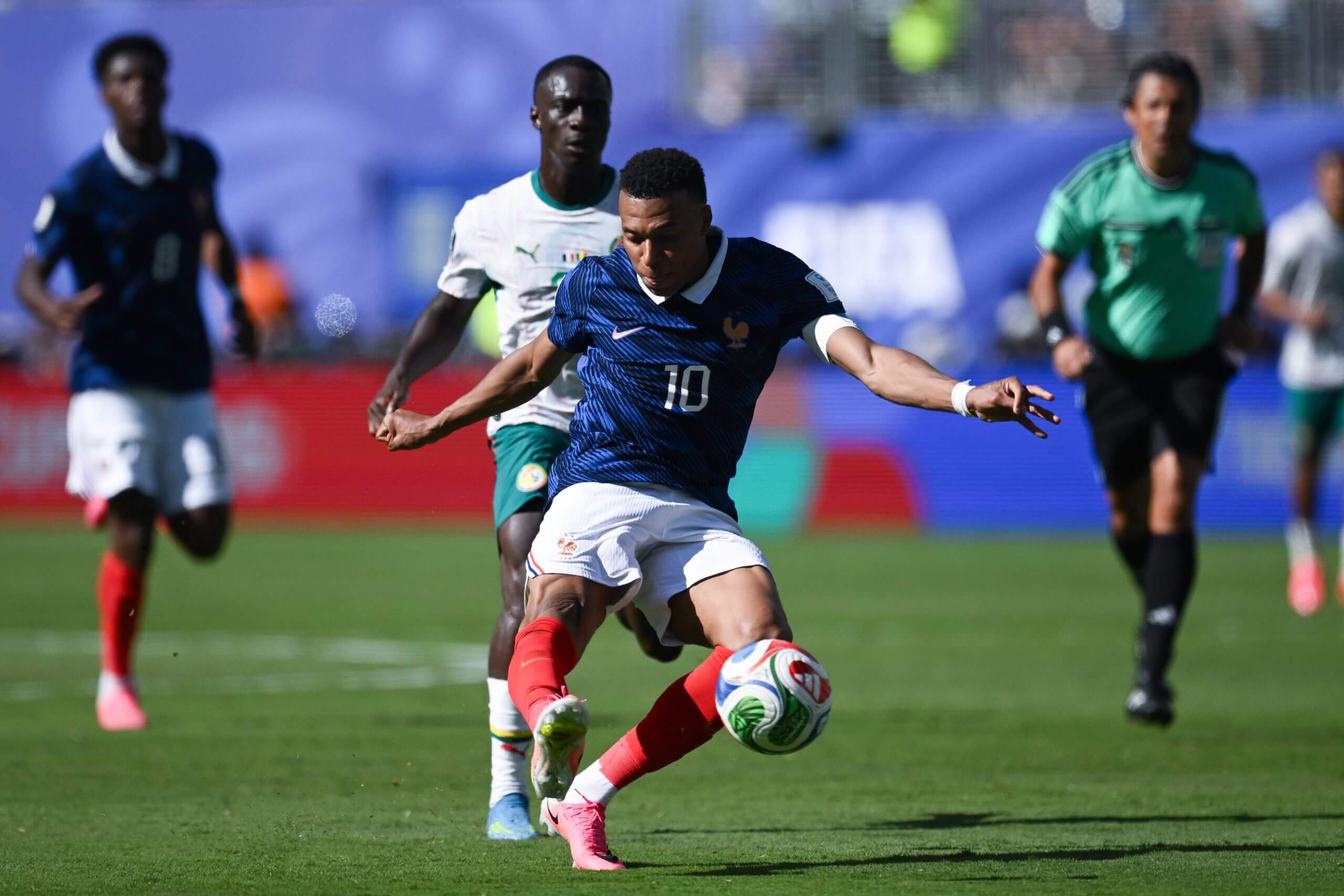
Trailing him is Mbappe, who commanded the second-highest transfer fee in the world (€180million; £166m) eight years ago yet remains one of the sport’s most coveted players. Indeed, TFG’s data values him still higher than the fee agreed for him, after a season-long loan from Monaco, by Paris Saint-Germain in 2017, at £182.8m. There is a reason he is France’s megastar.
Mbappe has been flying for France (Image Photo Agency/Getty Images)
Haaland follows in third at a cool £163.9million; very much the figurehead for a Norway team hoping to go beyond the round of 16 for the first time at a World Cup. Only two other Norwegians — Arsenal’s Martin Odegaard (32nd most valuable) and Atletico Madrid’s Alexander Sorloth (149th) — appear inside the top 200.
The World Cup has always been famed for its stars and that most valuable 20 reflects as much. Household names abound. Most of them will, or already have, take centre stage this summer.
International football has long been seen as the great leveller but it is telling that the countries with the largest number of high-value players in their squads just so happen to be the pre-tournament favourites.
That seems obvious but there is a clear gulf in numbers. World Cup talent, just like in club football, is concentrated in a select few. Three Norwegians out of 200 players seems low until you realise only eight of the 48 squads enjoy a bigger cohort.
France, winners in 2018, penalty shootout runners-up four years ago, and many peoples’ favourites again in 2026, boast 16 squad members in the 200-strong list, more than any other nation.
Nine of those fall inside the top 50, highlighting the huge value of Didier Deschamps’ squad.
Mbappe leads the way but four more — Michael Olise (4th), William Saliba (9th), Warren Zaire-Emery (11th) and Desire Doue (18th) — are valued beyond £100million. In all, 21 French players were ranked. So great are France’s options that four just weren’t selected by Deschamps. Hugo Ekitike (60th) is injured.
Behind them, each of Spain and England, the other two favourites, have 15 of their squad in our list. Portugal rank fourth with 13; until their display of drudge in a 1-1 draw with DR Congo on Wednesday, many also had them as fourth favourites to lift the trophy on July 19.
Outside Yamal, Spain display a mix of high-value players below superstar level — £114.2million-rated Pedri (15th) is in the nine-figure bracket, but then almost a full team inhabits the £50-100m range: Ferran Torres (27th), Pau Cubarsi (46th), Dani Olmo (56th), Martin Zubimendi (61st), Gavi (69th), Alex Baena (78th), David Raya (83rd), Rodri (87th) and Marc Cucurella (93rd). The unselected Pablo Barrios (63rd) would have joined them. The injured Fermin Lopez (12th) is the most valuable player in the world (£117.9m) not present at the tournament.
That this is viewed by some as England’s best chance of replicating the glory of 1966 is underlined by the huge value of those in Thomas Tuchel’s squad. After France, England’s tally of six in the top 50 — Jude Bellingham (5th), Declan Rice (7th), Bukayo Saka (8th), Harry Kane (35th), Morgan Rogers (41st) and Nico O’Reilly (44th) — is more than any other nation.

Rice is one of three England players in the top 10 (Francois Nel/Getty Images)
Tuchel has so much to choose from that he could leave out not only Palmer but 10 others listed among the 200 most valuable. Of those, only Ben White (178th) was injured. The rest, including Phil Foden (73rd) and Trent Alexander-Arnold (98th), just weren’t picked. No other nation left out so many high-value players (Spain were next, with seven not selected and two injured).
The Premier League is widely seen as football’s highest quality division and it stands to reason the skill of the best English players has improved by facing many of the best from elsewhere each and every week. Intrinsic values of England’s best players have risen as a result.
Like just about everything else, England’s top tier dominates player valuations: 87 of the total 200 players (44 per cent) ply their trade there (even after we account for Cucurella, 93rd, and Anthony Gordon, 157th, moving abroad), and the proportion remains the same after weeding out the 75 on the list who won’t make an appearance this summer.
Of the 1,248 players selected for this World Cup, 152 (12 per cent) play in the Premier League. No other division breaches 100. In a club-based list of who is supplying the most valuable players to the tournament, Arsenal’s 14 leads the way. Four other English sides inhabit the top nine.
In the context of almost a quarter of the planet playing in these finals, 75 of the world’s 200 ‘best’ players missing it seems a troublingly high percentage.
The reasons for absence are varied. For a start, 14 are injured, with Lopez, Jurrien Timber (Netherlands, 25th), Rodrygo (Brazil, 48th) and Lennart Karl (Germany, 55th) the most valuable casualties.
Thirty-one failed to be selected, over half of them by England (10) or Spain (seven). Palmer aside, the highest-valued player not to be selected also plays his football for Chelsea. Joao Pedro (26th) was, to the shock of many, left out of Brazil’s squad. He’s also the highest-valued striker on the list who missed out.
The final 30 absentees are less contentious: their countries just didn’t qualify. For the most part, those nations had a smattering of one-off stars — e.g. Cameroon’s Bryan Mbeumo (62nd) — but the list highlights the enormous underachievement of Italy, who have now failed to make it to the last three World Cups.
Ten Italian players feature, more than all but five other nations, underscoring how badly they performed in qualifying. Italian appearances occur some way south of Yamal and Co., goalkeeper Gianluigi Donnarumma is ranked highest among his compatriots at 67 but their failure to qualify remains damning. Of the 48 countries at the World Cup, 21 have no squad members at all among the most valuable 200 players. Of those, four hail from Europe, and so qualified ahead of Italy.
Haaland has some friends for Norway but several of this year’s World Cup squads contain just one player on TFG’s list. Uruguay’s Federico Valverde (19th) tops the pile of individuals but there have been other standouts to keep an eye on with Ghana (Antoine Semenyo, 54th), Austria (Konrad Laimer, 99th), Uzbekistan (Abdukodir Khusanov, 127th), South Korea (Lee Kang-in, 154th) and Algeria (Ibrahim Maza, 176th).
And what of the USMNT?
The World Cup’s primary hosts have three of the most valuable players among their current number in Weston McKennie (122nd), Folarin Balogun (169th) and Christian Pulisic (191st). A fourth, Johnny Cardoso (129th) is missing through injury.
Mapping player values onto one tournament isn’t a perfect exercise and certainly not a predictor of how much individuals might contribute.
Player ages provide a case in point. Yamal is both the most valuable and the youngest player from the list at the World Cup (Karl, seven months his junior, would have been if not for injury), but a majority of the high-value players at this World Cup are aged between 23 and 27. Just four are aged over 30, with Mohamed Salah (Egypt, 143rd) the eldest. Plenty of older heads will provide much this summer even as their relative value wanes.
Salah turned 34 on June 15 and is five years younger than Mr Messi. Argentina’s captain hit 39 on June 24, an age which pretty much disqualifies him from holding significant value. Of the $12.5billion in accumulated value allocated to the world’s 200 best players, of the $8.6bn covering 125 of the players performing at this World Cup, nothing is assigned to Messi.
When he tears teams apart like he did Algeria, that feels odd. If he does it to a potential winner, odder still. But then odd too is the fact that, across his career, no one has ever paid a transfer fee for him.
Perhaps that is apt. After all, how, really, do you value genius?