A proposal that would keep students in transitional kindergarten through 12th grade from using their cell phones in class except for educational purposes, but allow the older students to use them at lunch time, was discussed by Ramona Unified School District trustees on Jan. 20.
Trustees, who are preparing to adopt a policy on student use of mobile communication devices, heard two proposed policy options.
Trustees preferred option 2, which details expectations for student use of mobile devices in transitional kindergarten through eighth grade and separately details expectations for grades 9-12. One of the main differences for the upper grades would be allowing students to use their devices during the entire lunch period.
Kerri Bjork, director of the district’s multi-tiered support systems, told trustees that state Assembly Bill 3216 requires the school board to adopt a policy limiting or prohibiting student smartphone use while on school grounds or under district supervision by July 1. Ramona’s policy is expected to begin at the start of the next school year.
“The heart and intention of the legislation is to have cell phone-free schools,” said Bjork, noting that it addresses issues related to cell phone use such as anxiety, social disengagement, and filming fights on campus. “This is something I believe our staff are looking for.”
Ramona’s policy would apply to mobile communication devices including but not limited to cell phones and smartphones, smart watches, wearable communication devices, earbuds, wireless headphones and any personal device capable of sending or receiving messages, images, recordings, notifications or accessing the internet.

Stephanie Rene Ogilvie
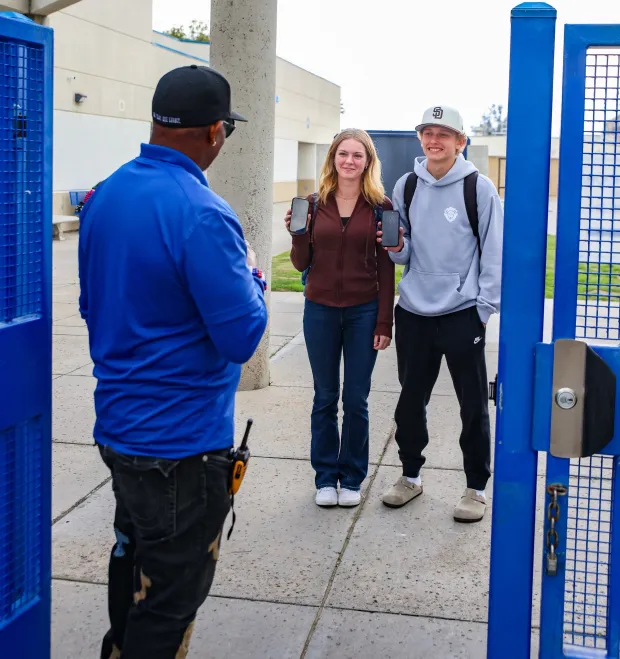
Ramona High School seniors Ingrid Ferguson and Dylan Myrick show campus Security Guard Marc Boykin their student IDs on their cell phones as they leave the campus for lunch. (Stephanie Rene Ogilvie)
Interim Superintendent Leslie Wilson said staff will bring back option 2 with staff revisions for trustee consideration at the next meeting on Feb. 12.
Option 2 would allow devices to be used during lunch in grades 9-12. Otherwise, devices must be stored away during instructional time, including class periods, assemblies and other structured learning environments unless teachers or administrators allow their use for instructional or essential approved purposes.
In grades TK-8, devices must remain off or in silent mode at all times during the school day unless exceptions are approved, according to the draft policy. Students would be allowed to use their devices during the first six minutes and last six minutes of the lunch period.
Student school board representatives voiced their concerns about the proposed policy at the meeting.
Ingrid Ferguson, Ramona High School’s ASB president and school board representative, said students at her campus are accustomed to texting and communicating with each other electronically during their passing periods and at lunch.
“Taking that away would be something we would need to get used to,” Ferguson told the trustees, adding that she uses mobile technology in classes such as anatomy and chemistry. “I’m a good student and I put my phone away in class, but if I can’t have it during the break I would be peeved. I think that would be bad.”
Edan Hollander, Montecito High School’s student school board representative, said there’s value in being able to search online for information at school.
“Phone use does increase anxiety,” he said, acknowledging some downsides to mobile devices. “It’s because of social media and the amount of consumption. A majority of us have Instagram and TikTok because it’s fun.”
School Board President Daryn Drum said the district began implementing a practice of limiting access to cell phones beginning in 2024, but it was not a board policy.
“We were far ahead of the curve,” said Drum, who noted he is opposed to banning cell phones on campuses completely and favors a reasonable solution to including them at the schools. “If I remember correctly, there were not a lot of people beating our door down objecting to the practice we enacted as a district in 2024. That was surprising, I expected more.”
Drum said the school board would not dictate how a mobile communication device policy would be implemented in the classrooms and throughout the district.
“We just give the policy and say, ‘Make this operational,’” he said. “I’m not a teacher or a principal. I don’t presume to tell them how to do this. We stick to a high level and say, ‘You figure it out.’”

Stephanie Rene Ogilvie
From left, Ramona High freshmen Hailey Gonzalez and Emily Phelan use their phones during breaks to check for updates on their school assignments. (Stephanie Rene Ogilvie)
Dan Summers said he and the other board members are working on a compromise position that would largely restrict cell phone use on campuses and during school activities but still allow students to communicate.
“I have no idea how I got through my entire course of education without a cell phone,” Summers told his fellow trustees. “What I did was communicate one-on-one with everyone I knew at school and because I communicated I developed the skills to communicate well.
“I understand the negative parts of having cell phones on campus is significant,” he said. “On the other hand, it’s 2026 and technology has come a long way.”
Trustee Rodger Dohm, a teacher in the Poway Unified School District who has been an educator for 30 years, said one of the district’s goals is to teach students to use technology, including cell phone cameras and the internet, in responsible ways.
Ramona Unified staff developed the draft policy based in part on feedback from a districtwide survey, Bjork said. The survey results, and the draft board policy, were reviewed by the District Advisory Council to get their input and recommendations, a staff report said.
Bjork said school districts in Oceanside and Palo Alto have reported positive results from similar policies. Students at other districts who struggle with anxiety are engaging with their peers and there is greater enforcement with a formal policy in place, she said.
According to option 2, students may possess mobile communication devices on school grounds. However, use is restricted according to grade level. Devices must not disrupt instruction, school activities or a safe learning environment, the draft option states. Devices shall not be used in any manner that infringes on the privacy rights of any other person, it states.
The policy is expected to incorporate exceptions for health and disability needs in addition to allowing devices to be used in an emergency situation involving an immediate threat to student safety or when a student is directed to use a device by staff or emergency responders.
Trustee Dawn Perfect said she is in favor of including language to allow a site administrator to create exceptions on a case-by-case basis. Trusted adults should be aware that a student is struggling and needs to call or text a parent or guardian, she said.