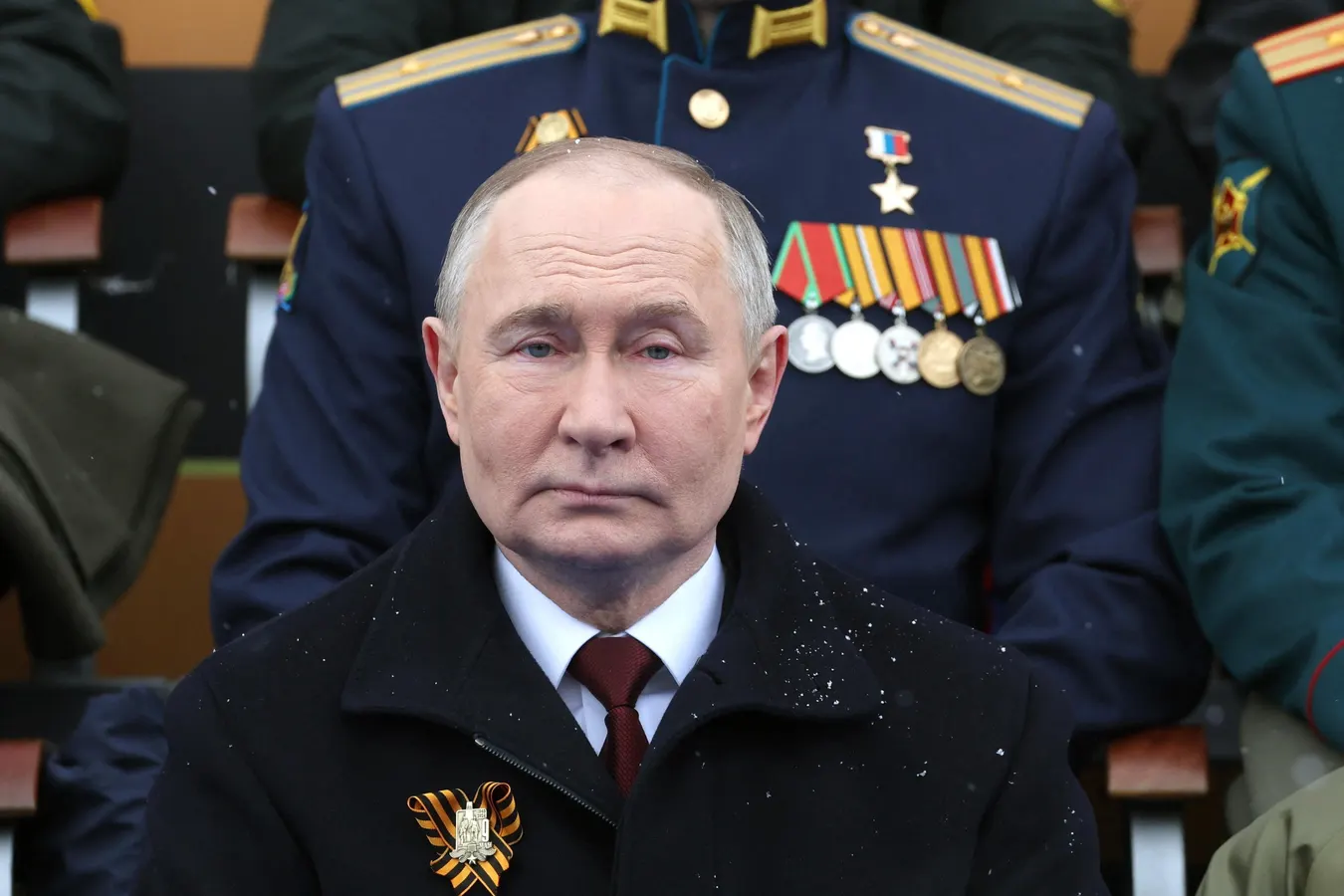

Russia’s President Vladimir Putin attends the Victory Day military parade in central Moscow on May 9, 2024. (Photo by Mikhail KLIMENTYEV / POOL / AFP)
POOL/AFP via Getty Images
Russia’s annual Victory Day parade has long been designed to project strength. Tanks roll across Red Square. Fighter jets roar overhead. It is less a military ceremony than a political ritual built around the idea of Russian power since 1945. This year, the mood is different.
The BBC reported on May 7 that this year’s parade would feature no military hardware on Red Square for the first time in nearly two decades. “Our tanks are busy right now,” Russian MP Yevgeny Popov told the BBC. “They are fighting. We need them more on the battlefield than on Red Square.”
Moscow’s public warnings and security measures suggest concern that Ukraine could target events connected to the May 9 celebrations. According to Reuters, Russia’s Foreign Ministry openly warned of retaliation if Ukrainian attacks disrupt the parade. Russian authorities have reportedly urged diplomatic missions to prepare to evacuate personnel from Kyiv in the event of a major Russian strike.
For years, Ukrainians have lived under the constant threat of Russian missile and drone attacks. Public events across Ukraine have been scaled back or moved underground. Large gatherings have become potential targets. Now Moscow is taking similar precautions.
Moscow Takes Precautions
According to reports from Russian media, mobile internet and SMS services are expected to be restricted in Moscow during the parade for security reasons. Russian officials say the measures are intended to protect public events from potential attacks. Germany’s Der Spiegel reported on May 7 that the Kremlin also withdrew accreditation from Spiegel and other foreign media outlets for the May 9 parade, with only Russian media allowed to attend.
Russian occupation authorities in Crimea also canceled Victory Day parades and major public events, citing safety concerns amid intensified Ukrainian drone strikes. ASTRA, an independent Russian media outlet, reported that at least 15 Russian regions canceled May 9 parades.
The guest list also looked thinner. Yaroslav Trofimov, chief foreign affairs correspondent for The Wall Street Journal, wrote on X that Xi Jinping attended last year’s parade, while this year’s expected foreign dignitaries were limited to a much smaller group, including Belarusian leader Alexander Lukashenko, and several leaders from smaller or disputed entities.
Ukraine’s Long-Range Pressure
The Institute for the Study of War has argued that the continued Ukrainian strikes deep inside Russia highlight Moscow’s ongoing difficulty in reliably defending major cities and infrastructure across European Russia from drone and missile attacks. Protecting those areas forces Russia to disperse air defenses and electronic warfare assets across a much wider geography.
“Recently, there have also been important results in Chelyabinsk, up to 1,800 kilometers away, as well as in Yekaterinburg, nearly 2,000 kilometers away,” Ukrainian President Volodymyr Zelensky wrote on X on May 7. In recent months, the Moscow and Leningrad regions have also come under growing pressure.
“The Leningrad and Moscow regions are highly populated and economically vital for Russia’s war machine,” Cristian Terheș, a member of the European Parliament, told me. “Ukraine is successfully executing classic economic and psychological warfare against them, with the purpose of knocking out hard-currency revenue for the war machine as well as making the Russian elites understand what war is.”
Ukrainian capabilities have steadily expanded in both range and scale. “Ukraine is now building drones at a massive scale – on track for around seven million this year,“ Dmytro Kavun, co-founder and president of Dignitas Ukraine, a U.S.-based nonprofit that focuses on defense technology innovation in Ukraine, told me. Over the past week, Ukrainian drones have struck Moscow multiple times.
The May 9 parade is meant to reinforce the image of a strong and stable Russia carrying forward the legacy of the Soviet victory in World War II. A successful Ukrainian strike near Moscow during the celebrations would do more than cause physical damage. It would undermine the sense of security the Kremlin wants to convey.
That may explain the increasingly sharp rhetoric coming from Moscow. Russia first announced what it described as a unilateral ceasefire for May 8 and 9. Ukraine responded by proposing a broader pause in fighting beginning earlier in the week. Kyiv then accused Moscow of violating the truce almost immediately through continued strikes and frontline attacks.
Moscow wants to secure its parade without appearing vulnerable. Ukraine wants to show that Russia’s center of power is no longer untouchable. “Our enemy understands only the language of force, and until it receives a strong blow in return, it will not change its plans,” Andrii Pelypenko of Ukraine’s 419th Battalion of Unmanned Systems, told me.
Following negotiations with the Ukrainian side, President Donald Trump announced a separate three-day ceasefire for May 9-11 on Truth Social, which both Kyiv and Moscow later confirmed. The truce, he said, would also include a planned exchange of 1,000 prisoners of war from each side.
Jonathan Lippert, president of Defense Tech for Ukraine, told me “given the huge chasm between how much Ukrainian and Russian leaders value the lives of their soldiers, any prisoner swap is a win for Ukraine, and this would be one of the two largest of the entire war.”
A Ceasefire Around Red Square
A decree published by the Ukrainian president’s office said Red Square would be excluded from Ukraine’s target list for the duration of the parade, from 10 a.m. Kyiv time on May 9. The document framed the move as being made for “humanitarian purposes” after talks with the American side.
Steven Moore, founder of the Ukraine Freedom Project, argued that the situation undercuts Putin’s image of strength. “Trump likes winners and doesn’t like losers,” Moore told me. “Putin just went to Trump and asked him to ask Zelensky for a ceasefire for his military parade, a spectacle meant to show he is powerful. But he is not powerful enough to impose his will upon Zelensky to protect his parade from Ukrainian missiles and drones.”
Even if no major Ukrainian strike occurs during the celebrations, the fact that Moscow feels compelled to disable communications networks, warn diplomats and publicly threaten retaliation shows how much the strategic balance has shifted since the early months of the war.
Russia still possesses overwhelming missile firepower and retains the ability to inflict enormous damage on Ukrainian cities. But Ukraine has increasingly demonstrated that it can impose costs deep inside Russian territory and raise political pressure on the Kremlin.