
Ukraine’s recent drone strikes on St. Petersburg provided arguably the most visible indication to date that Vladimir Putin’s invasion is not going according to plan. They also served to underline the fact that the war is now no longer confined to Ukraine and is increasingly being fought inside Russia itself.
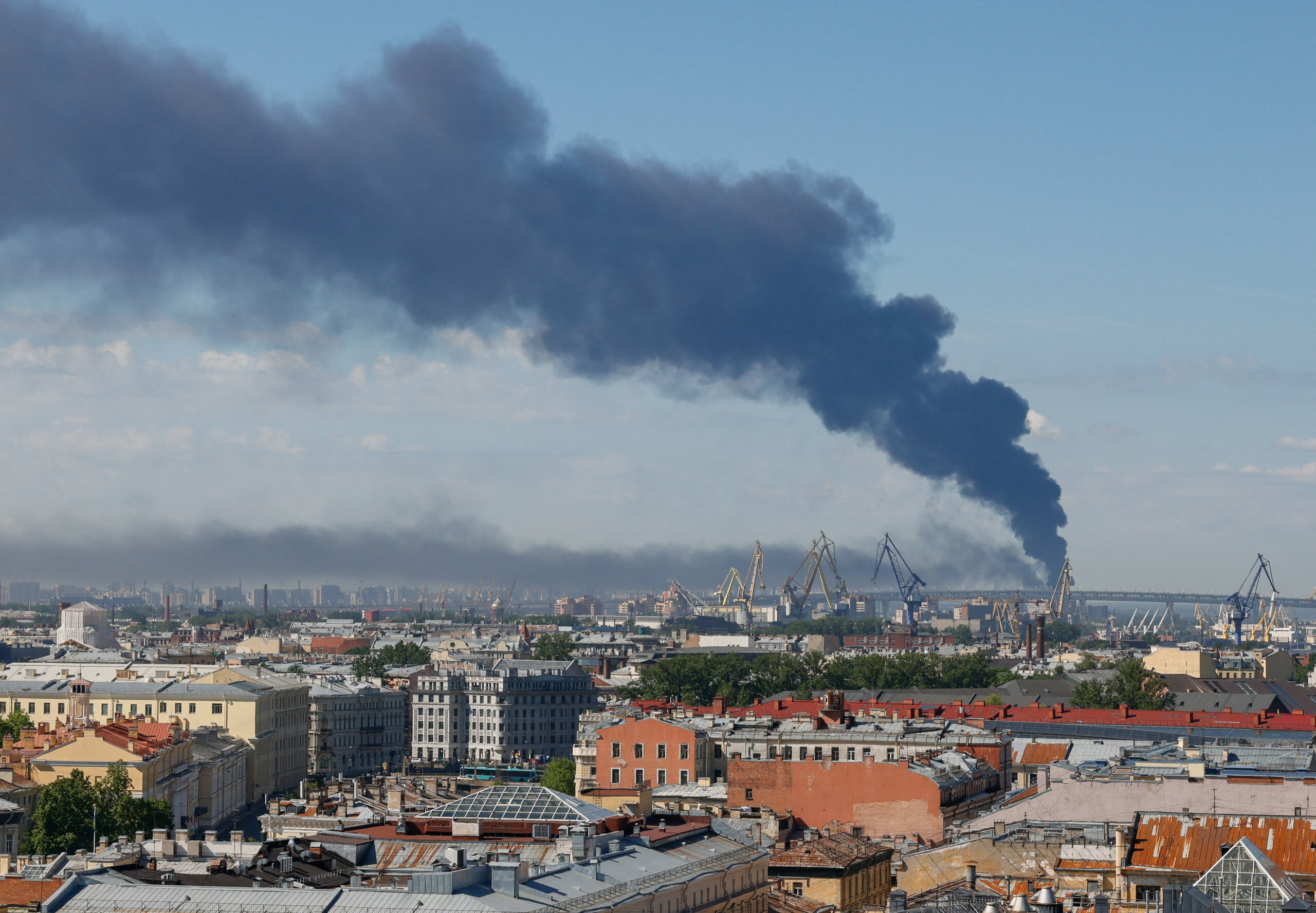
The drone attacks on Russia’s second city took place in early June as it hosted the St. Petersburg International Economic Forum. This flagship event has traditionally been used by the Kremlin to project power and status on the global stage. On this occasion, however, delegates making their way to the official opening were confronted by unmistakable evidence of Russia’s vulnerability, with the skyline shrouded in black smoke rising from the site of a recent Ukrainian bombing raid on a nearby oil terminal.
Ukraine’s spectacular strikes sparked a lively debate in Russia over the state of the country’s air defenses. There was widespread alarm at Putin’s apparent inability to prevent enemy drones from reaching his home city as he welcomed foreign guests attending Russia’s biggest international event of the year. Many noted that if such an important occasion could be targeted, nowhere in Russia that lies within range of Ukraine’s drones could now be considered safe.
Stay updated
As the world watches the Russian invasion of Ukraine unfold, UkraineAlert delivers the best Atlantic Council expert insight and analysis on Ukraine twice a week directly to your inbox.
This was Putin’s second very public humiliation in less than a month. In early May, the Kremlin dictator was forced to dramatically scale down Russia’s annual Victory Day parade on Red Square due to fears of possible Ukrainian drone strikes. Putin was so concerned that he sought help from US President Donald Trump to broker a temporary ceasefire, leading to widespread ridicule. Ukrainian leader Volodymyr Zelenskyy took full advantage of Putin’s obvious discomfort, issuing a spoof presidential decree “permitting” the parade to take place.
These high-profile incidents have come against a backdrop of steadily expanding Ukrainian drone and missile strikes on military and industrial targets deep inside Russia. During the first half of 2026, there has been a noticeable escalation in Ukrainian attacks as Kyiv seeks to bring Putin’s invasion home to Russia. This is bad news for the Kremlin, which has worked hard to protect the Russian public from the negative impact of the war.
Since 2022, the Russian authorities have aimed to insulate major cities like Moscow and St. Petersburg from the realities of the Ukraine invasion. For nearly four and a half years, this wartime social contract has focused on ensuring that Russians living in the country’s political and economic core experience minimal disruption to their daily lives. In exchange, they have been expected to passively accept the war and tolerate a reduction in personal freedoms.
This system worked well until recently, but cracks are now beginning to appear. The changing tone in Russia’s public discourse owes much to Ukraine’s increasingly effective strategic bombing campaign, which is becoming far more difficult to downplay or ignore. Footage of explosions now floods Russian social media on a daily basis, with recent attacks on the Moscow region striking a particularly raw nerve.
Beyond the psychological impact, Ukrainian drone strikes on oil refineries are contributing to a mounting fuel crisis in regions across Russia. As a result, many ordinary Russians are facing restrictions on gasoline and diesel purchases, sparking visible frustration and surprise on social networks. Air travel is also now regularly disrupted by Ukrainian drones, with flights canceled and passengers forced to spend days trapped at airports.
Eurasia Center events

The Kremlin has added to the darkening mood in Russia by imposing sweeping new restrictions on internet access. Tellingly, Kremlin officials have sought to justify these unpopular measures by claiming they are necessary to combat the Ukrainian drone threat and prevent Kyiv from using the internet to coordinate attacks. While many have noted that Ukrainian drone attacks continue despite the internet crackdown, the current limited connectivity is another example of how the war is impacting everyday life in Russia.
None of this means the Putin regime is on the brink of collapse. Nevertheless, it is clearly becoming much harder to shield the Russian public from wartime realities. As a result, the political model that has protected Putin since 2022 is growing less reliable and more expensive to maintain.
The most likely response from the Kremlin will be to impose further restrictions and introduce additional mobile internet shutdowns, while allocating greater resources to domestic security. These steps may help to reduce the immediate risk of destabilization on the home front, but they will also make the war even more visible to ordinary Russians.
In parallel, Russia is likely to pursue a policy of escalation in Ukraine, with intensified strikes against Ukrainian cities, civilian infrastructure, and transport networks in a bid to restore deterrence and show that Ukraine pays a higher price for attacking Russia. The Kremlin may also attempt to accelerate hybrid operations in Europe to demonstrate that it still controls the escalation ladder in the wider international arena.
Ukrainian drones alone will not win the war or spark a new Russian collapse, but they have already succeeded in imposing significant military, economic, political, and psychological costs on the Kremlin. Crucially, Ukraine’s bombing campaign is now reaching the populations of Moscow, St. Petersburg, and the handful of other major Russian cities where the vast majority of the country’s most influential citizens live. This is making it harder for the Kremlin to preserve the illusion that Russians can wage war in neighboring countries without paying the price.
Maksym Beznosiuk is a strategic policy analyst whose work focuses on Russia, Ukraine, and international security. He is an associate fellow at GLOBSEC. William Dixon is a senior associate fellow of the Royal United Services Institute and an associate fellow at GLOBSEC. He specializes in cyber and international security issues.
Further reading
The views expressed in UkraineAlert are solely those of the authors and do not necessarily reflect the views of the Atlantic Council, its staff, or its supporters.

The Eurasia Center’s mission is to enhance transatlantic cooperation in promoting stability, democratic values, and prosperity in Eurasia, from Eastern Europe and Turkey in the West to the Caucasus, Russia, and Central Asia in the East.
Follow us on social media
and support our work
Image: Heavy smoke billows after Ukrainian drones hit oil infrastructure in St Petersburg, Russia. June 3, 2026. REUTERS/Stringer