In my previous post on Elbridge Colby’s weak strategic tea, one commenter suggested I was “being a bit hard” on Colby:
Sure, everything you say is correct. But as you concede, he’s the most significant legitimate strategist in the administration, and we know he’s a smart serious professional, whether we agree with all his positions or not. So the biggest question is, “do we want someone like Bridge relatively high up in this administration, or do we want Trumps and Hegseths all the way down?” If the answer is “we want Bridge, because he presumably is generally a voice of sanity in a field of idiots, nuts, and grifters,” then we should cut him some slack. Working inside the system requires sacrifices, and one of them is your intellectual pride—because at times you will have to defend stupid bad policies that your team is enacting.
The “voice of sanity” logic is akin to the “adults in the room” logic that many Trump administration first-termers made about why they served — and one could argue that the more erratic and counterproductive foreign policy of Trump’s second term is evidence that honorable service for a dishonorable president is possible.
In Colby’s case, however, the company he keeps even when he’s not serving the current administration is a red flag. The other red flag is one that I raised a few months ago about how to evaluate Marco Rubio’s service to this president: “for this argument to work, it has to follow that Rubio’s value above replacement Trumper is positive…. It’s not obvious at all that Rubio has provided any value-added over any other lapdog who would have occupied his position in his stead. Like everyone else, he has functioned as a yes man for Trump.”
Colby is a rung lower than Rubio, so the odds are even lower that he is speaking truth to power or improving what would otherwise be an even worse American foreign policy.
This matters, because it sure seems as though the Trump administration has not just lost the Iran War — it is losing the war multiple times over.
I know this because I keep having to write posts like “The Strategic Defeat of the United States” or “The Trump Administration Is a Loser in Iran” or “Donald Trump Has Lost the Iran War.” And what is remarkable is that no matter what Elbridge Colby has advised Trump, the president keeps on losing — to the point where he has exhausted his exit options.
This summer the hard-working staff here at Drezner’s World has given the occasional talk about the current state of American foreign policy. Mostly I have been using Operation Epic Fury as the synecdoche of the larger issues in the Trump administration’s conduct of U.S. foreign policy.
Here are two slides that I’ve been using for the past several months — before, during, and after the Islamabad Memorandum of Understanding was signed. I think they hold up pretty well:
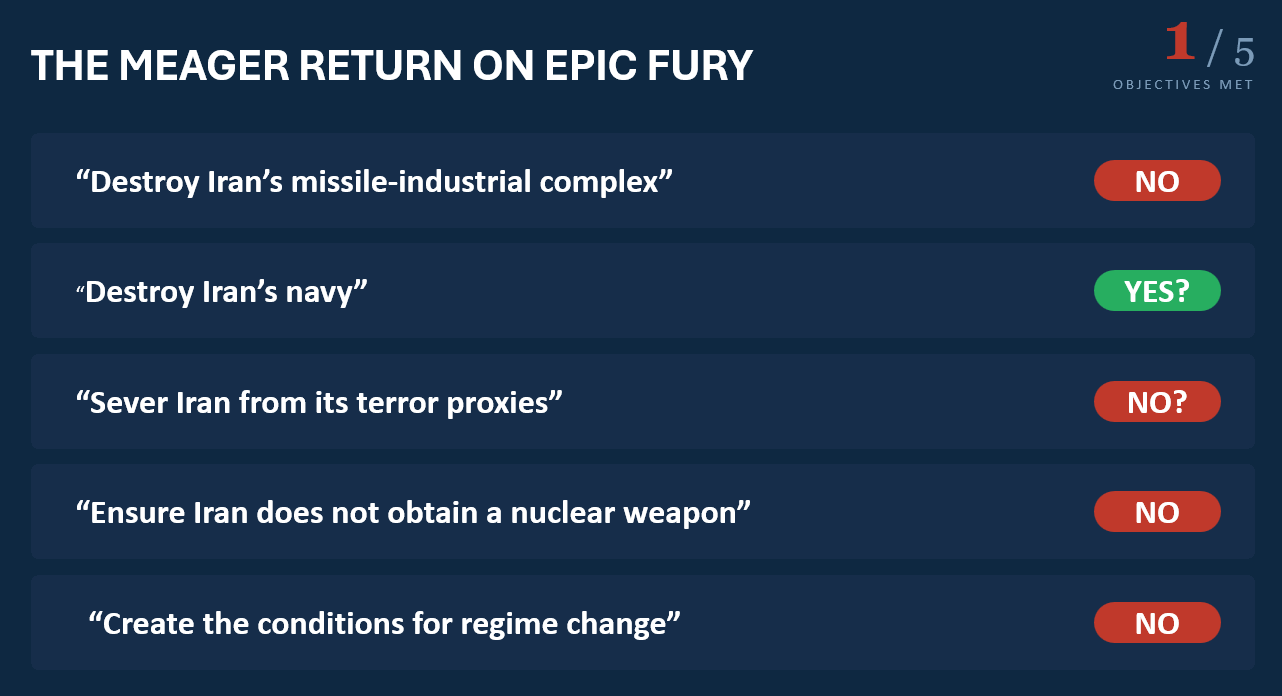
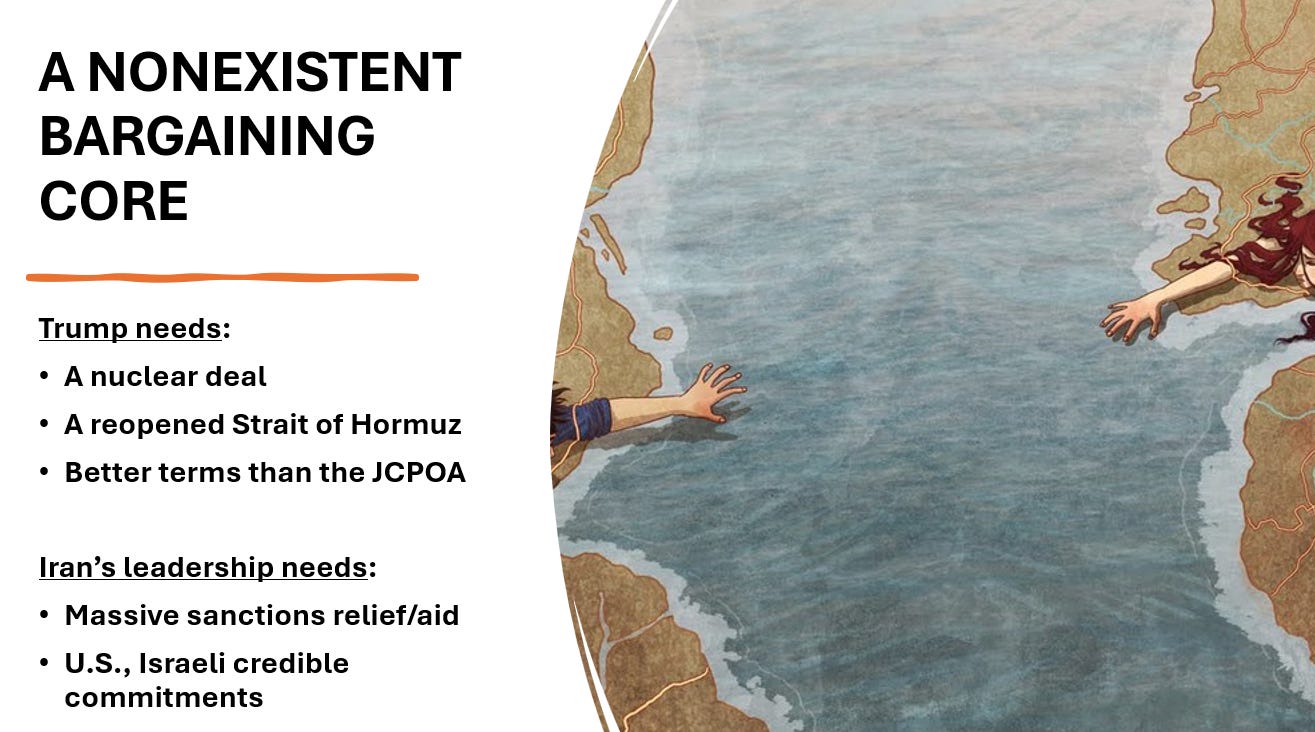
Does this seem like an exaggeration? I don’t think so. If anything, it understates the current problem. Multiple press accounts reveal the degree to which Trump finds himself boxed in on Iran. Despite renewing air attacks against the country, the law of diminishing marginal returns has kicked in. Axios’ Barak Ravid reports that, “the top U.S. military commander in the Middle East, Adm. Brad Cooper, recommended stopping the bombing campaign around the Strait of Hormuz because it has reached the limit of its effectiveness.”
That seems like a bad sign. Trump could opt for a serious escalation of major combat operations, but the New York Times’ Eric Schmitt and Jonathan Swan report that he and his advisors have ruled that out as well for reasons that, oh, I don’t know, could have been considered back in February:
President Trump has set aside, at least for now, plans to sharply escalate the American military assault against Iran, with particular concern that intensifying the war could dangerously drain the Pentagon’s already diminished stockpile of Patriot antimissile interceptors and other air defense munitions in the Middle East.
The threat to interceptor stockpiles is one of many considerations that have made a return to major combat operations a hugely risky endeavor, administration officials say. Mr. Trump and his top aides are also uneasy about the prospect of a widening war in the Middle East, the alienation of key Gulf allies who are vulnerable to Iranian attack, a global economic crunch, and growing energy and refugee crises…. (emphasis added)
Gen. Dan Caine, the chairman of the Joint Chiefs of Staff, has cautioned privately that resuming major combat operations against Iran was doable but that it would dangerously deplete interceptors available to the military’s Central Command, which is responsible for operations in the Middle East, the officials said. A spokesman for General Caine declined to comment on advice the general gives the president….
Mr. Trump has been wrestling with how to proceed in his nearly five-month war against Iran and specifically with how to reopen the Strait of Hormuz, as gas prices climb again amid the resumption of hostilities over the past two weeks. Diplomacy has broken down, and the latest round of extensive U.S. attacks do not seem to have deterred Iran militarily.
“Uneasy” is such an amazing word choice, it covers up all kinds of sins.
Remember when Trump’s defenders said that he had restored America’s deterrent power? Not so much, as it turns out.
Furthermore, the New York Times’ David Sanger points out that Iran is symbolic of this president’s increasing inability to alter the course of events in America’s favor:
[Trump] has been unable to control surging oil prices, or their effects on the stock market. The shipping that crawled to a stop in the Strait of Hormuz, then was opened for a few short weeks, is back to a trickle, with a second choke point, between the Red Sea and the Gulf of Aden, now threatened. And while the president has threatened to take Kharg Island, where Iran ships oil, or to seize its underground stores of enriched uranium, he has said publicly that he knows there is no appetite for sending in ground troops.
Those limits have left him deeply frustrated, his aides say, and have made him more erratic, even by Trumpian standards. Last week alone, Mr. Trump’s energy secretary signed a historic pact with Saudi Arabia to provide civil nuclear power to the kingdom, before the president undercut the deal less than 24 hours later, stunning the Saudis by declaring that the agreement, negotiated over 18 months, was dead unless the country joined the Abraham Accords and recognized Israel….
Not all of Mr. Trump’s frustrations, people close to the president say, are driven by the war, now so unpopular that only 29 percent of Americans polled by The Washington Post and Ipsos approved of his handling of the conflict. But much of it is. And the angst is clear as he promises to stop Iran’s nuclear program at any cost, while his allies at home want out….
U.S. officials now worry that President Vladimir V. Putin of Russia and Xi Jinping of China could be factoring the shortages [of missile interceptors] into calculations of their next moves, in Ukraine and Europe for Mr. Putin and perhaps against Taiwan for Mr. Xi.
This is all infuriating for anyone who pointed out five months ago that attacking Iran was a bad idea. These stories also reveal something else, however: the futility of advising Donald Trump in 2026. American foreign policy largely remains the purview of Donald Trump’s whims.
In this political moment, I am no longer sure it is possible to honorable serve this dishonorable leader — because no matter how one advises, Trump will make the situation worse.