The Other China
朱公千古
atque in perpetuum
On 12 August 2026, it was reported that Zhu Rongji (朱鎔基, 1938-2026), premier of the Chinese People’s Republic from 1998 to 2003, had passed away. We commemorate his memory with an elegiac couplet 輓聯 wǎn lián, composed by and written in the hand of Liu Chan 劉蟾.
Liu, who also goes by the literary sobriquet Dasheng 大生, is a writer, scholar and calligrapher. Born in Shaanxi, he lives in Beijing where he edits The Chinese Study 中國書房. We have frequently featured Liu’s work in The Other China, including the series Dasheng’s Calligraphic Comments on Current Affairs.
***
The Chinese and Latin rubrics of this chapter in The Other China are 朱公千古 and atque in perpetuum. 朱公 Zhū gōng is a respectful title for Zhu Rongji. It means ‘the honoured Master Zhu’. As for the expression 千古 qiān gǔ, ‘[so-and-so] now belongs to eternity’, it has been used to mourn the dead for some fifteen hundred years. Here it features in Liu Chan’s elegiac composition. The second part of the rubric — atque in perpetuum, ‘and forever’ — comes from the famous last line of Catullus 101, a poem composed by Gaius Valerius Catullus (c.84-c.54 BCE) for his dead brother.
***
We previously marked the death of Premier Li Keqiang 李克強, a subsequent successor to Zhu Rongji, in our series Xi Jinping’s Empire of Tedium. See:
In China, the passing of Zhu Rongji in August 2026 led to another wave of online nostalgia for a bygone era. See, for example, Dreaming of Zhu Rongji’s China.
***
The official obituary published in People’s Daily praised Zhu for ‘daring to speak the truth and not being afraid of offending people’ 敢於說真話,不怕得罪人. For his part, Liu Chan structures his memorial couplet around the expression 功過是非 gōng guò shì fēi, literally ‘achievements and failings, pros and cons’. Other independent commentators summed up the former premier’s legacy as being worthy both of ‘praise and blame’ 毀譽參半 huǐ yù cān bàn.
— Geremie R. Barmé
Editor, China Heritage
15 August 2026
The Honoured Zhu Rongji has Passed into Eternity
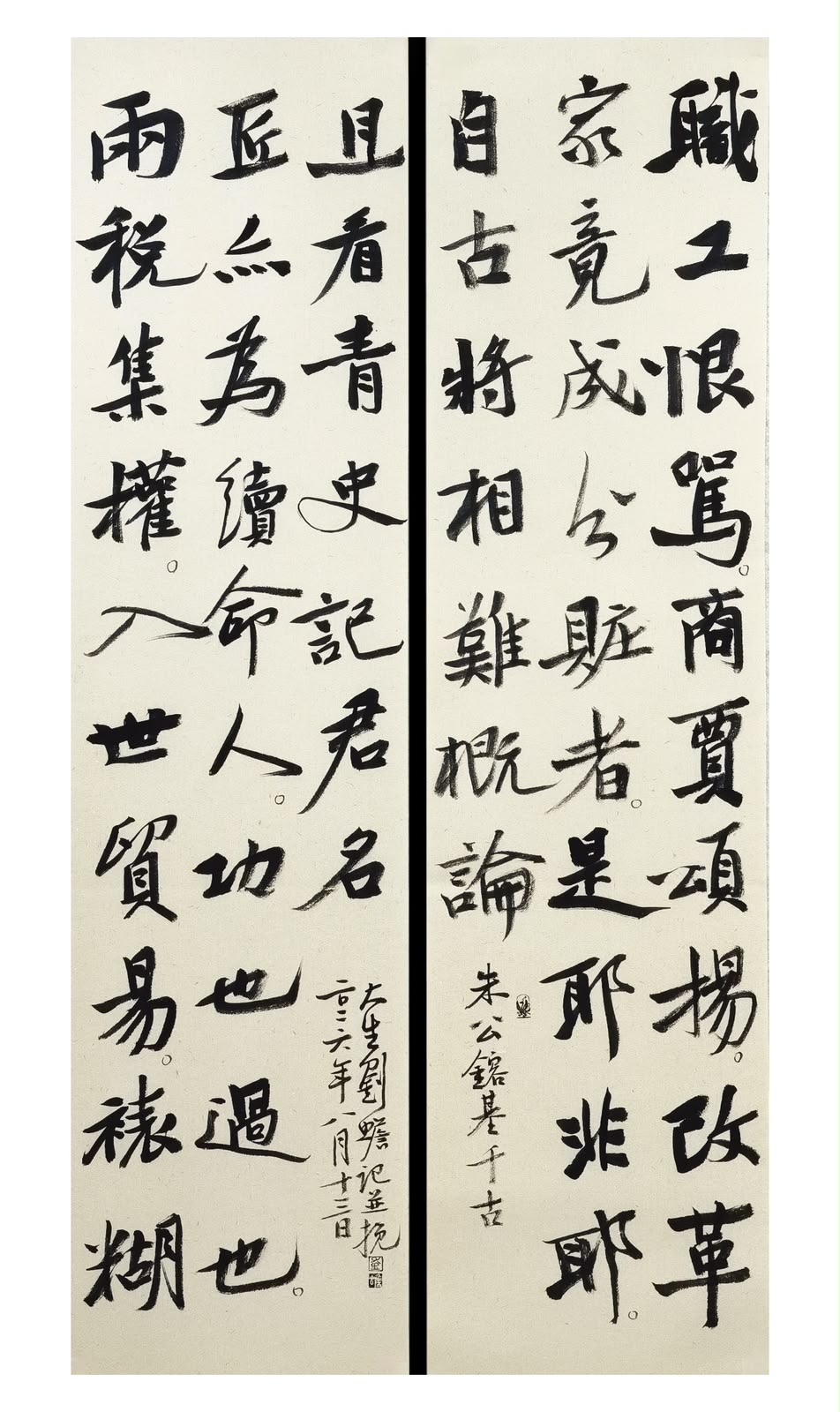
Liu Chan’s elegiac couplet: The right-hand panel is to be read from top to bottom right to left, while the left-hand panel should be read left to right.
Resented and decried by workers and salaried employees alike, yet he enjoyed the adulation of those in commerce. In his time, reformers could readily divvy up the spoils. Was he right or was he in the wrong? Since ancient times the posthumous reputations of premiers have been contested.
The Honoured Zhu Rongji has passed into eternity
His dual-tax reform further enabled centralised rule and he championed China entering the WTO. By papering over cracks in the system he helped to extend its lifespan. Was this an achievement or flaw? Let’s see how history will ultimately appraise his name and reputation.
— Dasheng Liu Chan thus record and mourns [Zhu Rongji’s death]
on this the 13th of August 2026. Translated by Geremie R. Barmé
***
China Heritage is grateful to Dasheng for sharing his recent work. For previous chapters in this series, see:
- War, OpenClaw and CEOs — Dasheng’s Calligraphic Comments on Current Affairs (I), 20 March 2026
- Hong Xiuquan’s American Brother, Orbán Goes and the KMT Comes — Dasheng’s Calligraphic Comments on Current Affairs (II), 16 April 2026
- The Zealot and the Pretender — Dasheng’s Calligraphic Comments on Current Affairs (III), 1 May 2026
- Black gold streaked red with blood — Dasheng’s Calligraphic Comments on Current Affairs (IV), 30 May 2026
- The Qin Empire Inspires, and Haunts, Xi Jinping’s China — Dasheng’s Calligraphic Comments on Current Affairs (V), 3 August 2026
- The Buzz Around Huawei — Dasheng’s Calligraphic Comments on Current Affairs (VI), 6 August 2026
- Trump Proves He’s a Patzer at Chinese Chess — Dasheng’s Calligraphic Comments on Current Affairs (VII), 12 August 2026
As well as:
***