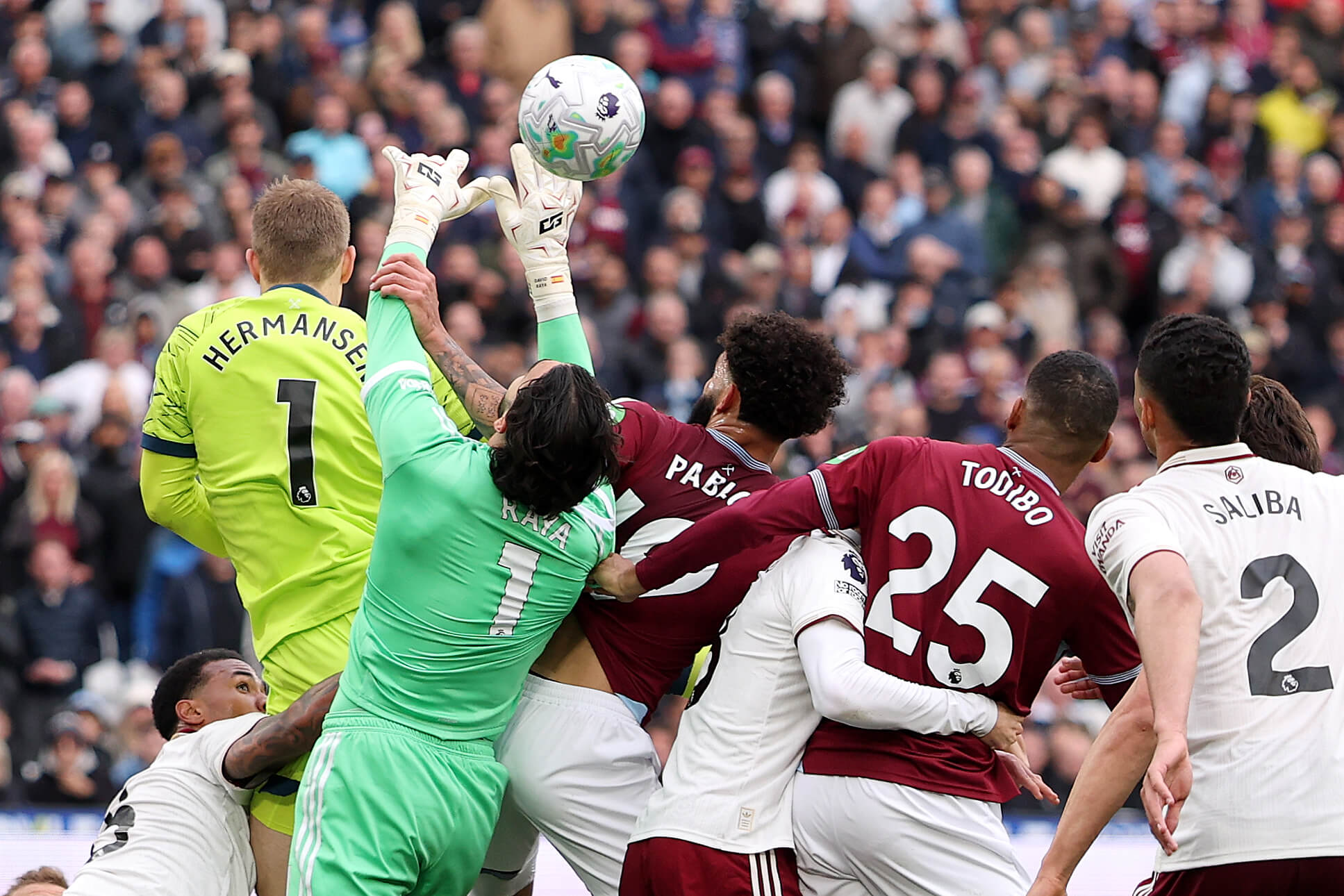
Cinematic endings, outstanding quality and big moments: there are ways we all want matches and Premier League titles to be decided. But a five-minute VAR delay to analyse a possible foul on Arsenal goalkeeper David Raya at a corner is not very Hollywood.
There was furore in the final minutes at the London Stadium on Sunday, as Callum Wilson’s late equaliser for West Ham was eventually ruled out. One West Ham player, Pablo, had his arm across Raya’s chest and a hold of his left forearm and another, Jean-Clair Todibo, was pulling his shirt at the shoulder.
That scenario, of goalkeepers being swarmed by attackers, has been prevalent in the Premier League all season. The share of inswinging corners has risen from 48 per cent in 2022-23 to 71 per cent this term. Meanwhile, outswingers head toward extinction — they are as (in)frequent as short corners now — with most corners resembling a rugby scrum or wrestling match of physical duels and bodies packed around the ’keeper.
So forget the ceaseless debate about VAR for a moment. The Premier League has a deeper problem to solve: corners are broken.
Three stats sum up the state of play. Even with two full matchweeks of it left, this season ranks highest since 2018-19 for inswinging corners (2,503), fouls on goalkeepers (146) and goals from corners (174).
“I think we need to change the rules,” says Graham Scott, a former Premier League referee for a decade before he retired last year — he’s now a writer here at The Athletic. “It’s become a licence for pretty much anything goes.
“When I started refereeing, if someone made physical contact with a goalkeeper right in front of the goal, your instincts were to give a free kick, because that would be the safer option. People shrugged their shoulders, rolled their eyes and said, ‘Goalkeepers are overprotected’, but they kind of accepted it, and they wanted their own goalkeeper to be protected (in the same way).
“That’s changed in the past two or three seasons. Now, just because you’re the goalkeeper gets you no privileges at all.”
Attacking teams have weaponised blocking to target specific zonal markers and facilitate runs for their best headers of the ball. Arsenal and Aston Villa were unique in their approaches a few years ago, two of the first teams to employ set-piece coaches and prioritise inswingers. Now, almost all Premier League sides have assistants specialising in this aspect of the game.
Defenders are now equally aggressive in grappling and holding. West Ham can make justified arguments that Arsenal trio Declan Rice, Martin Odegaard and Leandro Trossard were all committing fouls too during the Jarrod Bowen corner from which they ‘scored’ their disallowed equaliser on Sunday.
The Premier League sets what it calls a “high threshold” for fouls and, before this season, announced an “enhanced recognition of holding offences” as one of multiple points of emphasis for its referees.
The physicality of the English league is a point of pride and identity, something that sets it apart from Europe’s other major divisions. However, it becomes a challenge when teams, in an era of marginal gains, try to stretch the rules to their maximum. Liverpool head coach Arne Slot and Oliver Glasner, his Crystal Palace counterpart, have both remarked on how fouls are called much more readily at corners elsewhere around the continent.
Were there also fouls on West Ham players at their last-minute corner? (Alex Pantling/Getty Images)
None of Europe’s other top-five leagues comes close to the Premier League for the number of inswingers or, more importantly, for corner goals this season. Germany’s Bundesliga, an 18-team league, has seen 133, with 120 in Serie A and 111 in La Liga, two divisions which are the same size as the 20-club Premier League.
However, the challenges for officials in England’s top flight, Scott explains, are tied to a vicious circle, with the shift to inswingers targeted into the six-yard box.
An absolute must for referees at corners is to have a line of sight to the goalkeeper. “Now we have 16, 17, 18 players in an area about 10 by 10 (yards) in front of the goal. Everyone is in a duel except two or three zonal markers. So it’s impossible, and it’s why so few fouls are given,” Scott adds.
Leniency is preferred because spotting every duel at once — and working out who initiated which contact — is especially hard. He believes that clubs have become particularly smart with positioning players around the goalkeeper before a corner is taken. Unless violent conduct occurs, referees cannot penalise for contact until the ball is kicked.

“The referee is a servant of the competition,” Scott says. “They get some stick because they should be doing more about it. It’s not ‘just following orders’, that sounds very weak, but it is in conjunction with PGMO (the referees’ governing body) and the Premier League. They agree (collectively) where the thresholds are.”
So what are the solutions?
Teams have tried their own technical and tactical approaches. Brighton and Hove Albion head coach Fabian Hurzeler brought in an MMA fighter to help his players with their physicality. Earlier this season, Chelsea kept three attackers out on the halfway line at defensive corners to give them counter-attacking outlets and to force opponents to match them up, helping clear the penalty area of bodies.
“I’m up for quite radical changes rather than tinkering,” Scott says of the current rules. “I don’t think any minor changes would necessarily make a difference.”

The disallowed equaliser at West Ham on Sunday could have huge ramifications at both ends of the table (Alex Pantling/Getty Images)
One suggestion of his is to take inspiration from penalty corners in field hockey. For those, a maximum of five defenders have to start behind the goal line and the opposition’s attackers must be positioned outside the shooting circle.
Some kind of legislation using the six-yard and 18-yard boxes as zones is a possibility. A return of goal line officials — who, before the introduction of goal-line technology, used to stand next to the post to give goals and corners — could be another.
All that will take time, including experimentation in other leagues first. But it is worthwhile and required to prevent a repeat of the stoppage-time scenes at West Ham on Sunday.
Corners need to be about attacking quality again. About creative routines and clever movement. Not reduced to physical contests.
Scott believes so anyway: “We need to have that debate. We need to try something different.”