
Listen to this article
Estimated 4 minutes
The audio version of this article is generated by AI-based technology. Mispronunciations can occur. We are working with our partners to continually review and improve the results.
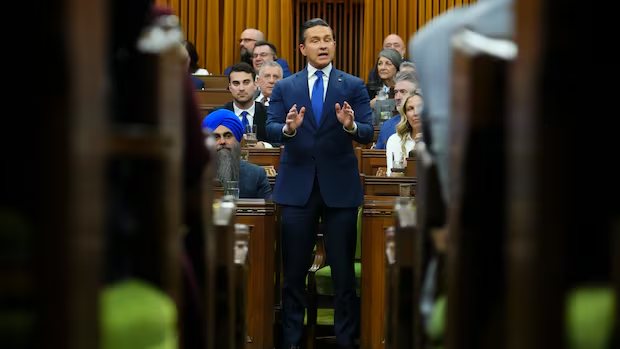
Ahead of an important fiscal update this week, Conservative Leader Pierre Poilievre is demanding Prime Minister Mark Carney cap the federal deficit at $31 billion, in part by eliminating big ticket items like a major rail project and the gun buyback program.
“We should have no deficit,” Poilievre wrote in a letter to Carney. “And if I were Prime Minister right now, we would be on track to achieving that. But your Liberal government has made that impossible for this year.”
The $31 billion cap Poilievre proposes is what the former Trudeau government projected the deficit to be for the 2026-27 fiscal year when it tabled the 2024 fall economic update.
When the Carney government tabled the 2025 budget last year, the deficit for the 2026-27 fiscal year was projected to be approximately $65 billion.
To bring spending down, Poilievre is calling on Ottawa to cancel the high-speed rail project planned to link Toronto and Quebec City, which is estimated to cost between $60 and $90 billion.

The Conservative leader also wants Carney to ditch the federal government’s gun buyback program — which is capped at $742 million — alongside reducing spending on external consultants, the federal bureaucracy and foreign aid.
Poilievre’s letter comes days before the Carney government tables its spring economic update on Tuesday, which will give Canadians a better idea of the country’s finances amid a U.S. trade war and instability in the Middle East.
Finance Minister François-Philippe Champagne said in a video posted to social media on Sunday morning that the update is a plan to continue Canada’s momentum after signing several trade and defence agreements around the world.
“Our new government is doubling down on efforts to tackle long-term structural challenges, generational investment in infrastructure and productivity, strengthening Canada’s investment climate and making economic growth a clear priority. And the world is noticing,” Champagne said.
Since tabling the 2025 budget, the Carney government has announced a temporary increase to the GST credit, which is estimated to cost $12.4 billion over six years. It also announced a temporary removal of the federal excise tax on gas and diesel, which is expected to cost an estimated $2.4 billion.
Canadian economy ‘soggy,’ says expert
In an interview on Rosemary Barton Live that aired Sunday morning, Deloitte Canada’s chief economist Dawn Desjardins described the Canadian economy as “soggy” with a number of uncertainties over U.S. trade and fuel costs.
Sahir Khan, executive vice-president of the Institute of Fiscal Studies and Democracy, told Barton the upcoming update will have to reflect “growing uncertainty in the economic environment.”

Chief political correspondent Rosemary Barton speaks with Dawn Desjardins, Deloitte Canada’s chief economist, and IFSD co-founder and executive vice-president Sahir Khan about the current state of the Canadian economy and what they expect from Tuesday’s update. Plus, Nova Scotian Keely Corrigan discusses the challenges she is facing with the cost of living and the financial pressure she is experiencing.
Khan said the federal government needs to explain the different scenarios and contingencies it’s considering. Plus, Ottawa needs to detail how to execute its ambitious projects and set realistic expectations with Canadians.
On that final part, Khan said “I think that the prime minister started with that in his talk about forward guidance, but I think we’re going to have to hear more of that realism in this planning environment going forward.”
The spring update also comes a few months before Canada, the United States and Mexico must decide whether to approve a renewal of the existing North American free trade agreement or signal their intention to exit the pact.
Canadian and U.S. officials have said talks will likely run past the July 1 deadline — as there are both bilateral and trilateral issues to hammer out.

Prime Minister Mark Carney confirmed current trade talks with the United States ahead of the Canada-U.S.-Mexico Agreement review are not the norm but said ‘we have more than enough’ to do in Canada for U.S. relations to be the first focus. ‘I do not get up first thing in the morning and think about the United States,’ Carney said.
Tensions between Canada and the U.S. ran high earlier this week after U.S. Trade Representative Jamieson Greer criticized Canadian provinces for removing U.S. alcohol from the shelves — something that was initially done last year in response to U.S. President Donald Trump’s tariffs.
Carney bristled at a question about Greer’s comments during a news conference on Thursday, pointing to the U.S. sectoral tariffs.
“You know what’s an irritant? A 50 per cent tariff on steel and aluminum, 25 per cent on automobiles, all of the tariffs on forest products. Those are more than irritants. Those are violations of our trade deal, OK?” Carney said.