The Philips Baristina is an interesting espresso machine. It’s an automatic, but also not quite an automatic. How does that work, I hear you ask? Let me explain.
So, while it grinds, doses, tamps, and brews without any input from you (aside from you clicking the shot button), you also have to empty the portafilter. Isn’t that the worst part of any manual machine? The coffee grounds always get stuck to my hands. Anyway, if you’re after an espresso machine that does most of the hard work for you, the Baristina could be ideal.
However, the espresso does taste pretty mid, and the price is about $200 more than I’d expect. So, could it be one of the best espresso machines? Hm. I don’t think so. But want to find out the full story? Keep reading this Philips Baristina review.
Latest Videos FromTom’s Guide
Philips Baristina review: Specs
Philips Baristina review: Price & availability

The Philips Baristina is $449-$529 from Amazon U.S. and £299-£379 from Amazon U.K. While this price is reasonable enough in the U.K., I would not recommend paying $529 if you’re in the U.S. You don’t even get a built-in milk frother — it looks and feels like a Nespresso Aeroccino standalone milk heater/frother. You can’t customize milk texture at all.
Even though I think the Baristina is overpriced, it’s an automatic machine, which means it’s always going to be pricier than manuals. However, I would wholeheartedly recommend spending just a little more for a genuinely decent machine.
Instead of spending $529 on what is effectively an espresso maker and a separate (cheap-feeling, one-trick-pony) milk frother, I’d spend $699 on the Philips 2300 Series, $799 on the KitchenAid KF2, or, heck, even $379 on the Nespresso CitiZ + Aeroccino. It’s a pod machine, sure, but honestly? It makes a better brew.
Philips Baristina review: Design

So, I’m not a huge fan of how the Baristina looks. I think it looks incredibly cheap, like something that costs $200 rather than $530. When I found out how much it costs, I actually gasped.
While it doesn’t look bad, it does look cheap. Whether this is a dealbreaker will depend on your preferences. For me, I’d rather spend a little extra on the KitchenAid KF2 or just get a bog-standard manual like the $300 Breville Bambino.
You get a “portafilter”. I say “portafilter” because, yes, it’s technically a portafilter in that it has a handle and a basket where the coffee goes. But you can’t use it like a traditional portafilter — you don’t dose and tamp manually. All you have to do is push the portafilter over to the grinder side at the start of the brew and then sit back and relax.
While, yes, I loved watching the portafilter snap back into place after the grinder finished (it’s the simple things), I think this is more of a style gimmick than actual function. If you’re after a truly automatic machine, it might even be a major con. Yes, you have to empty and clean out the portafilter yourself.
Philips Baristina review: Espresso

If you’re an espresso aficionado, you won’t want to read this. However, if you’re someone who prioritizes speed, ease of use, and simplicity, you’re the perfect candidate for a Baristina.
As it’s a bean-to-cup automatic — despite having a “portafilter” — you have very little input. Pour your beans in, press the espresso button, slide the portafilter to the grinder side (which is super fun), and you’ve done all the work. The machine snaps the portafilter into place hands-free, and, yes, this is mesmerizing to watch. I don’t care how lame that makes me; I enjoy watching a portafilter careen across a coffee machine like a stone from a slingshot. It’s novel. Sue me.
In terms of espresso flavor… it’s okay. It tastes incredibly average. I tried the machine with both artisan Ethiopian beans and your generic “strong” dark roast, and it tasted better with the latter. I’d recommend using cheaper, darker beans on this machine, as the excessive 16-bar pressure and the tiny (40mm) pressurized portafilter destroys any nuance anyway.

As you can see, this espresso shot is foamy and aerated, which means it was extracted under too much pressure. The crema is fluffy, but it dissipated within seconds. The first Ethiopian beans (which usually taste divine) were overly sour and astringent. However, the second generic Illy-brand beans resulted in a stronger, more palatable coffee taste. Of course, this won’t impress coffee nerds, but this isn’t a machine for coffee nerds.
Even so, I struggle to recommend this machine wholeheartedly considering you can get much better machines for just a little extra. The Philips 2300 is a modest stretch at $699; the KitchenAid KF2 is $799. Considering these machines have built-in milk preparation and zero user input, I’d recommend them if you’re after a totally automatic machine. The espresso tastes much nicer.
Philips Baristina review: Grinder
While the Philips Baristina does have a built-in grinder and therefore demands a standalone ‘grinder’ section, this is going to be extremely short.
The grinder is not adjustable. Yes, you heard me correctly. Not adjustable. The grinder grinds to one size and one size only. Want it finer? Not possible. Coarser? Oh, again, you guessed it, not possible.
Other automatic machines such as the De’Longhi Rivelia have an adjustable grinder, and also the $699 manual bean-to-cup De’Longhi Arte Evo. If you’re interested in actually playing and experimenting with coffee, I’d recommend the Arte Evo over the Baristina. You’re paying an extra $150, but it’s often discounted to $599 (so just $50 more), and you get all the bonuses of a manual machine with the ease of an assisted tamping system.
Philips Baristina review: Milk

As mentioned earlier, the Baristina comes in two variants: with milk frother and without milk frother. If you order the cheaper model, it won’t come with the frother.
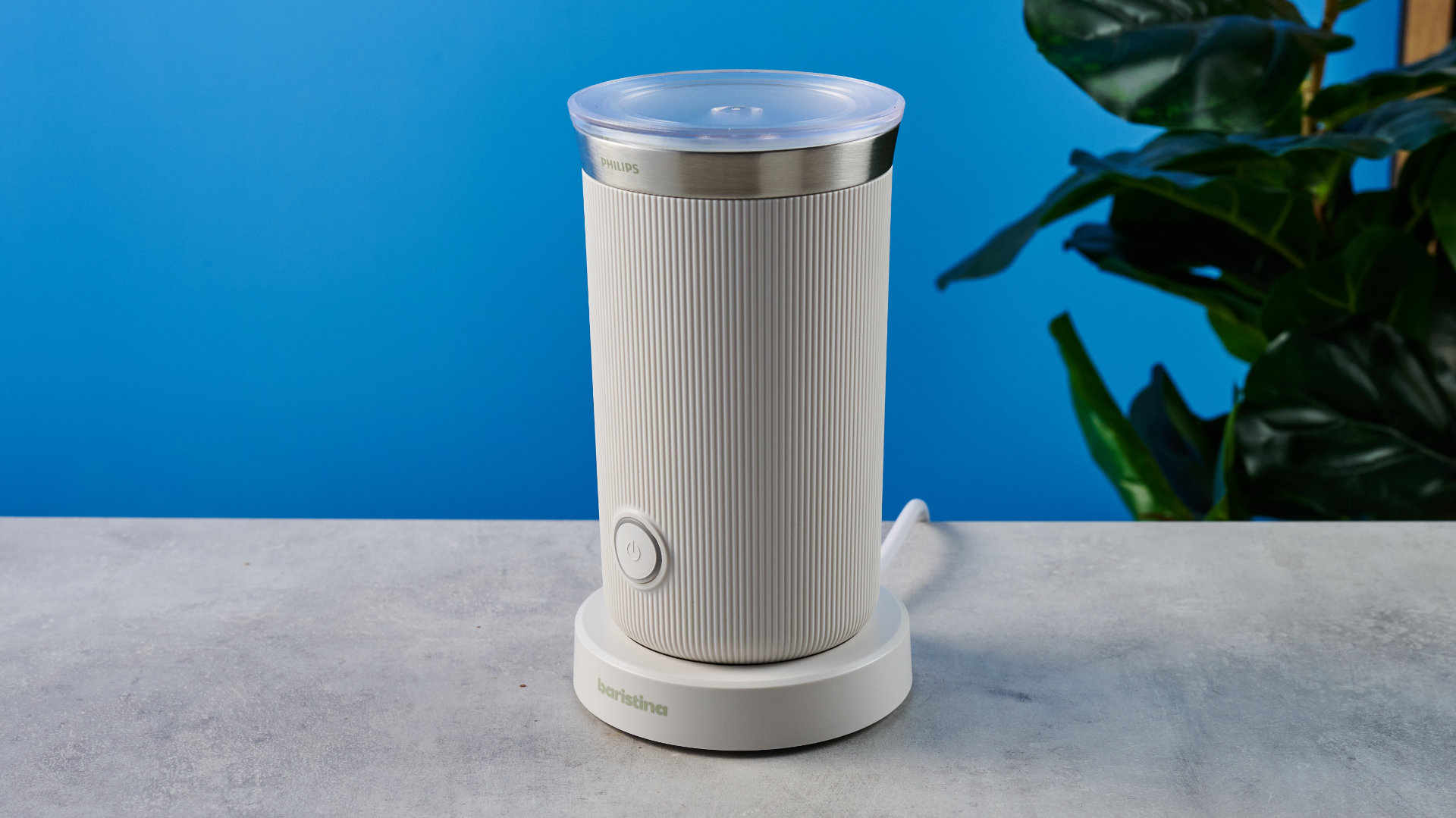
Those familiar with something like the Nespresso Aeroccino will recognize this milk frother: the Philips model is essentially just your standard countertop model. It’s not particularly unique or innovative, but damn, it works. If it ain’t broke, don’t fix, right?
Here’s a photo of a milk drink made. Notice how I said “milk drink” rather than latte or cappuccino — the Baristina can only make one type of milk. No wet lattes or dry cappuccinos here. Milk or no milk only!

As you can see, the milk is extremely thick. Don’t get me wrong, the texture is satisfying, with well-distributed, evenly sized bubbles. However, this isn’t going to impress people who are used to barista-crafted beverages. It cannot make microfoam; therefore, drinks like lattes and flat whites are out of the question. You can only make cappuccinos.
Philips Baristina review: Storage & maintenance

Although 15 inches tall, the Philips Baristina feels a lot smaller. This height is solely due to the grinder hopper — its main body is more compact. Of course, you’d need to ensure you have space under your counters for the hopper, but the machine should take up less space than you think.
Due to this size, the machine has a teeny-tiny drip tray. I always recommend cleaning out your drip tray after every use, but in this case, it’s definitely a necessity. If you don’t clean it out every day, it’s going to overflow before you know it.
As with the rest of the machine, the drip tray is incredibly plasticky. This is one of my biggest complaints — a design this plasticky is pretty inexcusable when you’re charging $549 from an aesthetic and longevity perspective.
Speaking of longevity, you get a 2-year warranty as standard, which is the same as Breville, Ninja, and De’Longhi.
Philips Baristina review: Verdict
While I don’t think the Philips Baristina is the worst espresso machine I’ve ever used, I can’t recommend it wholeheartedly. Only a very specific user base should get this machine. If you can’t stretch to $699 for a Philips 2300 Series, you don’t mind mid-tasting espresso, you’re happy with one-size-fits-all milk texture, and you’re happy to spend $200 more than I think you should, then yes, this would be the machine for you.
All other people, though? You’d either be better off with the $699 Philips 2300 Series, the $799 KitchenAid KF2, or even venture into the world of manual bean-to-cups with the fantastic De’Longhi Arte Evo.
As I said earlier, if you want simplicity and ease of use over anything else, I’d even go as far to say you’re the perfect candidate for a Nespresso CitiZ + Milk.