Pacific leaders have criticised China’s recent intercontinental ballistic missile test at their most significant regional meeting after weeks of internal wrangling over how they should respond to Beijing’s swelling military power.
Pacific Islands Forum (PIF) chair and Palau President Surangel Whipps Jr — who has been one of the region’s most forceful critics of China — had pressed Pacific leaders to endorse a joint statement on the test during a retreat at his private residence in the country’s north.
After returning to Palau’s commercial hub Koror for the PIF leaders meeting closing ceremony, Mr Whipps told journalists that a consensus had been reached in their final joint statement.
“Leaders … registered concern on the recent intercontinental ballistic missile (ICBM) test, which overflew a number of members without adequate notice,” he said, reading from the communique.
“Leaders called on all states undertaking ICBM testing to ensure transparency and reassurance, including through the provision of advance notification of a test at least 24 hours in accordance with international practice.”
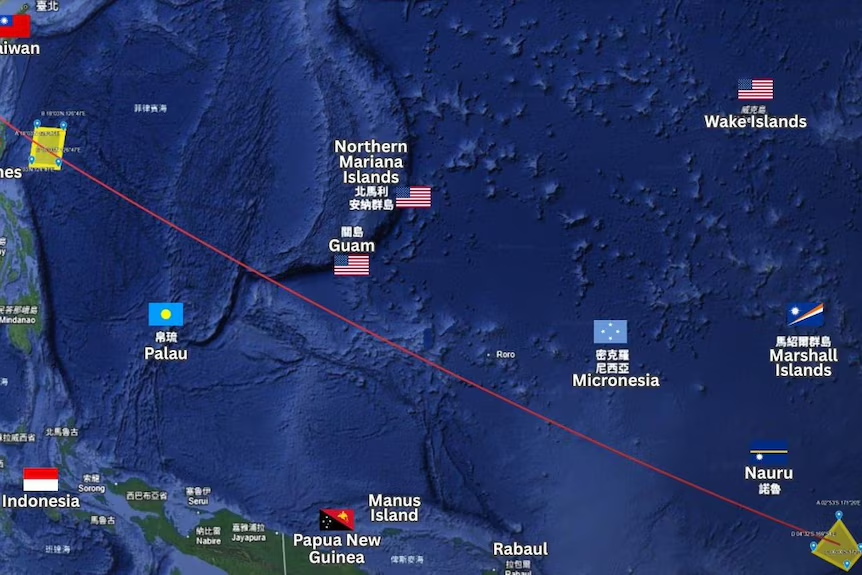
The trajectory of a test-fired Chinese ballistic missile in the Pacific, according to the Taiwanese government. (Supplied: Joseph Wu/Government of Taiwan/X)
The statement is stronger than the one issued by Pacific foreign ministers last month, who also called for “transparency and reassurance” from China over its ballistic missile test in their final communique.
But there are question marks over how firm the Pacific leaders’ consensus is, with clear signs that the two Pacific nations who blocked a standalone Foreign Ministers statement on the test — Naoero and Kiribati — are still not on board.
Naoero dissents from criticism, while Kiribati’s president skips meeting altogether
Mr Whipps told reporters after the retreat that Naoero had “dissented” from the section in the communique criticising the test, and that its position would be noted in the document.
Kiribati’s President Taneti Maamau skipped this year’s PIF leaders meeting, and was represented instead by the country’s recently returned envoy to China, senior official David Teaabo.
There was an awkward moment in the PIF closing ceremony when the event emcees initially forgot to publicly recognise Mr Teaabo, along with the other senior country representatives, before hastily correcting the record a few minutes later.
Meanwhile, New Zealand Prime Minister Christopher Luxon told journalists in Koror that Mr Teaabo was not at the leaders retreat.
“Kiribati wasn’t with the leaders today,” he said.
“I wasn’t aware that there was a representative from Kiribati in the room all day.”
New Zealand’s Prime Minister Christopher Luxon said the leaders’ conversations over China’s missile test had been “unifying”. (AFP: Saeed Khan)
The usual convention is to have every PIF member represented at the gathering, but Mr Luxon did not say why they were absent — although he insisted there was no move to exclude them.
Debate over missile test ‘unifying’, NZ PM says
Mr Luxon also said the statement was a “pragmatic” compromise, and that the leaders’ conversation over the test was “unifying” and “high quality”.
“It was important that we have a statement in the communique … and I think we’ve got to a very good place,” he said.
“I’d sooner have a statement that summarises the vast consensus (for) everyone except for one (country).”
Mr Luxon also said that it was important to “push back” against China’s behaviour.
“I don’t want to see this normalised — when you fire a nuclear missile into the nuclear free Pacific… that’s not something we want to see,”
he said.
On Thursday China’s Foreign Ministry spokesperson Guo Jiakun sharply criticised Palau over the debate, saying it was trying to “sensationalise” the test and hold other PIF states “hostage” to its position.
“Its intentions are sinister, and its scheme will not succeed,” he said.
“China never engages in military expansion.
“We are willing to work together with South Pacific countries to contribute to maintaining peace and stability and promoting development and prosperity in the South Pacific.”