Key Points
-
Nvidia’s data center business grew 117% year over year during the second quarter.
-
As shipments of Blackwell and Vera scale, Nvidia needs to procure more components for its GPUs and CPUs.
-
Nvidia’s management made it clear that the bulk of its supply and capacity spend will be allocated toward memory.
- 10 stocks we like better than Nvidia ›
Nvidia (NASDAQ: NVDA) just told the market that it is willing to lock down more than a quarter-trillion dollars’ worth of critical components to scale its data center empire. During second-quarter earnings, Nvidia CFO Colette Kress revealed that the company will be spending $279 billion on supply commitments over the next few years — up from $119 billion only three months earlier. The reason for the jump is primarily about memory.
This figure is so large that it sounds less like a purchase order and more like an industrial policy. In an environment where everyone already knows high bandwidth memory (HBM) is scarce and expanding generative models need more of it, the size and speed of Nvidia’s commitment are the real story.
Missed Nvidia in 2009? This Rare Signal Is Flashing Again. In 2009, a “Double Down” signal flashed for a little-known chipmaker called Nvidia. For the first time in years, that same “Total Conviction” signal is flashing for a company 1/100th the size of Nvidia. Continue »
Nvidia is not merely hedging by a quarter. It is pre-paying for the next several years of the artificial intelligence (AI) factory build-out so Blackwell systems and Vera central processing units (CPUs) can actually ship. Allow me to explain why.
Image source: Nvidia.
Nvidia’s commitment redefines the AI supply chain
A budget of $279 billion is not a mere inventory buffer. It represents roughly three years of highly concentrated buying power pointed at the tightest part of the AI chip stack. Of this total, $92 billion is due in the remainder of fiscal 2027, followed by $87 billion and $88 billion across fiscal 2028 and 2029. Nvidia is effectively reserving the near-term memory market and not leaving it open until the next decade starts.
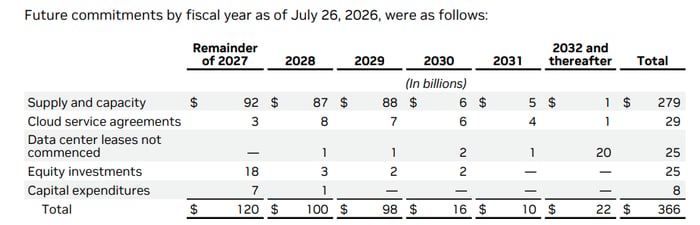
Image source: Nvidia Investor Relations.
The company’s data center business is the key reason. Revenue from this segment reached $89 billion during second quarter fiscal year 2027, up 117% from a year earlier and on the way to a companywide guide of $108 billion for this quarter (fiscal third quarter).
Kress spoke about 70% total revenue growth in fiscal 2028, fueled by ongoing Blackwell shipments, scaling Vera Rubin as it reaches full production, and both pairing Vera CPUs with the company’s existing graphics processing unit (GPU) architectures and selling them as a new stand-alone product. In essence, every extra rack, GPU, and CPU socket multiplies the HBM and server DRAM layered on top. Memory is no longer a line item seen as a commoditized, accessible solution. It has emerged as the bottleneck of AI infrastructure build-outs.
When a company with Nvidia’s balance sheet increases supply commitments by more than double in a single quarter, it is signaling to producers that memory demand is real enough to underwrite new fabs. At the same time, it tells investors that the cost of this demand is going to show up in Nvidia’s cost of goods before it fully materializes in higher selling prices down the road.
Understanding the AI memory tax
Scaling Blackwell and Vera is more than a silicon problem. More deeply, it is a packaging and memory problem. Each new generation of accelerators needs more HBM stacks, higher bandwidth, and tighter systems integration. Investors already know that memory prices are rising, though. What Nvidia’s $279 billion supply and capacity budget does is prove that the company would rather absorb memory-driven inflation and guarantee future supply, instead of missing chip shipments.
The opportunity cost for Nvidia will be seen in gross margin. The company’s gross margin was 75% last quarter and is guided to 74% this quarter. Management commented that a further dip into the low 70% range is realistic by the end of fiscal 2027. Higher average selling prices from DRAM and HBM are the most straightforward explanation for Nvidia’s margin deterioration.
The bulk of Nvidia’s memory spend will almost certainly land between SK Hynix (NASDAQ: SKHY) and Micron Technology (NASDAQ: MU). These two companies are at the center of HBM qualification for Nvidia’s platforms. When Nvidia commits to a multi-year check this large, it is not spreading it evenly across a commoditized DRAM market.
Instead, Nvidia will concentrate its capital on two leading memory producers that it already knows can actually deliver the specialized components that make Blackwell and Vera perform as advertised. For Micron and SK Hynix, Nvidia’s spending is not a cyclical restocking. It is a multi-year offtake that funds capacity additions these companies would have historically only hoped for.
Why AI memory stocks may be mispriced
Wall Street is already forecasting healthy revenue growth for SK Hynix and Micron over the next few years. However, the scale and duration of Nvidia’s $279 billion supply order could easily drive higher-than-expected sales for both memory specialists. Taking this one step further, pricing power dynamics appear to be moving in favor of HBM and DRAM producers. This should fuel further earnings expansion for SK Hynix and Micron as Nvidia chooses to pay now rather than wait for supply to catch up with demand.

MU Revenue Estimates for Current Fiscal Year data by YCharts.
Despite this growth and compelling profitability dynamics, Micron and SK Hynix both trade at forward price-to-earnings (P/E) multiples around 6. I think this suggests the market is less comfortable owning the AI memory story as opposed to a known quantity such as Nvidia.
Two fears are keeping memory valuations in check: the notion that accelerating AI capex spend is a bubble that will burst, and the idea that memory is destined to follow its boom-bust cycle. In my eyes, Nvidia’s data center results and the company’s established $279 billion commitment mitigate both fears.
A bubble narrative has a hard time debunking $89 billion of data center revenue, a $108 billion next-quarter guide, and a 70% growth outlook for next year, all while the same company is simultaneously locking in three years’ worth of memory solutions. Against this backdrop, cyclicality looks less realistic when the largest memory buyer in the AI landscape decides to pre-commit at this scale instead of risking spot orders that can vanish in a quarter.
This is why the better expression of an AI inflection may be investing in the memory suppliers rather than the platform owner. Micron and SK Hynix get more volume, pricing power, and visibility from Nvidia, all without having to defend margin erosion from the memory tax. All told, neither stock is priced as if a quarter-trillion-dollar customer order just reserved the next three years of inventory.
I think a prudent strategy is to buy Micron and SK Hynix together. They complement each other geographically and in product mix, all while sitting on the same Nvidia purchase order. While Nvidia remains the engine driving the AI revolution, these two memory producers are the fuel for the engine that the market still treats as a cyclical afterthought, for now.
Should you buy stock in Nvidia right now?
Before you buy stock in Nvidia, consider this:
The Motley Fool Stock Advisor analyst team just identified what they believe are the 10 best stocks for investors to buy now… and Nvidia wasn’t one of them. The 10 stocks that made the cut could produce monster returns in the coming years.
Consider when Netflix made this list on December 17, 2004… if you invested $1,000 at the time of our recommendation, you’d have $430,571!* Or when Nvidia made this list on April 15, 2005… if you invested $1,000 at the time of our recommendation, you’d have $1,399,268!*
Now, it’s worth noting Stock Advisor’s total average return is 986% — a market-crushing outperformance compared to 214% for the S&P 500. Don’t miss the latest top 10 list, available with Stock Advisor, and join an investing community built by individual investors for individual investors.
*Stock Advisor returns as of August 29, 2026.
Adam Spatacco has positions in Nvidia. The Motley Fool has positions in and recommends Micron Technology and Nvidia. The Motley Fool has a disclosure policy.
