Key Points
-
Modern data centers powered by advanced Nvidia chips require significantly more power compared to traditional setups.
-
Technology companies have signed some major long-term power purchase agreements with independent power producers.
-
Hyperscalers are also turning to behind-the-meter, off-grid power solutions like gas turbines and fuel cells.
- 10 stocks we like better than Nvidia ›
Modern data centers require massive amounts of power, and those demands are only growing. High-density AI clusters packed with Nvidia (NASDAQ: NVDA) graphics processing units (GPUs) can require 100 kilowatts (kW) to over 300 kW per rack, or up to 20 times the electricity consumption of traditional server racks.
Computing capacity is capped by power availability, which has proven to be a major bottleneck in the AI data center build-out. As a result, capital is flowing to companies that can reliably deliver power or manufacture power equipment. For investors looking to capitalize on the AI energy boom, here are some of the companies emerging as top winners.
Missed Nvidia in 2009? This Rare Signal Is Flashing Again. In 2009, a “Double Down” signal flashed for a little-known chipmaker called Nvidia. For the first time in years, that same “Total Conviction” signal is flashing for a company 1/100th the size of Nvidia. Continue »
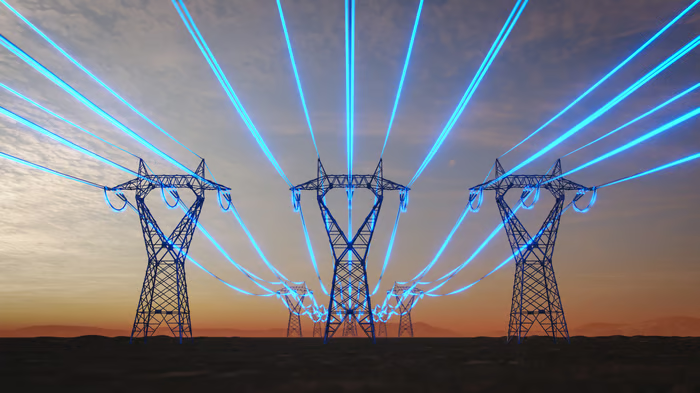
Image source: Getty Images.
Utility operators are immediate beneficiaries of the energy demand boom
Regulated utilities operate under government oversight and are appealing because they can offer predictable income and reliable dividends to navigate market cycles. NextEra Energy (NYSE: NEE) is a regulated utility with upside from its renewables business. The company owns the stable utility Florida Power & Light. It also owns NextEra Energy Resources, one of the largest producers of wind and solar power.
That said, connecting power-hungry data centers to the public utility grid often faces three- to seven-year interconnection queues, creating an opportunity for independent power producers (IPPs). Also known as merchant power companies, these companies own electricity generation assets but not the transmission grid.
This group includes companies such as Constellation Energy (NASDAQ: CEG) and Vistra (NYSE: VST), which sell electricity in competitive wholesale markets and benefit from supply constraints and surging demand.
Constellation is appealing because it is the largest nuclear operator in the United States, with 22 gigawatts (GW) of nuclear energy capacity. Because it can provide carbon-free, baseload energy, nuclear energy has emerged as a top choice among hyperscalers looking to power their growing data center footprints. In recent years, Constellation has signed major power purchase agreements with Microsoft and Meta Platforms.
Vistra is another massive power producer, with 44 GW of total generation capacity, including natural gas, nuclear, and coal. The company also signed an agreement with Meta Platforms earlier this year. In addition, Vistra, along with KKR, the Kuwait Investment Authority, and Nvidia, formed Helix Investments to build AI infrastructure. As part of this, Vistra will be Helix’s preferred power provider.
Grid-independent solutions have grown in popularity
Because of transmission bottlenecks and grid interconnection delays, which could take up to a decade in some cases, hyperscalers are turning to off-grid dispatchable power solutions to generate electricity on-site at data centers. These benefit companies that provide gas turbines or fuel cells that can run on natural gas, including GE Vernova (NYSE: GEV) and Bloom Energy (NYSE: BE).
GE Vernova is a global leader in power equipment, with technology that generates roughly 25% of the world’s electricity. The company has seen unprecedented demand for its heavy-duty and HA-advanced high-efficiency natural gas turbines, which can be deployed to provide baseload power in months rather than years. GE Vernova boasts a massive backlog totaling $163 billion, with agreements extending through 2031.
Bloom Energy provides solid-oxide fuel cell systems (Bloom Energy Servers) that can use a wide range of fuels, including natural gas, biogas, or hydrogen. Bloom has signed massive deals in recent years, including an expanded strategic infrastructure agreement with Brookfield Asset Management for $25 billion, along with contracts with Oracle, Intel, and CoreWeave.
Aggressive investors may want to consider these highly speculative energy stocks
The next frontier of long-term power generation could be driven by small modular nuclear reactors (SMRs) and utility-scale battery storage systems.
In the nuclear space, Oklo (NYSE: OKLO) and NuScale Power (NYSE: SMR) are two popular SMR developers that could revolutionize how nuclear energy is deployed. These companies intend to offer factory-fabricated, modular nuclear reactors that could provide off-grid, safe nuclear energy on-site for data centers and other industrial operators. These reactors are promising, but won’t be commercially available until the 2030s at the soonest.
Then you have battery storage solutions, such as those provided by Fluence Energy (NASDAQ: FLNC). Fluence provides modular battery energy storage systems (BESS), such as its Smartstack platform, along with software tools to help stabilize electrical loads.
On June 1, Fluence announced a partnership with Nvidia (along with Siemens and nVent) to integrate its Smartstack BESS into Siemens’ AI data center blueprints for Nvidia’s DSX Vera Rubin NVL72 platform.
Investors have a few ways to play the AI energy boom
For aggressive investors, Oklo, NuScale, and Fluence have significant upside potential, but they must balance that potential against the long time horizon and high costs of scaling up.
Independent power providers, such as Constellation and Vistra, should benefit from securing long-term agreements with technology customers. Meanwhile, off-grid power solutions from GE Vernova and Bloom Energy are experiencing a historic surge in demand, which should drive strong growth over the next several years.
When it comes to data center build-out, modern data centers require significant power, turning boring energy and industrial stocks into long-term winners thanks to technological innovations and the massive spending boom in data centers and related infrastructure in the coming years.
Should you buy stock in Nvidia right now?
Before you buy stock in Nvidia, consider this:
The Motley Fool Stock Advisor analyst team just identified what they believe are the 10 best stocks for investors to buy now… and Nvidia wasn’t one of them. The 10 stocks that made the cut could produce monster returns in the coming years.
Consider when Netflix made this list on December 17, 2004… if you invested $1,000 at the time of our recommendation, you’d have $419,408!* Or when Nvidia made this list on April 15, 2005… if you invested $1,000 at the time of our recommendation, you’d have $1,348,694!*
Now, it’s worth noting Stock Advisor’s total average return is 966% — a market-crushing outperformance compared to 213% for the S&P 500. Don’t miss the latest top 10 list, available with Stock Advisor, and join an investing community built by individual investors for individual investors.
*Stock Advisor returns as of August 20, 2026.
Courtney Carlsen has positions in Bloom Energy, Constellation Energy, Fluence Energy, GE Vernova, Meta Platforms, Microsoft, Nvidia, Oracle, and Vistra. The Motley Fool has positions in and recommends Bloom Energy, Brookfield Asset Management, Constellation Energy, Fluence Energy, GE Vernova, Intel, KKR, Meta Platforms, Microsoft, NextEra Energy, Nvidia, Oracle, and Vistra. The Motley Fool recommends NuScale Power. The Motley Fool has a disclosure policy.