
Key Points
-
It would have been difficult for Nvidia and AMD to manufacture AI accelerators without ASML’s advanced chipmaking equipment.
-
The heavy investments in AI data center infrastructure and the booming demand for memory chips will be a tailwind for ASML.
-
ASML’s improving long-term growth prospects suggest the stock is poised to jump higher following a solid performance so far in 2026.
- 10 stocks we like better than ASML ›
Nvidia and Advanced Micro Devices are among the leading designers of artificial intelligence (AI) chips, with both companies boasting an impressive customer base that includes major hyperscalers, AI companies, and governments.
However, what’s worth noting is that Nvidia and AMD are fabless chipmakers that only design and sell chips. They outsource the manufacturing part to a third-party, Taiwan Semiconductor Manufacturing, in this case. Additionally, Nvidia and AMD purchase other key components, such as memory chips, from the likes of Micron Technology, Samsung, and others.
Missed AI’s “Act 1”? Act 2 Could Be 15x Bigger. Most investors think they missed the AI boat because they didn’t buy Nvidia in 2005. But according to our analysts, we’re only at the end of “Act 1″—the R&D phase. “Act 2” is the global rollout. Continue »
In simple words, Nvidia and AMD rely on other companies in the semiconductor ecosystem to manufacture cutting-edge chips that handle model training and inference in AI data centers. However, the most important name the above-mentioned companies rely on is ASML Holding (NASDAQ: ASML).
Let’s look at the reasons why ASML is the most important AI stock among all the companies mentioned in the article so far.
Image source: ASML.
ASML’s machines are extremely important in the AI ecosystem
ASML makes extreme ultraviolet (EUV) lithography machines, which use an advanced manufacturing technique that helps print small electronic circuits on silicon wafers. The advanced chips made using this process can pack billions of transistors onto an integrated circuit, enabling faster performance and low power consumption.
Specifically, ASML’s EUV machines are used to manufacture chips with sizes of 7 nanometers (nm) or smaller. It is worth noting that Nvidia and AMD are currently designing advanced chips based on the 3 nm process node and are moving toward 2nm to make even better chips. Not surprisingly, the demand for ASML’s EUV machines is growing at a nice clip, driven by the growing demand for AI chips.
ASML CEO Christophe Fouquet noted on the company’s July earnings call:
In logic, there is a continued investment, not only to enable the expansion of 3 nm capacity in support of the latest generation of AI accelerators, but also at both the 5 nm and the 4 nm nodes to support the diverse set of chips required by AI product[s]. At the same time, the 2 nm node continues to ramp rapidly to support next generation HPC and mobile applications.
He added that ASML customers are also looking to develop chips on the 1.4 nm node. As a result, the demand for the company’s machines from foundry and logic customers should strengthen. ASML expects a 25% increase in sales of its machines to foundry/logic customers this year. The Dutch semiconductor bellwether is collaborating with major foundries, such as Intel and TSMC, to increase sales of its EUV lithography machines.
At the same time, memory manufacturers are driving greater growth for ASML’s advanced machines. The company expects a 75% increase in system sales to memory manufacturers in 2026, primarily driven by the growing demand for high-bandwidth memory (HBM). Memory manufacturers, including Micron, Samsung, and SK Hynix, have been relying on EUV lithography to make chips ideal for handling AI workloads.
The stunning demand for memory chips explains why ASML is anticipating a big jump in memory revenue this year. Importantly, the memory shortage is expected to last until 2030, according to SK Hynix. So, the aggressive investments in memory manufacturing equipment should continue over the long run.
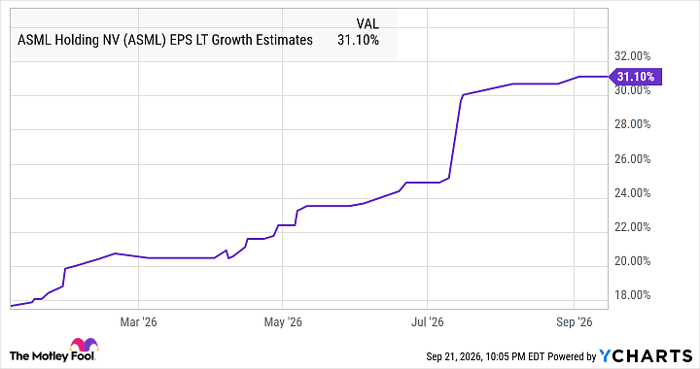
Moreover, ASML has a monopoly in the EUV lithography market. This puts the company in a terrific position to capitalize on the growing demand for advanced chips deployed in AI data centers. So, it is easy to see why analysts have increased their long-term earnings per share (EPS) growth expectations for ASML significantly this year.
Data by YCharts
Now is a great time to buy this growth stock
ASML stock has jumped 60% so far this year. The good part is that it can still be bought at 28 times forward earnings, which isn’t very high considering the tech-laden Nasdaq-100 index’s forward earnings of 24.2.
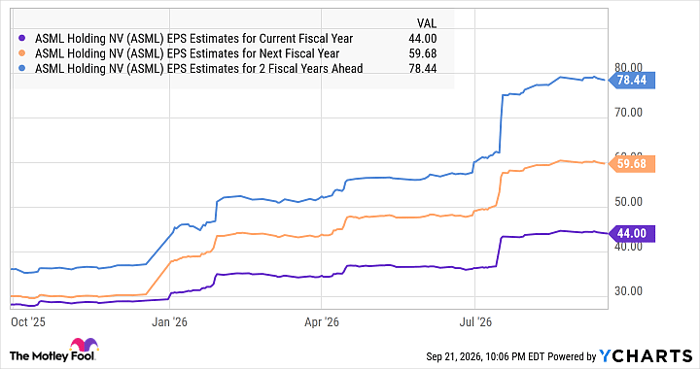
We have already seen that ASML’s earnings are poised to grow at over 30% per year in the long run, and it won’t be surprising to see this estimate rise. In fact, ASML’s EPS consensus estimates have increased impressively through 2028.
Data by YCharts
PwC expects annual AI infrastructure spending to rise from $800 billion in 2026 to $1.8 trillion in 2050, driven by the need for chip upgrades. ASML’s important position in the global semiconductor space puts it in a commanding position to capitalize on this lucrative opportunity. So, investors looking to buy a top semiconductor stock for the long run that’s driving the AI infrastructure boom should consider ASML, as it seems primed to jump higher.
Should you buy stock in ASML right now?
Before you buy stock in ASML, consider this:
The Motley Fool Stock Advisor analyst team just identified what they believe are the 10 best stocks for investors to buy now… and ASML wasn’t one of them. The 10 stocks that made the cut could produce monster returns in the coming years.
Consider when Netflix made this list on December 17, 2004… if you invested $1,000 at the time of our recommendation, you’d have $387,158!* Or when Nvidia made this list on April 15, 2005… if you invested $1,000 at the time of our recommendation, you’d have $1,365,749!*
Now, it’s worth noting Stock Advisor’s total average return is 932% — a market-crushing outperformance compared to 211% for the S&P 500. Don’t miss the latest top 10 list, available with Stock Advisor, and join an investing community built by individual investors for individual investors.
*Stock Advisor returns as of September 22, 2026.
Harsh Chauhan has no position in any of the stocks mentioned. The Motley Fool has positions in and recommends ASML, Advanced Micro Devices, Intel, Micron Technology, Nvidia, and Taiwan Semiconductor Manufacturing. The Motley Fool has a disclosure policy.