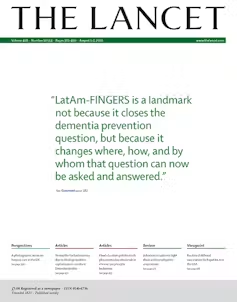
A new study recently presented in London to an audience of more than 1,000 global experts on dementia during the Alzheimer’s Association International Conference (AAIC 2026) and simultaneously published in the journal The Lancet reinforce the positive impacts of lifestyle changes on cognitive health. Dubbed LatAm-FINGERS, the study’s findings caused a major stir in the scientific community, as they show that lifestyle changes can improve overall cognitive performance by up to 55% in older adults at risk of developing cognitive decline and dementia.

The Lancet
LatAm-FINGERS is the first multicenter randomized clinical trial conducted in Latin America to investigate strategies for preventing cognitive decline in older adults. It mirrors FINGER, one of the first studies to examine the effectiveness of this type of intervention, conducted in Finland with participants aged 60 to 77 who were at high risk for cognitive decline and dementia.
Published in The Lancet in 2015, FINGER participants were randomly assigned to two groups: one received only general health guidance; the other received a systematic, multi-domain intervention covering physical activity, diet, clinical monitoring, cognitive training, and socialization. After two years of follow-up, the study showed that participants who received the systematic intervention improved their overall cognitive performance by 25% compared to the group that received only general health guidance.
FINGER garnered significant attention, sparking interest within the scientific community in replicating these positive results in other contexts, and in 2025 the U.S. Pointer study, conducted in the United States, was published in The Journal of the American Medical Association (JAMA). It also observed positive effects of this multidomain intervention on the overall cognitive performance of 2,111 people aged 60 to 79 who were at high risk for cognitive decline and were followed for two years.
A Growing Global Problem
With the aging of the global population, the prevalence of dementia worldwide has risen significantly. In Latin America and Brazil, some studies indicate that the incidence of dementia among the elderly is the highest among all geographic regions of the world. A meta-analysis published in 2022, which analyzed 31 studies conducted in Latin America, showed a prevalence of dementia of 9% among people aged 65 and older.
There are some risk factors for dementia that are not modifiable, such as age and genetics. On the other hand, there are factors that can be altered, treated, or controlled, and that can reduce the risk of the condition. For this reason, there has been an effort by the global scientific community — especially over the past two decades — to identify these modifiable factors and calculate the impact of controlling them on reducing the number of cases.
The Lancet itself established a commission dedicated to this topic several years ago. In its most recent publication, in 2024, the journal identified 14 modifiable risk factors that have an impact throughout life: in childhood, these include illiteracy and low educational attainment; later in life, other factors emerge, such as hearing loss, high blood pressure, diabetes, physical inactivity, and reduced visual acuity, among others.
And what the publication showed is that, if we were to eliminate all these risk factors, we would significantly reduce the number of dementia cases. Projecting the data to Brazil, nearly 60% of dementia cases would be eliminated if all these risk factors were controlled or eliminated.
The Latin American study
About a decade ago, Latin American research groups began discussing the possibility of conducting FINGER similar study in the region. The Alzheimer’s Association, a US-based organization and major funder of research projects in this field, strongly supported the idea and funded our study.
Twelve research centers in 11 Latin American countries were then brought together: Argentina, Bolivia, Brazil, Chile, Colombia, Costa Rica, Ecuador, Mexico, Peru, the Dominican Republic, and Uruguay. Brazil had two centers: one at the Federal University of Minas Gerais (UFMG) and another at the University of São Paulo (USP). At each center, we had multidisciplinary teams comprising physicians, psychologists, physical educators, nutritionists, laboratory research staff, and radiologists (to establish a biobank of blood samples and brain MRI scans).
We selected participants with the same profile as in the Finnish study — ages 60 to 77 and with high risk factors for cognitive decline and dementia — who were followed for two years. They were also divided into a group that received general health guidance and another that received a systematic, multi-domain intervention, with follow-up by the multidisciplinary teams. The intervention areas were defined a priori by the researchers so that centers in all countries would follow exactly the same protocol.
The interventions consisted of:
-
Physical activity: supervised by physical education instructors, four times a week, one hour per day. The activity began with a warm-up and stretching, and then included both aerobic exercises and strength training.
-
Nutritional counseling: implementation of the MIND diet, which combines the Mediterranean diet with the DASH diet, a low-sodium diet for hypertension. The nutrition teams from each country discussed possible adaptations to local realities. In Brazil, for example, we substituted berries for açaí, olive oil for avocado, and so on. Regional adaptations were made to address both socioeconomic issues and the dietary habits of each country or population.
-
Cognitive training: conducted using a computerized cognitive training program called Brain HQ. Participants used this resource under the guidance of neuropsychologists and undergraduate psychology students, whose role was to help them use the program, encourage them, and ensure they completed the exercises with the desired frequency.
-
Clinical and cardiovascular management: regular medical follow-up, monitoring, and clinical guidance for managing hypertension, diabetes mellitus, high cholesterol, and other medical conditions.
-
Socialization: achieved through cognitive training and physical activity, both of which were group activities.
Significant results
Our hypothesis was that, in Latin America, the window of opportunity for response would be even more significant than in the original Finnish study. And that was precisely the result we obtained. We demonstrated that, after two years, the individuals who received the systematic nonpharmacological intervention showed an improvement in overall cognitive performance relative to the other group of approximately 55%. In addition to overall cognition, we also observed significant positive effects on memory, executive function (i.e., planning ability), and information processing speed.
And why such a large difference in results compared to the original FINGER study? There are some epidemiological studies showing that, in European countries and the United States, the incidence of dementia has decreased over the past 30 years. In these countries, life expectancy was already high. Thus, the effect of aging was already present. What has been achieved is an improvement in these people’s socioeconomic conditions, education, and cardiovascular health. This has led to a reduction in the incidence of dementia in these countries.
In Latin America, however, the demographic transition is still underway, with significant population aging in recent decades and projected to continue in the coming decades. Additionally, the prevalence of modifiable yet uncontrolled risk factors for dementia remains very high. Unfortunately, there is a large number of people in the region with hypertension and diabetes who do not seek treatment or who irregularly manage these risk factors.
With a population carrying a higher burden of uncontrolled cardiovascular risk factors, the improvement achieved when these factors are controlled is also greater.
Next steps
We have secured new funding from the Alzheimer’s Association to continue following the LatAm-FINGERS participants for four years — not with the initial controlled intervention, but simply by observing them, in the hope that they will maintain these lifestyle habits over time. In this longer-term study, we may be able to see the impact of lifestyle changes in the medium term and investigate whether or not there will be a reduction in the incidence of dementia.
What we have already confirmed is an improvement in overall cognitive performance and in three specific cognitive domains, which leads us to hypothesize that, even in the case of a degenerative disease such as Alzheimer’s disease, an increase in these individuals’ cognitive reserve may delay the onset of symptoms. In addition, of course, there are benefits for cardiovascular and metabolic health that have an impact on the occurrence of cerebrovascular disease and even neurodegenerative diseases.
The Alzheimer’s Association, which funded the study, has now decided to invest in implementation — that is, to assess how the scientific data from these various studies can be translated into “real life”, particularly in health promotion and disease prevention policies. The Association has issued a call for proposals to fund pilot studies to test this implementation.
Our group at UFMG, as well as the group at USP, submitted proposals that were fortunately selected. Thus, in addition to following up with participants in the LatAm-FINGERS study, we will investigate how to implement these lifestyle changes into the daily lives of other older adults in the community, which is essential for assessing their applicability as public policy. We will conduct a study in Belo Horizonte, Brazil’s Minas Gerais state capital, seeking a partnership with a primary care clinic in one of the city’s neighborhoods.
The idea is to select around 40 or 50 people served by this primary care clinic, invite them to participate, and observe their adherence, as well as assess the difficulties people face in following — and maintaining — what the program proposes. It is very important that this information be shared with society — with the people who need it and can use it to improve their future and the quality of their aging experience.
Brazil has a National Policy on Comprehensive Care for People with Alzheimer’s Disease and Other Dementias, which was approved in 2024 but has yet to be implemented. The results of the LatAm-FINGERS study are good news for prevention and health promotion programs, and perhaps, with the implementation project that is about to begin, we will be able to demonstrate to public health officials that it is worth investing in multidisciplinary teams within the Unified Health System and offering this program. We believe this is the kind of investment that pays off, as the cost is lower than the expenses associated with medications and care for people with dementia.