Investors just experienced one of the most volatile weeks in the stock market this year.
On July 29, the Nasdaq Composite closed in a correction — down 10.1% from its all-time high as investors digested Alphabet‘s increased capital expenditure (capex) spending on artificial intelligence (AI) and braced for upcoming earnings reports from Microsoft, Meta Platforms, Amazon, and Apple.
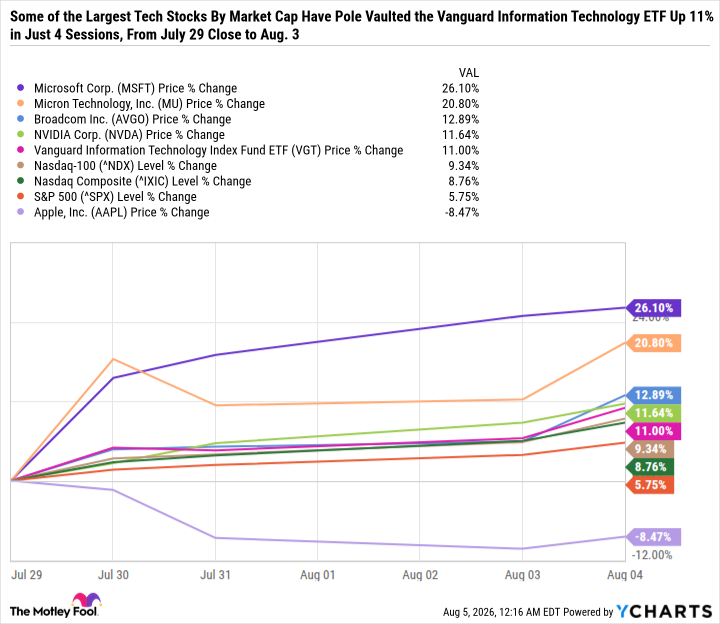
Just four trading sessions later, as of the market close on Aug. 4, the Nasdaq Composite recovered a staggering 8.8%, and the S&P 500 closed at an all-time high — fueled by encouraging earnings reports from Amazon and Microsoft.
Over that period, the Vanguard Information Technology ETF (VGT +1.37%), which mirrors the tech sector, gained 11%. Here’s why tech stocks are surging, and why the Vanguard Tech ETF remains an excellent buy for growth investors.
Image source: Getty Images.
Dynamic dominance
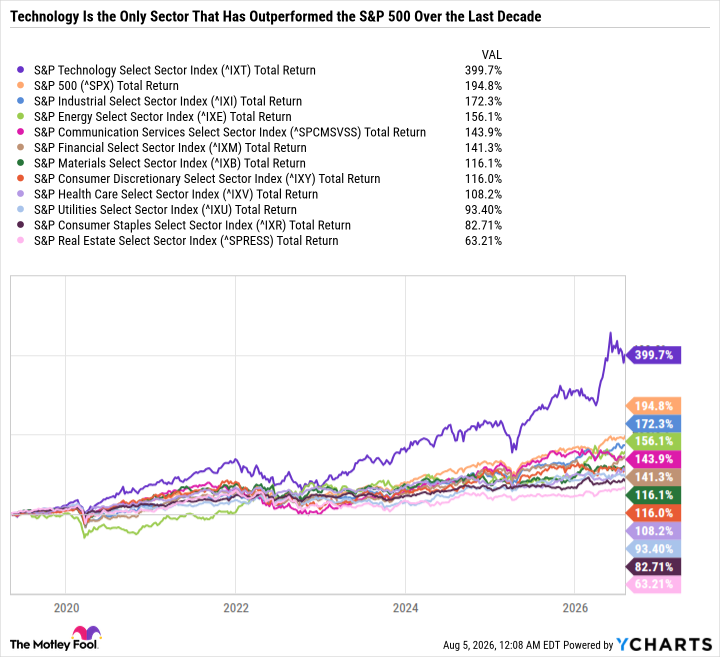
If you had invested in the technology sector 10 years ago, you would have quintupled your money. In fact, the gains in the tech sector have impacted the S&P 500 to such a wide margin that tech is the only sector to have outperformed the index over the past decade.
But those gains are in the past. Folks looking for opportunities to invest their hard-earned savings care more about future potential. And what makes the tech sector unique is that it doesn’t depend on a single catalyst.
In just the past decade, several themes have driven the sector to new heights. Notable paradigm shifts include the push toward e-commerce, with transactions, communications, and work increasingly done online and on mobile devices. The tech sector has been front and center in the software-as-a-service, cloud computing, and artificial intelligence (AI) boom.
Those themes have benefited different industries within the tech sector at different times. There have been multi-year periods when semiconductor stocks were in a cyclical downturn, and periods when semiconductors have contributed the vast majority of sectorwide gains — which is the period we’re in now. Similarly, software was the hottest industry for years, and lately, it has been dragging down the sector.
Among the most valuable tech stocks by market value, Apple was crushing Nvidia and Microsoft year to date but is down since reporting earnings, while Microsoft and Nvidia are up big in just four sessions.
Investing in a tech-sector ETF provides exposure to companies driving sectorwide gains, which have historically far outpaced the declines of laggards. While not a perfect solution, it does ensure that investors don’t become overly concentrated in just one or two themes within the tech sector and leaves room for breakout potential from hidden-gem stocks.
Microsoft is back in favor
Microsoft is perhaps the best example of how sentiment can turn on a dime and why investors are better off building their portfolios around quality companies than getting caught up in whatever companies are in or out of favor.
Leading up to its July 29 earnings report, Microsoft was under pressure amid a broader sell-off in software stocks, driven by AI disruption fears and rising cloud infrastructure capex. But Microsoft proved the doubters wrong with impressive growth and upbeat fiscal 2027 guidance, including positive free cash flow in the upcoming fiscal year despite rising spending.
Microsoft gained 26.1% in just four sessions — or a mind-numbing $757 billion in market value. That’s like creating a company with a value equivalent to Advanced Micro Devices in less than a week, and AMD is one of the 20 most valuable S&P 500 companies.

Vanguard Information Technology ETF
Today’s Change
(1.37%) $1.64
Current Price
$121.24
Key Data Points
AUM
$169B
Dividend Yield
2.06%
Expense Ratio
0.09%
Top Holdings
NVDA
16.10%
AAPL
14.33%
MSFT
8.28%
Some stocks are worth premium valuations
One-third of the Vanguard Tech ETF is invested in just four stocks — Nvidia, Microsoft, Micron, and Broadcom. Big gains in those megacap names have helped drive the ETF higher in recent sessions,even after accounting for a significant decline in Apple.
Some investors may be concerned that the tech sector is overbought and ripe for a pullback. Or that growth potential is already priced in, given investor enthusiasm. Those concerns are certainty warranted, given the Vanguard Tech ETF’s 36.2 price-to-earnings (P/E) ratio as of June 30. But looking at a single valuation metric such as P/E ratios or simply the price action on a chart misses the most important reason the Vanguard Tech ETF remains an excellent buy now — which is earnings growth.
Earnings growth is the most powerful force in investing. It can make even the most expensive stocks look cheap in the long run. A company with a 40 P/E that can grow earnings by 20% to 30% per year over the long term is a better value than a company with a 20 P/E with a single-digit earnings growth rate.
Microsoft and Apple are growing earnings at their fastest rates in years. Despite difficult comps, Nvidia and Broadcom continue to grow at impressive rates, justifying their valuations. Supply constraints on memory chips have contributed to massive earnings growth in Micron Technology (MU -0.69%) and other memory stocks.
These are just some of the many examples of tech stocks that have rewarded patient investors with big gains but could still be good buys now.
A sector built around quality companies
With a reasonable 0.09% expense ratio, or $0.90 for every $1,000 invested, the Vanguard Information Technology ETF offers investors a low-cost way to get exposure to a basket of hundreds of tech stocks. However, it’s worth noting that the sector’s performance is heavily dependent on a handful of names, as Nvidia, Apple, Microsoft, Micron, Broadcom, and AMD account for over half of the ETF.
Concentration is a double-edged sword, as it can amplify gains when a big-name component such as Microsoft stages a rapid rebound, but it can also lead to rapid downturns if a key industry such as semiconductors sells off. Therefore, investors should consider the Vanguard Tech ETF only if they have a high risk tolerance and a long-term investment horizon to withstand prolonged volatility.