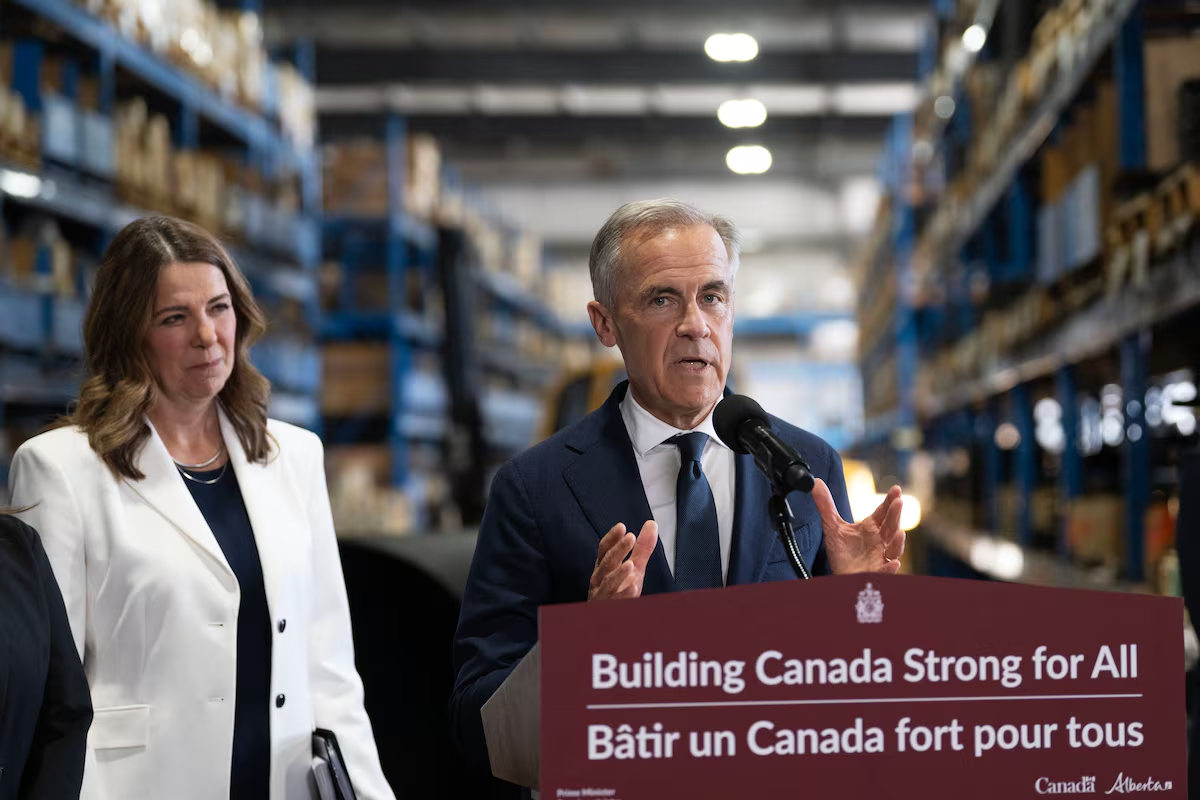
Prime Minister Mark Carney and Alberta Premier Danielle Smith announce a proposed pipeline from Alberta to the B.C. coast, Calgary, July 2.Todd Korol/The Canadian Press
Prime Minister Mark Carney’s way of communicating and branding things is so distinct that some choice Carneyisms have crept into everyday Canadian speech over the year and a half he’s been a daily national presence.
We don’t have plans or policies in this country right now – everything is a strategy. Public money purportedly luring private investment is, of course, catalyzing.
And if you’ve ever found yourself inadvertently saying “tranche” when you mean a bunch of something, you may be entitled to compensation from the federal government.
The language is unmistakably borrowed from the banking world where Mr. Carney spent most of his career, and its invocation in politics suggests seriousness, solidity and control.
But no other term has travelled from business-school obscurity to the public lexicon as swiftly as the memorandum of understanding, or “MOU.”
There are plenty of examples of earlier federal governments signing MOUs on this or that, but the Carney government has made them a centrepiece of how it does and advertises its work. Memorandum of understanding is shorthand for: “We are getting stuff done here, people.”
Opinion: Welcome to the Mark Carney major projects sweepstakes
Just in the past few weeks, the federal government and British Columbia unveiled a $20-billion MOU plainly designed to soothe West Coast feelings over the Alberta pipeline agreement, which was launched with great fanfare by its own MOU in the fall.
Days later, the Prime Minister met with the President of the Philippines to sign two MOUs to boost tourism and cultural connections. And this week, Mr. Carney went to Saudi Arabia to tout 13 commercial agreements and MOUs “worth over $1 billion – spanning health technology, mining, infrastructure, and defence.”
So what exactly are these things? What does a memorandum of understanding do, what is beyond its grasp, what is it normally used for, and how is the Carney government employing them?
To start, MOUs are essentially an exercise in making sure everyone is on the same page about broad goals before launching into an elaborate project together.
“I consider MOUs as a first step in confirming mutual intentions between parties,” said Jeremy Barretto, a Calgary-based regulatory partner in the infrastructure, energy and resources group at the law firm Torys LLP. “They are typically not very long or complicated, and can be non-binding on the parties.”
He often represents project proponents, and was previously the external lawyer for Trans Mountain Corp. for more than a decade.
Taxpayers asked to foot the bill for another pipeline
In the private sector, MOUs are often used as the first step to set out how two companies will work together on a longer contractual agreement, he said. In the public sector, they’re useful especially between governments to find common ground on issues such as project development, regulations or future steps, Mr. Barretto said.
“In my experience, governments do take them seriously, and try and work towards the goals set out in MOUs,” he said.
He uses the term “mutual intention” because an MOU lays out on paper what the parties agree to. The alternative is waiting for a private-sector proponent to step up and trudging through a process that eats up years and enormous amounts of money, only to find out at the end whether the governments agree, he said.
“I think in especially the federal-provincial context, focusing on Western Canada, there hasn’t always been complete alignment on policies from climate to oil and gas development to economic development in recent years,” Mr. Barretto said, with admirable understatement.
While MOUs may be non-binding, he stresses that they are not empty exercises, but have real-world impact on policy.
“It’s one thing for the Prime Minister and the Premier to stand at a podium and say they agree on something,” Mr. Barretto said. “It’s another thing to put out a document that has details on the price of carbon 10 years in the future.”
Opinion: It’s good that we’re building pipelines, but not so good that we’re paying for them
Michael Wernick, former clerk of the Privy Council under prime minister Justin Trudeau, points out that “memorandum of understanding” is simply how this government has labelled the agreements that governments enter into all the time with foreign states, other levels of government or Indigenous communities. Others have called them agreements in principle, political accords or framework agreements.
He describes the recent Alberta and B.C. MOUs as “an alignment exercise” because they got the federal government and both provinces moving in the same direction. To Mr. Wernick, that’s no small feat, and what’s not in those agreements or left unsaid seems important.
“Essentially, the Alberta government and the oil and gas sector have, after 18 years, finally accepted there is never going to be an oil pipeline to northwest B.C.,” he said. “They basically have said it is just not going to happen.”
At the same time, B.C. Premier David Eby has watered down his wine, too, Mr. Wernick points out: “He’s basically accepted the reality that there is going to be oil traffic going in and out of southern terminals, as there is today out of Burnaby.”
As for whether Mr. Carney conjuring up a lucrative MOU to assuage B.C.’s pipeline misgivings could spark a lineup of other provinces looking for their own loot bags, he views that as “totally normal federalism” and simply a part of the gig.
“That’s where being the federal government, you’ve got to keep an eye on 13 different chessboards,” he said.
But the real challenge goes back to what a memorandum of understanding is in the first place: just the starting point for these long-term, complex and difficult processes.
“I think we may look back on 2026 as the year of negotiations and deal-making, and what lies ahead is implementation and delivery,” Mr. Wernick said. “Are you actually going to hit the mark on all these strategies and frameworks and agreements and MOUs?”