Listen to the audio version of this article (generated by AI).
Key Points
- Defense-tech contractor Lyntris raised nearly $300 million in a downsized IPO at $17.50 per share, well below its original target, as investors weighed the company’s $272 million debt load and growing losses.
- The company is growing quickly with a $924 million backlog, but 97% of its revenue comes from U.S. government contracts, creating significant concentration and policy risks.
- Lyntris faces an uphill battle against larger, more profitable defense contractors. Turning its $13 million first-half loss into a profit and reducing debt will be key to winning over investors.
The United States and Israel are at war with Iran. Ukraine is still fighting Russia. Those conflicts mean big money for global defense contractors and their investors… especially as this year’s global military budgets are expected to surge beyond last year’s nearly $2.9 trillion in world military expenditures.
That makes U.S. defense-technology contractor Lyntris’ (LYNX) downsized August 19 IPO rather interesting.
Lyntris, which manufactures battlefield sensors and designs software for the U.S. and its allies, began trading on the New York Stock Exchange last week after it raised $297.5 million in a downsized IPO at $17.50 per share for 17 million shares. That fell below initial company expectations of 24 million shares priced between $19 and $22 each.
What Caused Lyntris’ Soft IPO?
The short answer is debt and losses. As of the end of June, Lyntris reported $272 million in long-term debt, which severely hampers profitability. In fact, Lyntris plans to use roughly $60 million of its $297.5 million IPO proceeds to help pay off some of that balance.
On top of the debt, Lyntris has absorbed increasing operational costs. During the first half of 2026, the company’s net losses grew to $13 million, up from $9.7 million during the first half of 2025. That 34% growth in operating loss nearly negates the 35% revenue growth the company achieved during the first half of 2026.
Other factors contributed to Lyntris’ soft IPO, which helped bring the stock down more than 14% from its initial IPO price of $17.50 to $15.01 at market close on August 19.
“The market is discounting that this is a capital structure, rather than a venture capital deal,” claimed Josef Schuster, chief executive of Chicago-based IPO index and research firm IPOX Schuster.
That “capital structure” often includes heavy debt backed by private equity rather than a leaner, higher-growth venture-capital structure. In fact, private-equity firm Trive Capital created Lyntris by rolling Accelint and Vitesse Systems, two defense holdings, into one business. And that business, Lyntris, was saddled with $272 million in long-term debt from the get-go.
Beyond that, only 5.7 million of the 17 million shares sold during Lyntris’ IPO were actually offered to the public. The remaining 11.3 million shares, valued at roughly $197.8 million, were sold and cashed out by the company’s private-equity partners. While this is somewhat standard for private equity “roll-up” companies like Lyntris, the cashing out by partners still raises skepticism among investors.
That left Lyntris with $69.5 million in net proceeds… $60 million of which will be used to pay down its debt. That doesn’t exactly fill investors with confidence. Lyntris will have to prove to investors that it can pay off that debt to earn that confidence.
Finally, a combination of recent defense-technology IPOs – Applied Aerospace & Defense (AADX), HawkEye 360 (HAWK), and Aevex (AVEX), to name a few – and a general calming of the defense sector from its early 2026 highs created market sentiment that wasn’t ideal for an IPO.
But it’s not all doom and gloom for Lyntris.
In the first half of 2026, Lyntris generated $241 million in revenue, a 34.6% year-over-year increase. And the company more than doubled its backlog from the first half of last year to $924 million so far in 2026.
Still, investors have major concerns about Lyntris, specifically regarding its client list.
The Lyntris Concentration Risk
That client list I referred to is rather short. In fact, 97% of Lyntris’ revenue in 2025 came from U.S. government contracts – and nearly all of those contracts were with the federal government.
That includes equipment contracts with the Air Force, Navy, Marine Corps, and Space Force. Considering the Pentagon’s fiscal 2026 defense budget is nearly a trillion dollars, those contracts would appear to bode well for Lyntris. But plenty of risk comes when one client ostensibly generates more than 90% of your revenue.
Right now, as the war in Iran continues, Lyntris is a beneficiary. But what will happen (besides oil and gas prices dropping) once the war is over? Its significant backlog will likely sustain the company in the short term.
Plus, it’s not as if Lyntris is only supplying equipment and systems specific to this war. National security will always require the software and technology that Lyntris provides. And while the federal government represents most of the company’s business, Lyntris’ revenue is split across more than 200 active programs within the country. So, there is some measure of diversity.
But is it enough for investors? Because even a slight change in U.S. defense policy could negatively impact Lyntris. Plus, any delay in government contract approval would disrupt the company’s cash flow.
Most limiting, however, is that Lyntris has opted to pursue primarily domestic contracts. During the first half of 2026, non-U.S. contracts accounted for only 7% of the company’s revenue – which is actually up year over year from just 2%. Investors considering Lyntris should watch that number to see if it continues shifting in 2027.
Defense Stocks Outlook: Which Companies Have Outperformed?
The defense-tech industry as a whole is a risky proposition. It’s true that many major defense-contractor stocks – riding the tailwinds of the wars between Russia and Ukraine, Israel and Hamas, and the U.S./Israel and Iran – have risen sharply over the past year.
(Note: Performance data as of Aug. 25, 2026)
| Defense Stock | Year-Over-Year Performance |
| Lockheed Martin (LMT) | 24.3% |
| RTX (RTX) | 34.6% |
| General Dynamics (GD) | 17.8% |
| Elbit Systems (ESLT) | 57.5% |
| GE Aerospace (GE) | 31.1% |
But that hasn’t fully translated to the small- and mid-cap defense-tech companies.
| Defense Stock | Year-Over-Year Performance |
| Kratos Defense & Security Solutions (KTOS) | -21.3% |
| AeroVironment (AVAV) | -38.9% |
| Parsons (PSN) | -39.7% |
A couple of outliers are worth noting. VSE (VSEC) has gained 31.8% over the past year, and Ducommun (DCO) has soared by an impressive 93.1% year over year.
As for defense companies that recently went public, like Lyntris, results have been decidedly mixed since their debuts:
| Defense Stock | IPO Date | % Change Since Debut |
| HawkEye 360 | May 7, 2026 | -36.6% |
| Applied Aerospace & Defense | June 2, 2026 | -30.9% |
| Aevex | April 17, 2026 | -22.3% |
| Arxis (ARXS) | April 16, 2026 | 41.5% |
Then there are Lyntris and First Breach (FBDT), which debuted within a day of each other. Since its August 20 debut, First Breach stock has plummeted from its opening share price of $12 down to $1.43 at market close on August 25 – a staggering drop of 90.5%. Lyntris, which debuted a day earlier, has dropped around 13.9% since August 19.
By this point, you’ve probably noticed that the performances of these defense stocks are all over the place. We’ve seen the large-cap defense companies make some huge year-over-year gains, with the notable exceptions of Northrop Grumman (NOC), which is surprisingly down 7.7% over the past year, and L3Harris Technologies (LHX), which is down around 3.4%.
The small- to mid-cap companies have run the gamut from Ducommun (up 93.1%) to Parsons (down 39.7%). And the defense companies with recent IPOs have largely been down, with just a couple of exceptions.
What does this say about the overall defense sector? Mostly that geopolitical events do not solely drive it. If they did, every defense stock would be soaring right now, and that’s clearly not the case.
A deeper look at the stocks in the industry reveals that, even as more defense companies take their stocks public and sign government contracts, the “institutional” stalwarts – like Lockheed Martin and RTX – hold a significant advantage over less-established companies.
That’s because these companies possess massive backlogs that span several years (RTX currently has a $289 billion backlog), use cost-plus government contracts that allow the companies to pass unforeseen costs (supply chain, inflationary, etc.) back to the government, and increase earnings-per-share (“EPS”) guidance and stock buybacks to ensure investor returns.
Meanwhile, defense companies stuck in the middle tend to struggle because fixed-price contracts handcuff them and put the burden of extra expenses on them rather than the government. If material prices rise or the supply chain bottlenecks, these companies absorb the added costs, which chokes their profitability.
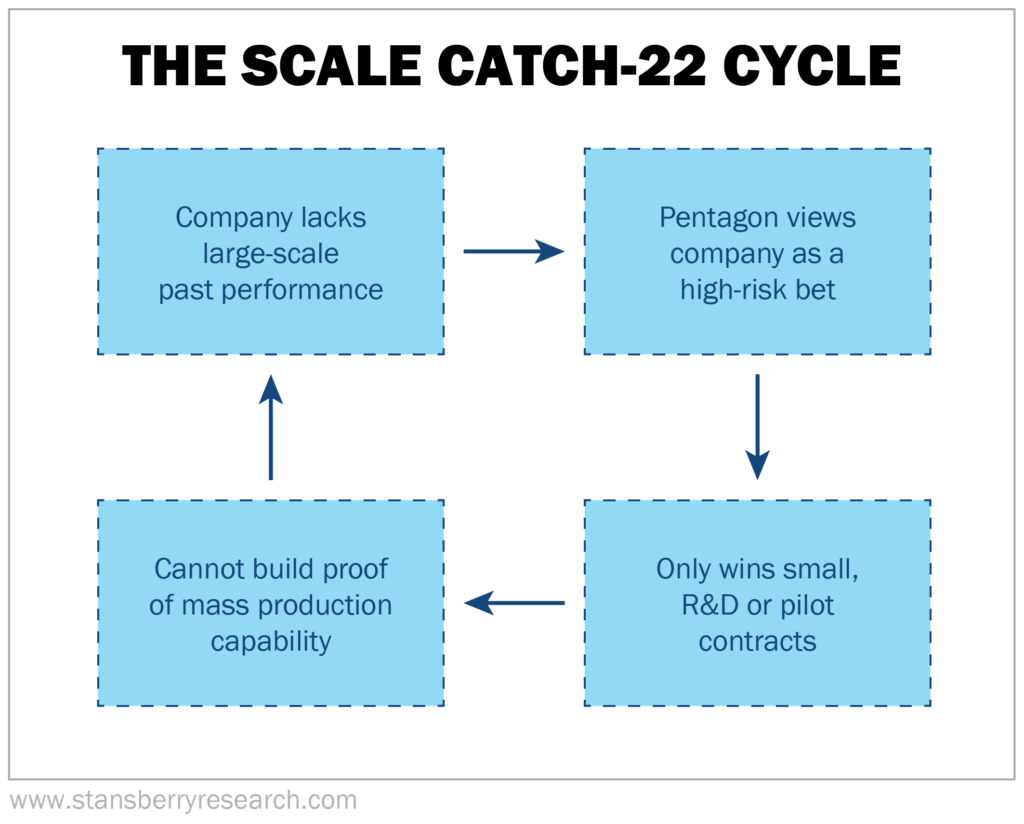
Additionally, while the big defense companies are procuring huge, profitable contracts, these companies in the middle are receiving research and development funds and securing smaller deals because they lack the track record of handling large contracts. However, they can’t prove they can handle large contracts if no one gives them any.
It’s a chicken-or-egg conundrum known in the industry as the scale catch-22, which looks like this:
That results in less available cash, which means these companies must take on debt to finance expansion… again, a hit to these companies’ profitability.
Is Lyntris a Good Investment Right Now?
Which brings us back to recent IPOs like Lyntris. As a smaller company that is losing money, its IPO was deemed too ambitious by investors, and the company was already in debt the second it went public. And First Breach started hemorrhaging as soon as it debuted.
But that doesn’t mean these stocks are lost causes. Lyntris, after just a few days of public trading, is holding fairly steady amid an iffy defense-tech market. To inspire investor confidence, Lyntris will certainly need to start turning a profit in the second half of 2026 after posting a $13 million loss in the first half.
It will also need to reduce its long-term debt, which sits at more than $270 million. Its net interest expense alone during the first half of 2026 was $16.9 million.
The Falls Church, Virginia-based company’s 2026 revenue is promising, as is its $924 million backlog, which more than doubles its backlog from the end of 2025. But it has a long way to go before it becomes a profitable business and one that investors can rely on for consistent returns. Its soft IPO was just the latest sign.
Regards,
David Engle
Editor’s Note: It’s easy to assume the AI story begins and ends with the big-name chip stocks. But there’s a quieter version of it playing out inside the defense budget – where the government isn’t just regulating AI, it’s starting to buy into the companies that build it.
A forensic accountant named Joel Litman – someone the Pentagon and FBI have actually consulted, and who called both the 2008 and 2020 crashes – argues this is one slice of a much bigger shift he calls the “Second Declaration.” He believes a handful of companies sitting where AI meets national defense could be repriced when a policy deadline arrives this November.
Watch his full presentation here → [LINK]
