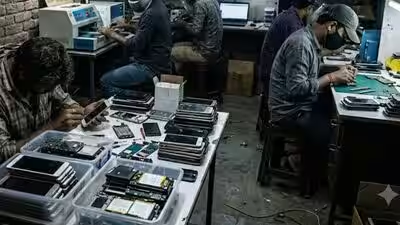
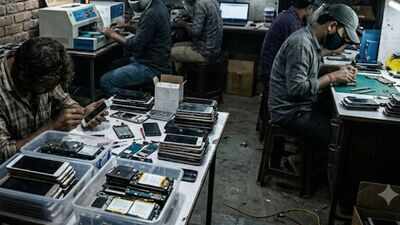
NEW DELHI: When smartphones are snatched or stolen in crowded streets, the snatchers aren’t the ones getting rich. They are the lowest link in what is a remarkably efficient shadow economy.What begins as a quick grab for immediate cash feeds a multi-crore supply chain built on turning stolen hardware into pure profit. The real money lies higher up, with organised syndicates that treat these phones less like stolen goods and more like raw inventory.
Delhi reports over 1.5 lakh phone theft cases this year
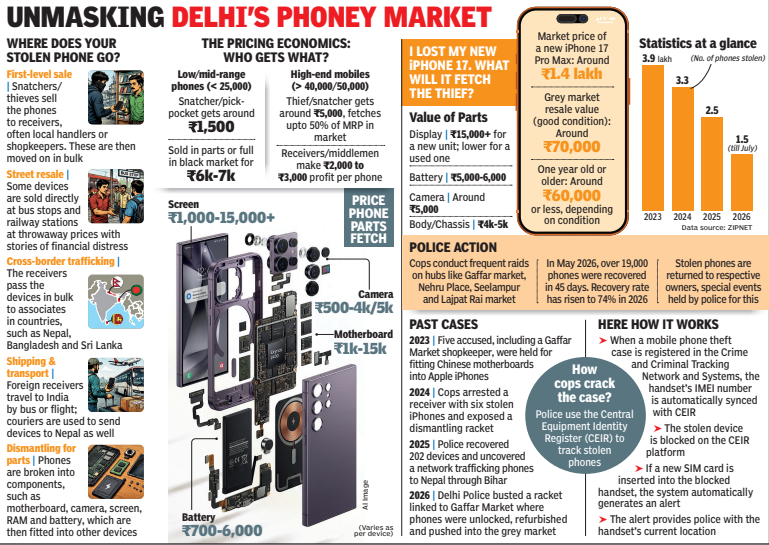
For them, every device is a high-margin asset waiting to be monetised — whether that means stripping a locked iPhone for its Rs 15,000 display, flashing IMEI numbers for the local grey market, or smuggling premium Androids across the border into Nepal.Valuation & Component MonetisationAround 2.5 lakh mobile phones in Delhi were reported to be snatched, stolen or lost in 2025. In the first seven months of this year, over 1.5 lakh such cases have come to the fore. Sources said the valuation of the city’s black market for stolen mobile phones is estimated at between Rs 150 crore and Rs 250 crore a year.According to investigators, the real profits are made not by the snatchers but by organised networks that acquire stolen devices cheaply before refurbishing, dismantling or trafficking them for resale.“While premium smartphones are sought after because of their high resale value, devices that cannot be activated without their owners’ credentials are often dismantled for spare parts instead of being resold,” said a cop whose team recently busted one such module.Such phones are stripped into components, such as the motherboard, display, camera module, RAM and battery, which are later used to repair or assemble other devices. Others are unlocked and pushed into the grey market.The resale value of stolen or snatched mobile phones depends on the model and condition. “A phone worth around Rs 25,000 is typically sold in the grey market for Rs 6,000 to Rs 7,000 if it’s in good condition, while older handsets or those with visible wear and tear fetch less. High-end smartphones are usually sold for about half their original price, or slightly more, often being passed off as new or refurbished,” said an officer.Their screens, cameras and batteries are among the most sought-after components. To evade police, different parts of the same phone are often sold to different dealers, making it harder for the cops to trace a single stolen device.“A low-end phone’s screen typically sells for Rs 1,000 to Rs 3,000, while its battery fetches Rs 700 or Rs 800. In contrast, screens of premium smartphones can sell for up to Rs 15,000, batteries for Rs 6,000 to Rs 7,000, and cameras for Rs 4,000 to Rs 5,000,” another cop said.Snatching, Tracing & RecoveryTracking stolen smartphones is difficult. IMEI numbers are altered or erased using specialised software, while dismantling destroys the device’s original identity. Cross-border trafficking further complicates recovery because phones moved to neighbouring countries are harder to track across different telecom networks.Investigators said snatching and theft of phones are largely carried out by two categories of offenders: juveniles and history-sheeters. The first are used for street-level crimes because they can move quickly through crowded areas and face less severe legal consequences if apprehended.The stolen devices are then passed on to repeat offenders, who use established criminal networks to transport, dispose of and sell them. Police added that substance abuse remains a major factor driving phone snatching, as stolen devices can be quickly converted into cash.Officers said the names of Gaffar Market, Seelampur market and Lajpat Rai market besides other tech hubs like Nehru Place have surfaced during investigations into these rackets, with several cases in recent years exposing such networks.Technology, thankfully, has significantly improved recovery efforts of late. Using Central Equipment Identity Register, investigators have been able to block and trace stolen devices more effectively. The recovery rate has also gone up sharply. Police data shows that only about 5% of stolen phones were recovered in 2024. The figure increased to 12% in 2025 and has reached 74% so far this year.Shutting down this multi-crore shadow economy, however, will require continued tech intervention and enforcement, starting from the streets.